Full List of Waterfalls in Odisha: 2026 Guide & Tips
Explore the best waterfalls in Odisha. Discover Barehipani, Khandadhar, Duduma, and hidden cascades with heights, routes, timings, and travel tips.

Odisha houses some of the most dramatic waterfalls in the Indian subcontinent, sculpted by the fractured sandstone plateaus of the Eastern Ghats. Over eighty surveyed cascades plunge through dense sal reserves, evergreen gorges, and sacred tribal river basins across thirty administrative districts. These natural cascades support critical river ecosystems and form celebrated outdoor destinations for eco-tourists throughout Eastern India.
Key Takeaways
- Barehipani Falls in Mayurbhanj drops 399 meters (1,309 feet), ranking as the tallest waterfall in Odisha and the second tallest across India.
- Khandadhar Falls in Sundargarh plunges 244 meters (801 feet) in an unbroken vertical ribbon over dense mineral-rich forest cliffs.
- Duduma Falls drops 175 meters (574 feet) along the Machkund River gorge, powering one of Eastern India’s oldest hydroelectric installations.
- The optimal travel window runs from October through February when post-monsoon water volumes remain high and forest access roads reopen.
- Forest eco-cottage stays near Similipal and Khandadhar require advance online permits through official state wildlife portals.
At-a-Glance: Top Waterfalls in Odisha by Height and District
Odisha features dramatic variance in cascade elevations, ranging from multi-tiered drops in Mayurbhanj to horse-tail river chutes in Koraput. Official geographic data compiled by the Department of Tourism, Government of Odisha highlights major sites across northern, western, central, and southern forest corridors. The table below catalogs primary cascades with their verified heights, parent river sources, and operational travel highlights.
| Waterfall Name | District | Drop Height | River Source | Key Highlights |
|---|---|---|---|---|
| Barehipani Falls | Mayurbhanj | 399 meters (1,309 feet) | Budhabalanga River | Two-tiered plunge within core Similipal National Park |
| Khandadhar Falls | Sundargarh | 244 meters (801 feet) | Korapani Nala | Single vertical horse-tail drop with perennial mist spray |
| Duduma Falls | Koraput | 175 meters (574 feet) | Machkund River | Historic hydroelectric site along the Odisha-Andhra border |
| Joranda Falls | Mayurbhanj | 150 meters (492 feet) | Budhabalanga Tributary | Straight-drop cliff cascade facing panoramic forest canopy |
| Khandadhar Falls | Keonjhar | 152 meters (500 feet) | Minor Forest Stream | Untouched forest cascade surrounded by mineral-bearing hill ranges |
| Koilighugar Falls | Jharsuguda | 61 meters (200 feet) | Ahiraj River | Valley cascade sheltering a submerged sacred Shiva lingam |
| Badaghagara Falls | Keonjhar | 60 meters (197 feet) | Ghagara River | High-volume single drop located 10 km from district headquarters |
| Sanaghagara Falls | Keonjhar | 30 meters (98 feet) | Sanaghagara Stream | Stepped recreational waterfall park with landscaped footpaths |
| Pradhanpat Falls | Deogarh | 30 meters (98 feet) | Pradhanpat Nala | Historic waterfall used for early princely hydroelectric power |
| Ludu Falls | Kandhamal | 30 meters (98 feet) | Dense Forest Stream | Secluded cascade situated deep within Kotgarh Wildlife Sanctuary |
| Gandahati Falls | Gajapati | 20 meters (66 feet) | Mahendratanaya River | Broad perennial sheet fall with elephant movement corridors |
| Putudi Falls | Kandhamal | 18 meters (60 feet) | Salunki River | Roaring forest gorge drop located 15 km from Phulbani town |
| Phurlijharan Falls | Kalahandi | 16 meters (52 feet) | Perennial Hill Spring | Multi-hued refraction pool visible in early morning sunlight |
| Deojhar Falls | Cuttack | 12 meters (40 feet) | Talasara Stream | Accessible hill forest waterfall near Narasinghpur block |
Planning a trip across these dispersed geographical zones requires careful consideration of road conditions and daylight forest timings. Travelers typically organize multi-day driving itineraries around regional clusters to minimize highway transit time between remote drops.
The Giant Cascades of Northern Odisha: Mayurbhanj and Keonjhar
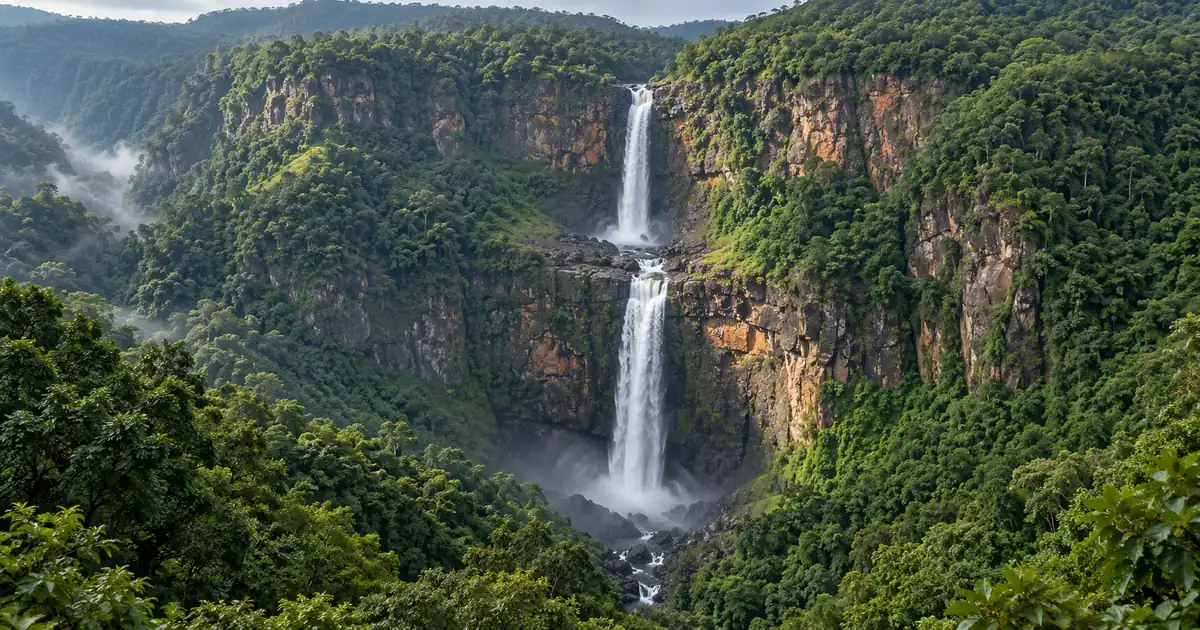
The northern highland massif of Mayurbhanj and Keonjhar hosts Odisha’s tallest waterfalls, nourished by extensive catchment plateaus in Similipal. Barehipani Falls stands as the undisputed crown of this territory, dropping 399 meters over two massive quartzite tiers. The cascade emerges from deep cliff fissures, sending columns of vapor across the surrounding deciduous valleys.
Located within the same wildlife biosphere, Joranda Falls drops 150 meters in an unyielding vertical column into a rocky abyss. Visitors view Joranda from an elevated forest department deck that commands open sightlines across the Similipal canopy. Travelers seeking comfortable overnight accommodation can reserve Similipal Tiger Reserve nature camp accommodations through government-managed eco-cottages.
Further east along the Similipal foothills in Udala block lies Devkund, an important religious and natural cascade site. Devkund features five distinct natural pools fed by descending river channels, crowned by the hilltop temple of Goddess Ambika. The site requires a moderate footpath walk across stony terrain, drawing nature lovers and pilgrims throughout the dry winter months.
Keonjhar district complements Mayurbhanj with its own dense cluster of powerful waterfalls fed by the Baitarani River system. Badaghagara Falls drops 60 meters through a narrow mountain gorge into a deep forest pool ten kilometers from Keonjhar town. Sanaghagara Falls sits just five kilometers from the town center, offering a 30-meter stepped cascade set within well-tended recreational forest grounds.
Bhimkund, situated on the border of Keonjhar and Mayurbhanj, provides a contrasting natural water spectacle. Rather than a vertical cliff drop, Bhimkund consists of a massive natural whirlpool carved into deep granite bedrock by the Baitarani River. Local historical traditions connect the swirling blue reservoir with the exile journey of the Pandavas described in the Mahabharata.
Forest entry permits for northern sanctuary cascades must be secured early in the morning at forest range counters. Online safari slot bookings and night-stay clearances operate under Eco Tour Odisha community management rules to protect regional wildlife habitats.
Western and Central Highlands: Sundargarh, Sambalpur, and Cuttack
Western Odisha features dramatic vertical drops where forested sandstone escarpments descend into industrialized valleys. The Sundargarh Khandadhar Falls drops 244 meters down an amphitheater of red-banded iron formations near Bonaigarh. The sheer plunge creates an intense downdraft of cool mist that maintains moist microclimate conditions at the base year-round.
Jharsuguda district preserves Koilighugar Falls near Kushabhadra village, where the Ahiraj River drops 61 meters into a shaded valley. The pool houses a submerged stone Shiva lingam known locally as Maheshwarnath, which emerges during lower water levels before summer. A suspension footbridge and concrete safety railings allow families to observe the cascade without stepping across slippery river boulders.
Sambalpur district presents Gudguda Falls, situated near the Deogarh border inside dense mango and sal forests. Gudguda features multiple natural tiers carved into polished granite stones, forming natural rock pools suitable for peaceful wading. Cascades like Pradhanpat Falls in Deogarh drop 30 meters against historic hill structures that provided hydro-mechanical power during the princely era.
Central Odisha holds several intimate forest cascades within short driving distance of urban coastal centers. A Deojhar Waterfall day excursion takes travelers to the Narasinghpur forest boundary in Cuttack district, only 120 kilometers from Bhubaneswar. Deojhar cascades 12 meters over horizontal rock beds into a broad pool sheltered by dense bamboo thickets.
Travelers visiting western and central waterfalls should note that mobile connectivity often weakens outside major state highways. Local roadside stalls supply drinking water and snacks, but visitors should carry primary fuel reserves when traveling between interior rural blocks.
Southern Highland Wonders: Koraput, Rayagada, and Gajapati
The rugged mountains of southern Odisha deliver high-volume river cataracts set against dramatic agricultural hillsides. Duduma Falls, located on the border between Koraput and Andhra Pradesh, plunges 175 meters into the deep Machkund gorge. The site functions as a major renewable power generator, operating the historic Machkund Hydroelectric Project established in the mid-twentieth century.
Visitors can explore detailed transport routes and safety protocols in our Duduma Waterfalls travel guide before departing Jeypore. Recent infrastructure enhancements include engineered railings, paved stairways, and scenic observation viewpoints that overlook the gorge. The surrounding hills host weekly tribal markets where indigenous communities trade forest produce and traditional handicrafts.
Rayagada district contains Hatipathar Falls along the Nagavali River, named for massive riverbed boulders resembling resting wild elephants. Minajhola, positioned at the confluence of three forest rivers, features clear cascading waters beside an ancient temple dedicated to Lord Shiva. Both locations provide peaceful waterside settings for photography and cultural heritage documentation during the cooler winter months.
Gajapati district features Gandahati Falls, an expansive 20-meter curtain cascade on the Mahendratanaya River near Paralakhemundi. Gandahati remains perennial throughout the year and is enclosed by wild mango orchards and rolling Eastern Ghat ridges. Wild elephants occasionally visit upper stream segments, prompting local forest personnel to supervise visitor pathways during dusk and dawn.
Comprehensive travel information for the southern region is detailed on the official portal of Incredible India. Southern roadways offer scenic driving across mountain passes, though visitors should conclude road journeys before darkness settles across forest roads.
Kandhamal and Daringbadi Forest Falls: Hidden Riverbed Drops
Kandhamal district sits at an average altitude exceeding 600 meters, creating ideal conditions for cascading hill streams. The district features dense sal forests, deep mountain valleys, and an abundance of relatively undisturbed river waterfalls. Putudi Falls drops 18 meters along the Salunki River, producing a thunderous roar audible across surrounding forest ridges fifteen kilometers from Phulbani.
Near the high-altitude plateau of Daringbadi, travelers encounter charming riverbed cataracts that flow across natural rock formations. Visitors frequently explore the Lovers Point Dadubada river cascades to experience natural rock pools and forested valley currents. The area provides clean mountain air, shade trees, and gentle walking paths suitable for families and eco-travelers alike.
Ludu Falls represents Kandhamal’s wildest waterfall destination, tucked deep within the Kotgarh Wildlife Sanctuary. The waterfall drops 30 meters into an undisturbed forest pool surrounded by elephant, sambar, and leopard habitats. Reaching Ludu requires navigating dirt forest tracks with high-clearance vehicles and engaging knowledgeable local forest guides from nearby settlements.
Katikram Falls offers another tranquil cascade tucked into the hilly outskirts of Daringbadi town. The waterfall drops across multiple rocky shelves, creating shaded alcoves where visitors can observe native birds and wild orchids. Kandhamal also produces prized GI-tagged turmeric, available for purchase from local farmer cooperatives in town markets.
Visiting Kandhamal requires warm clothing during winter evenings, when temperatures across high-altitude plateaus frequently fall below ten degrees Celsius. Roads connecting Phulbani, Baliguda, and Daringbadi remain paved and well maintained by state highway agencies.
Best Season and Weather Conditions for Waterfall Hopping
Waterfall flow volumes and trail access in Odisha fluctuate heavily with seasonal monsoon weather patterns. Visiting during the ideal climatic window ensures safe road travel, full water curtains, and comfortable daytime outdoor temperatures. The seasonal breakdown below outlines what travelers can expect across the regional landscape during different months.
- October to February (Peak Season): This period provides the ultimate conditions for waterfall travel throughout Odisha. Forest access roads are repaired after the rains, river volumes remain abundant, and skies stay clear and blue. Daytime temperatures average between 20 and 28 degrees Celsius, allowing extended hiking without extreme heat.
- July to September (Monsoon Months): Heavy monsoon showers swell waterfalls to maximum volume and cloak hillsides in rich green foliage. However, mountain roads experience occasional landslides, flash floods occur suddenly, and wildlife sanctuaries like Similipal remain closed. Visiting riverbeds or swimming in waterfall pools is hazardous during this season.
- March to June (Summer Season): Smaller seasonal cascades dry up entirely as temperatures climb past 40 degrees Celsius. Perennial giants like Barehipani, Khandadhar, and Duduma continue to flow, although their spray volumes decrease noticeably. Morning visits remain feasible, though hikers should carry ample water and sun protection.
Booking official accommodation at eco-tourism nature camps across Odisha during peak winter months requires early reservations. Forest community eco-resorts frequently sell out several weeks in advance during festive holidays and long weekends.
Essential Packing List and Trekking Safety Guidelines
Exploring forest waterfalls in Odisha involves walking on slick quartzite surfaces and navigating unpaved wilderness trails. Observing basic outdoor safety protocols prevents dangerous slips and protects delicate forest ecosystems from human disturbance. Review our curated recommendations for places to visit in Koraput highlands to coordinate safety preparations across rugged highland terrain.
- High-Traction Water Footwear: Wet river boulders harbor dense algae layers that make ordinary sneakers dangerously slick. Choose specialized hiking sandals or amphibious shoes featuring textured rubber outsoles with dependable grip.
- Waterproof Dry Bags: The ambient spray near giants like Khandadhar and Barehipani will saturate cameras and mobile phones within seconds. Store all electronic devices, vehicle keys, and identity papers inside sealed roll-top dry sacks.
- Forest Leech Prevention: Damp forest litter in Similipal and Kandhamal harbors active land leeches following rainy periods. Carry table salt or tobacco extract pouches, and wear tall anti-leech socks when hiking along shaded forest creeks.
- Hydration and Basic First Aid: Wilderness sites rarely feature commercial shops near the falls. Carry at least two liters of potable water, electrolyte packets, antiseptic wipes, adhesive bandages, and insect repellent.
- Observation Deck Discipline: Always observe waterfalls from designated steel railings and concrete forest viewing galleries. Never scale wet cliff edges or venture beyond perimeter warning markers for photographs.
- Strict Eco-Ethics: Carry all food wrappers, empty beverage containers, and plastic items back to district hotels for municipal disposal. Discarding plastic or disturbing local wildlife inside forest reserves carries severe statutory fines under wildlife protection laws.
Arriving at forest checkpoints by 9:00 AM ensures sufficient daylight hours to complete nature trails and exit reserves safely. Forest gates strictly prohibit outgoing visitor entries after 4:00 PM to protect travelers from encountering nocturnal wildlife.
Frequently Asked Questions About Waterfalls in Odisha
Which is the highest waterfall in Odisha?
Barehipani Falls in Mayurbhanj district is the tallest waterfall in Odisha, dropping 399 meters (1,309 feet) in two tiers within Similipal National Park. It ranks as the second-highest waterfall in India and flows perennially from the Budhabalanga River basin.
What is the second highest waterfall in Odisha?
Khandadhar Falls in Sundargarh district is the second-tallest waterfall in Odisha, featuring an unbroken vertical plunge of 244 meters (801 feet). A separate scenic waterfall sharing the same name also drops 152 meters in neighboring Keonjhar district.
What is the best time of year to visit waterfalls in Odisha?
The optimal time to visit Odisha waterfalls is between October and February during the cool post-monsoon months. Forest roads remain open during this period and river volumes sustain full cascades without monsoon flood hazards.
Are permits required to visit waterfalls in Similipal National Park?
Visitors must obtain day-entry permits from the Forest Department check gates at Jashipur or Pithabata to see Barehipani and Joranda. Entry closes daily by 9:00 AM, and all private tourist vehicles must exit the sanctuary before sunset.