Featured image for Emami Jagannath Temple Balasore: Visitor Guide
Temples · · 21 min read

Emami Jagannath Temple Balasore: Visitor Guide

Visit Emami Jagannath Temple in Balasore with details on timings, history, architecture, Mahaprasad, festivals, and how to reach.

Baleswar DistrictEmami Jagannath TempleTemples in OdishaRemuna

The first time I saw the Emami Jagannath Temple in Balasore, I was struck by how the warm morning sun made the red sandstone glow. It wasn’t the ancient, weathered stone of Puri, but there was a different kind of magic here. Tucked away in the quiet industrial outskirts of Remuna, this temple is a modern marvel that somehow feels like it’s been part of the landscape for centuries.

I remember walking through the main gates and being greeted by the scent of fresh incense and the distant sound of temple bells. If you’ve ever visited the famous Jagannath Temple in Puri, you’ll immediately recognize the familiar silhouettes of the deities, but the Emami temple offers a more serene, less crowded experience that’s perfect for reflection.

In this guide, I’ll take you through everything you need to know about visiting the Emami Jagannath Temple in 2026—from its fascinating history and unique “chariot” architecture to practical tips on timings, Mahaprasad, and the grand Ratha Yatra celebrations.

The Story Behind Emami Jagannath Temple Balasore

While many of Odisha’s famous temples date back to the 11th or 12th century, the Emami Jagannath Temple is a relatively new addition to the state’s spiritual map. It was built by the Emami Group, one of India’s leading business houses, as part of their corporate social responsibility and personal devotion.

The Vision of Founders

The vision for this temple came from Mr. R.S. Agarwal and Mr. R.S. Goenka, the founders of the Emami Group. Their connection to Balasore runs deep, primarily through the Emami Paper Mills, which has been a pillar of the local economy for decades. They wanted to create a spiritual landmark in Balasore, a city that has long been a hub for their industrial activities.

Construction began in late 2009. The founders weren’t just looking to build a structure; they wanted to create a masterpiece that would stand the test of time. This is why they reached out to the best in the field.

The Raghunath Mohapatra Legacy

What makes this temple truly special is the involvement of the late Padma Vibhushan Sri Raghunath Mohapatra. He was a legendary architect and sculptor who played a pivotal role in designing the structure. If you know anything about modern Odishan architecture, his name is synonymous with excellence.

Under his guidance, over 30 skilled artisans worked tirelessly for years. They used traditional techniques passed down through generations of “Maharanas” (temple builders). The temple was finally inaugurated and opened to the public in 2015. Since then, it has become one of the most visited temples in Odisha, filling a spiritual void in the northern part of the state.

Architectural Brilliance: A Chariot in Stone

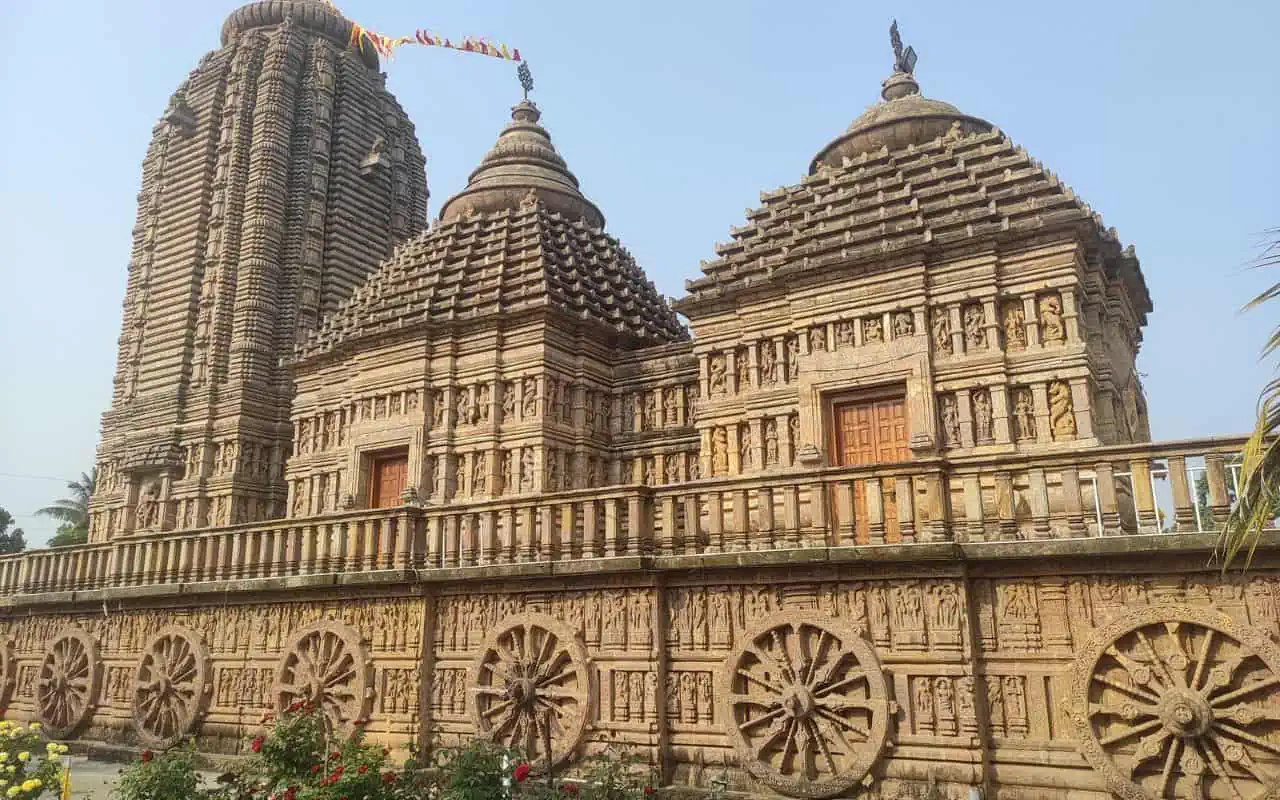
As you approach the temple, the first thing you’ll notice is that it doesn’t just look like a temple—it looks like a massive stone chariot. This design is clearly inspired by the Konark Sun Temple, and it’s a breathtaking sight.

The Chariot Concept and the 24 Wheels

The entire temple structure is built on a platform that resembles a grand chariot. This isn’t just an aesthetic choice; it’s deeply symbolic. There are 24 beautifully carved stone wheels attached to the base of the temple.

In Vedic tradition, these 24 wheels represent:

  • The 24 hours of a day.
  • The 24 fortnights (Pakshas) in a year.
  • The 24 petals of the cosmic lotus.

Each wheel is about 4-5 feet in diameter and features intricate motifs. You’ll see dancers in mid-motion, musicians playing traditional Odia instruments like the Mardala, and delicate floral vines that seem to grow out of the stone. I spent nearly half an hour just walking around the base, touching the cool sandstone and admiring the precision of the carvings.

The Main Shikhara and Nila Chakra

The main tower, or Shikhara, rises to a height of about 78 feet. While it is smaller than the 214-foot tower of the Jagannath Temple in Puri, its proportions are perfect. The tower is built using red sandstone, specifically a type known as Khondalite. This stone has a unique property—it hardens as it ages and develops a beautiful patina.

At the very top of the Shikhara sits the Nila Chakra (the Blue Wheel). This is made of “Ashta-dhatu” (an alloy of eight metals). The Nila Chakra is a symbol of protection. In Puri, it is said that the flag atop the wheel always flies against the direction of the wind. While the Emami temple is inland, the presence of the chakra and the fluttering “Patitapabana” flag immediately signals that you are in the presence of the Lord of the Universe.

The Four Sections: A Traditional Layout

The temple follows the classical “Rekha Deula” and “Pidha Deula” styles:

  1. Vimana (Sanctum Sanctorum): This is the tallest part where the deities reside. The interior is kept dark and cool, lit only by oil lamps, to help devotees focus their energy.
  2. Jagamohana (Assembly Hall): This is the square structure in front of the sanctum. The ceiling here is particularly beautiful, with a lotus motif carved into the center.
  3. Natamandapa (Festival Hall): This is a newer addition to the classical layout, often used for spiritual discourses and cultural performances.
  4. Bhoga Mandapa (Offering Hall): Located slightly apart, this is where the food is offered to the Lord before being distributed to the public.

The Artistic Soul: The Stone Carving Process

One cannot fully appreciate the Emami Jagannath Temple without understanding the sheer scale of the artistic endeavor involved. The process used here is the same “Shilpa Shastra” tradition that built the Konark Sun Temple nearly 800 years ago.

Every single inch of the red Khondalite stone was hand-carved. The “Maharanas” (master sculptors) began with massive blocks of raw stone brought from the quarries of Tapang and Naraj. Using nothing but iron chisels and wooden hammers, they first outlined the figures. If you look closely at the pillars of the Natamandapa, you’ll see the “Jali” (lattice) work where the stone has been hollowed out to create a three-dimensional effect. This is incredibly difficult with sandstone, as one wrong strike can crack the entire block.

The artisans worked in a “living workshop” on-site for nearly five years. I’ve heard stories from the locals about how the rhythmic “tink-tink” of the chisels became the heartbeat of Remuna during those years. The detail on the 24 wheels is particularly noteworthy—the spokes of the wheels are decorated with “Kanyas” (maiden figures) and “Gajabidalas” (mythical lion-elephant creatures), representing the victory of wisdom over strength. This dedication to traditional craft in a modern corporate project is what gives the temple its “soul.”

The Deities: Lord Jagannath, Balabhadra, and Subhadra

Inside the sanctum, you will find the divine trinity: Lord Jagannath, his elder brother Lord Balabhadra, and their sister Devi Subhadra.

The Daru Brahma

The idols are carved from the wood of the Neem tree, known as “Daru”. This is a unique tradition of the Jagannath cult. Unlike other Hindu deities which are made of stone or metal, the Jagannath idols are wooden and are replaced periodically in a ritual called “Naba Kalebara”.

Even though the Emami temple is relatively new, the idols have been carved by the same family of “Datta Mahapatras” who serve in Puri. When I stood before them during the evening Aarti, the atmosphere was electric. The large, round eyes of Lord Jagannath seem to look directly into your soul, no matter where you stand in the hall.

The Sub-Shrines: A Complete Spiritual Circuit

The 12-acre complex isn’t just about the main Jagannath temple. There are several smaller shrines that complete the “Kshetra” (sacred area):

  • Lord Shiva Temple: A beautiful shrine dedicated to the destroyer of evil. The Lingam here is always adorned with fresh Bel leaves and flowers.
  • Maa Bimala Shrine: In the Jagannath tradition, food becomes Mahaprasad only after it is offered to Maa Bimala. Her shrine here is small but very powerful.
  • Goddess Laxmi: The consort of Lord Jagannath. Friday evenings here are particularly special, as women from the surrounding Remuna area come to light lamps.
  • Lord Ganesh: The remover of obstacles, worshipped first before any other ritual.
  • Sankat Mochan Hanuman: A towering statue near the entrance, symbolizing strength and devotion.

Emami Jagannath Temple Timings for 2026

To help you plan your visit in 2026, here is the detailed daily schedule. Please note that during festivals like Ratha Yatra or Janmashtami, these timings may extend.

Ritual / SessionTimingSignificance
Dwara Phita (Opening)6:00 AMThe opening of the main doors.
Mangala Alati6:30 AMThe first lamp offering of the day.
Abhishek & Mailam7:00 AM - 8:30 AMRitual bathing and dressing of the deities.
Gopala Vallabha Bhoga9:30 AMMorning breakfast offering.
Sakala Dhupa11:00 AMThe main morning offering.
Afternoon Closing1:00 PMThe deities take their afternoon rest.
Evening Reopening4:00 PMDoors open for the evening session.
Sandhya Alati6:30 PMThe most beautiful and crowded ritual.
Sandhya Dhupa7:30 PMEvening offering.
Night Closing (Pahada)8:30 PMFinal rituals before the temple closes.

Pro-Tip: If you want a peaceful experience, visit between 9:00 AM and 11:00 AM on a weekday. If you want to experience the vibrant energy of Odia culture, the 6:30 PM Sandhya Alati is unbeatable.

Mahaprasad: The Soul of the Temple (Abhada)

You cannot visit a Jagannath temple and leave without tasting the Mahaprasad. At the Emami temple, the tradition of the sacred kitchen (Rosaghara) is maintained with the same rigor as in Puri.

The Ancient Way of Cooking

The cooking process is a ritual in itself.

  • No Modern Fuel: Only firewood is used to cook the food.
  • Clay Pots (Kudua): The food is cooked in earthen pots stacked one on top of the other. Remarkably, the pot at the very top always cooks first!
  • Sacred Water: Water from the temple well is used.
  • Pure Ingredients: No onion, garlic, or even “foreign” vegetables like potatoes or tomatoes are used in the main offerings. They stick to traditional vegetables like pumpkin, yam, and plantain.

What to Expect in Your Abhada?

The standard Mahaprasad meal, known as “Abhada”, usually includes:

  1. Arna: Steamed white rice.
  2. Dalma: A thick lentil soup with local vegetables.
  3. Besara: A tangy vegetable dish made with mustard paste.
  4. Saga Bhaja: Fried leafy greens.
  5. Kanika: A sweet, aromatic rice flavored with ghee and raisins.
  6. Khata: A sweet and sour chutney made from elephant apple (Ouu) or tomatoes.

I remember sitting on the floor in the “Anand Bazar” equivalent of the temple, eating from a dried leaf plate. The warmth of the rice, the earthy smell of the clay pot, and the perfectly balanced spices make it the most delicious meal I’ve ever had in Odisha.

Ratha Yatra 2026: The Grand Festival in Balasore

While Puri is the epicenter of Ratha Yatra, the celebration at Emami Jagannath Temple has its own unique charm. It brings together the entire population of the Baleswar District.

2026 Ratha Yatra Calendar

Mark your calendars for these dates:

  • Snana Yatra: June 30, 2026 (The grand bathing ceremony)
  • Sri Gundicha (Ratha Yatra): Thursday, July 16, 2026 (The chariot pulling starts)
  • Hera Panchami: July 20, 2026 (When Goddess Laxmi goes looking for the Lord)
  • Bahuda Yatra: Saturday, July 25, 2026 (The return journey)
  • Suna Besha: July 26, 2026 (The deities are adorned in pure gold)

The Experience

During Ratha Yatra, three massive wooden chariots are built from scratch. Pulling these chariots along the roads of Remuna is considered an act of great merit. The air is filled with the sound of “Hari Bol” and “Jai Jagannath”. If you are planning to visit during this time, I recommend checking the Official Odisha Tourism Website for any last-minute schedule changes or special events.

What I love about the Ratha Yatra here is the accessibility. In Puri, the crowds can be millions-strong, making it difficult to even see the chariots. In Balasore, while it is still crowded and energetic, you have a much better chance of actually touching the ropes and participating in the rituals.

Why Remuna is Called “Gupta Vrindavan”

The Emami Jagannath Temple is located in the Remuna block of Balasore. To understand the spiritual significance of this place, you have to know its history. Remuna has been a center of Vaishnavism for over 700 years and is often called “Gupta Vrindavan” (Hidden Vrindavan).

The Legend of the Milk Thief

Legend has it that Sri Chaitanya Mahaprabhu, the great saint of the 16th century, visited Remuna and spent many days in devotion. The presence of the ancient Khirachora Gopinath temple nearby makes this entire area a high-energy spiritual zone. The name “Khirachora” means “The Milk Thief,” referring to a story where the Lord himself stole a pot of condensed milk for his devotee.

When the Emami Group chose this location, they were essentially tapping into centuries of existing devotion. The energy here is palpable, and the locals treat the Lord as a living member of their community.

Design Philosophy: The Living Stones of Odisha

One cannot talk about this temple without discussing the design philosophy of Sri Raghunath Mohapatra. He believed that stone has a memory and a voice.

The Evolution of Style

While the temple is a replica of the Puri style, Mohapatra added subtle modern touches. The “chariot” theme is more pronounced here than in any other modern temple in India. He used “Khondalite” stone, which is known for its ability to withstand the saline air of the Odisha coast.

The carvings on the Natamandapa are particularly interesting. They don’t just show mythological scenes; they capture the daily life of Odisha. You’ll see farmers with their bullocks, women fetching water, and children playing. This “Humanization” of the temple space is what makes the Emami temple feel so welcoming. It’s not just a place for the Gods; it’s a space for the people.

Gastronomy of Balasore: Beyond the Temple

While the Mahaprasad is the highlight, your food journey in Balasore shouldn’t end there. The region has some unique culinary offerings that you must try in 2026.

The Famous Palua Ladu

If you travel about an hour south towards Bhadrak, you’ll find the famous “Palua Ladu”. This sweet is made from arrowroot (Palua), jaggery, and ghee. It is incredibly soft, healthy, and has body-cooling properties. The Bhadrak district administration is currently working on getting a GI tag for this delicacy, and you can find authentic versions in Balasore town as well.

Seafood of Chandipur

Since Balasore is a coastal district, the seafood here is world-class. If you head to Chandipur after your temple visit, try the fresh prawns and “Parshey” fish. The local preparation uses a mustard paste that is both pungent and delicious.

Shopping in Remuna: Handlooms and Brass

Don’t leave Remuna empty-handed. The area is famous for two things:

  1. Remuna Pata (Sarees): These are handwoven cotton and silk sarees known for their simple yet elegant designs. You can find them at local weaver cooperatives near the Gopinath temple.
  2. Brass and Bell Metal Work: Remuna and the nearby village of Sayedpur are hubs for traditional metalwork. You can buy beautifully crafted “Kansa” (bell metal) plates and bowls, which are said to have health benefits when used for eating.

I personally bought a small brass statue of a “Hamsa” (swan) from a local artisan near the Emami gate, and the craftsmanship is as good as anything you’d find in a high-end boutique in Bhubaneswar.

The 2026 Vision: New Tourism Circuits

By 2026, the Odisha government has integrated the Emami Jagannath Temple into several new tourism circuits.

The Coastal Highway Impact

The upcoming Coastal Highway project is set to pass through Balasore, significantly reducing travel time from Digha in West Bengal to Puri. This means the Emami temple will become a major stop-over for pilgrims traveling along the Bay of Bengal.

Eco-Tourism at Kuldiha

Just 40 km from the temple lies the Kuldiha Wildlife Sanctuary. In 2026, new eco-retreats have opened here, allowing you to combine a spiritual visit to the Emami temple with a wilderness experience where you can spot wild elephants and giant squirrels.

Socio-Economic Impact: Transforming the Community

It’s important to note how this temple has changed the face of Balasore. Before 2015, this area was purely industrial, dominated by the chimneys of the Emami Paper Mills. The temple has brought in a new wave of hospitality and service-based economy that has revitalized the entire Remuna block.

The growth of “Religious Tourism” here has led to the development of better roads, improved street lighting, and a surge in local entrepreneurship. Hundreds of local youth are now employed as guides, security staff, and gardeners. The small shops selling flowers, incense, and handicrafts have provided a steady income for many families.

The Emami Group also runs a school and a healthcare center nearby, making the temple the heart of a larger community development project. The influx of tourists from West Bengal and Jharkhand has also boosted the local hotel industry in Balasore town, leading to the construction of several new premium stays. In essence, the temple has acted as a catalyst for a “Culture-led Urban Renewal” of the region.

The Spiritual Aura: My Personal Experience

I want to share a small moment from my last visit. It was late evening, and I was sitting in the corner of the Natamandapa. The sun had set, and the temple was bathed in soft yellow light. A group of local women started singing “Bhajans” in a low, melodic voice.

In that moment, the industrial noise of the paper mills seemed miles away. There was only the sound of the wind, the smell of the sandalwood, and the presence of the Lord. Whether you believe in the divine or not, the “Peace of Mind” you get here is real. It’s a place where you can disconnect from the digital world and reconnect with yourself. The temple doesn’t just offer a view; it offers a feeling—a sense of being part of something much larger and more ancient than our daily worries.

How to Reach Emami Jagannath Temple: A Detailed Guide

Getting to the temple is quite easy, thanks to Balasore’s strategic location on the Eastern coast.

Balasore (BLS) is a major junction on the South Eastern Railway.

  • From Bhubaneswar: I recommend the Jan Shatabdi Express (departs 6:00 AM) or the Dhauli Express. It’s a comfortable 3-hour journey.
  • From Kolkata (Howrah/Sealdah): The Vande Bharat Express or the Shatabdi will get you here in under 4 hours. You can easily book your tickets on the IRCTC Website. Once you reach Balasore station, head to the “Auto Stand”. The pre-paid counter is reliable. The 12 km ride takes you through the heart of the town and then out towards the industrial area of Remuna. For the exact navigation, you can follow this Google Maps Location.

By Road

Balasore is connected by the NH16 (Chennai-Kolkata highway).

  • Bhubaneswar to Balasore: 200 km (approx. 4 hours). The road is a six-lane highway and very well-maintained.
  • Kolkata to Balasore: 250 km (approx. 5 hours). You’ll pass through the historic town of Jaleswar on the way.

By Air

The nearest commercial airport is Biju Patnaik International Airport (BBI) in Bhubaneswar. While there is a small airstrip in Balasore (Rasgovindpur) used for defense purposes, it is not yet open for regular commercial flights.

Things to Do Near Emami Jagannath Temple

If you are coming all the way to Remuna, make a full day of it. There are several best places to visit in Balasore that you shouldn’t miss.

1. Khirachora Gopinath Temple (2 km away)

This is a must-visit. Built in the 13th century by King Langula Narasimha Deva, it is famous for its “Khira” (condensed milk). The architecture is ancient and provides a beautiful contrast to the modern Emami temple.

2. Chandipur Beach (15 km away)

Famous for its “vanishing sea.” During low tide, the sea recedes up to 5 kilometers! You can actually walk on the sea bed. It’s a surreal experience that you won’t find anywhere else in India.

3. Panchalingeswar Temple (30 km away)

Located on a hilltop, you have to lie down and touch the five Shiva Lingams submerged in a perennial stream. The trek up the hill (about 250 steps) is very scenic.

Local Insights and Visitor Etiquette

  • Photography: You can take photos of the beautiful gardens and the chariot-shaped exterior. However, like all major Odia temples, photography is forbidden inside the sanctum.
  • Best Time to Visit: The winter months (October to February) are the most pleasant. If you visit in summer, try to go early in the morning (6:00 AM) or late in the evening (after 5:00 PM) to avoid the heat.
  • Shoes: There is a free, safe shoe-keeping counter at the entrance.
  • Language: Most locals speak Odia and Bengali. Hindi is also widely understood.

A Sample Day-Trip Itinerary

If you’re planning a one-day trip to Balasore, here’s how I would structure it:

  • 8:00 AM: Arrive at Balasore Railway Station and take an auto to Remuna.
  • 8:30 AM: Visit the Khirachora Gopinath Temple. Don’t forget to buy a pot of the famous Khira!
  • 10:00 AM: Arrive at the Emami Jagannath Temple. Spend time exploring the carvings and the sub-shrines.
  • 1:00 PM: Have the Mahaprasad (Abhada) at the temple.
  • 2:30 PM: Head towards Chandipur Beach.
  • 3:30 PM - 5:30 PM: Enjoy the unique tide at Chandipur and have some fresh seafood at the local shacks.
  • 6:30 PM: Head back to Balasore town for some local shopping or catch your evening train.

FAQs about Emami Jagannath Temple

1. Is there an entry fee?

No, entry to the temple is absolutely free for everyone.

2. Can non-Hindus enter the temple?

Unlike the Puri Jagannath Temple, the Emami Jagannath Temple generally allows people of all faiths to enter the complex and witness the architecture.

3. Is parking available?

Yes, there is a large, secure parking area outside the temple for both two-wheelers and four-wheelers.

4. Are there any hotels nearby?

There are several guest houses in Remuna, but for better facilities, I recommend staying in Balasore town (Hotel Arpita or Hotel Swarnachuda are good options).

5. What is the dress code?

Modest clothing is recommended. Avoid wearing shorts or sleeveless tops as a mark of respect to the local culture and traditions.

6. Can I take my pet inside the temple?

Pets are generally not allowed inside the main temple complex, though they may be permitted in the outer parking area.

7. Is there a place to sit for the elderly?

Yes, the 12-acre complex has several benches and shaded areas specifically designed for senior citizens and families to rest.

8. Are there any festivals specific to Balasore celebrated here?

While it follows the Puri calendar, the “Baleswari” influence is seen in the types of local sweets offered and the specific folk music played during evening festivals.

Conclusion

The Emami Jagannath Temple in Balasore is more than just a corporate project; it is a labor of love and devotion. Whether you are a spiritual seeker, an architecture enthusiast, or just a traveler looking for a peaceful getaway, this temple has something for you.

The way it blends the ancient traditions of Lord Jagannath with modern artistic excellence makes it a must-visit destination in Northern Odisha. So, next time you are traveling between Kolkata and Bhubaneswar, make sure to take a detour to Baleswar. Trust me, the sight of the stone chariot glowing in the sunlight is something that will stay with you long after you’ve left.

For more inspiration, check out our guide on the 20 Best Tourist Places in Odisha to plan your complete 2026 itinerary.


Consider reading: Jagannath Temple in Puri – History, Mystery & More

Found this helpful? Share it with others.

Rajesh Kumar avatar

Rajesh Kumar

Travel Writer & Odisha Explorer
10+ years experience

Documenting Odisha’s districts, culture, festivals, heritage sites, and practical local information to help travelers and residents alike.

Odisha Tourism Culture Heritage Nature Local Guides