Bhulekh Odisha: Plot Details, Naksha, and Land Records
Learn how to check Bhulekh Odisha plot details, ROR records, Bhu Naksha maps, plot IDs, and land records online easily today.
The Bhulekh Odisha portal, accessible via bhulekh.ori.nic.in, stands as the primary digital repository for land records in the state of Odisha. Managed by the Revenue & Disaster Management Department, this platform has revolutionized the way citizens, legal professionals, and government officials interact with land-related data. In 2026, the portal serves as a cornerstone of the state’s “5T” (Teamwork, Technology, Transparency, Time, and Transformation) governance model, providing real-time access to the Record of Rights (ROR), cadastral maps (Bhu-Naksha), and historical land data across all 30 districts of Odisha.
Modern land management requires precision and transparency. Whether for agricultural planning, real estate transactions, or securing institutional credit, the digital records provided by Bhulekh Odisha offer a level of security and accessibility that was unattainable under the legacy manual systems. This comprehensive guide provides an authoritative overview of how to navigate the portal, interpret technical land data, and utilize the various services offered to property owners and stakeholders in Odisha.
The Significance of Digital Land Records in Odisha
The digitization of land records in Odisha is more than a technological upgrade; it is a legal and economic necessity. The Bhulekh portal ensures that the ‘Record of Rights’ (ROR)—commonly known as the Patta—is accurate, up-to-date, and protected from unauthorized alterations.
Key benefits of the digital system include:
- Transparency: Minimizes the role of intermediaries in accessing land information.
- Dispute Reduction: Clear, accessible records help prevent overlapping claims and fraudulent transactions.
- Economic Integration: Digital records are a prerequisite for schemes like PM-Kisan and KALIA, where direct benefit transfers rely on verified ownership data.
- Legal Security: Digitally signed records are recognized by courts and financial institutions as authentic evidence of ownership.
For a historical perspective on how land administration has evolved in the region, one may refer to the History of Odisha, which details the administrative shifts from the colonial era to the modern digital age.
Navigating the Bhulekh Odisha Portal: User Interface and Services
The Bhulekh Odisha website is designed to be accessible to both English and Odia speakers, with a language toggle available on the homepage. In 2026, the interface has been optimized for high performance, ensuring that data-heavy maps and records load efficiently even on slower network connections.
Core Services Available:
- ROR View: Accessing the front and back pages of the Record of Rights.
- Map View: Integrating with Bhu-Naksha for cadastral map visualization.
- Plot Details: Searching for specific information based on Plot Numbers or Unique IDs.
- Tahasil Statistics: Real-time data on land distribution and administrative counts across the state.
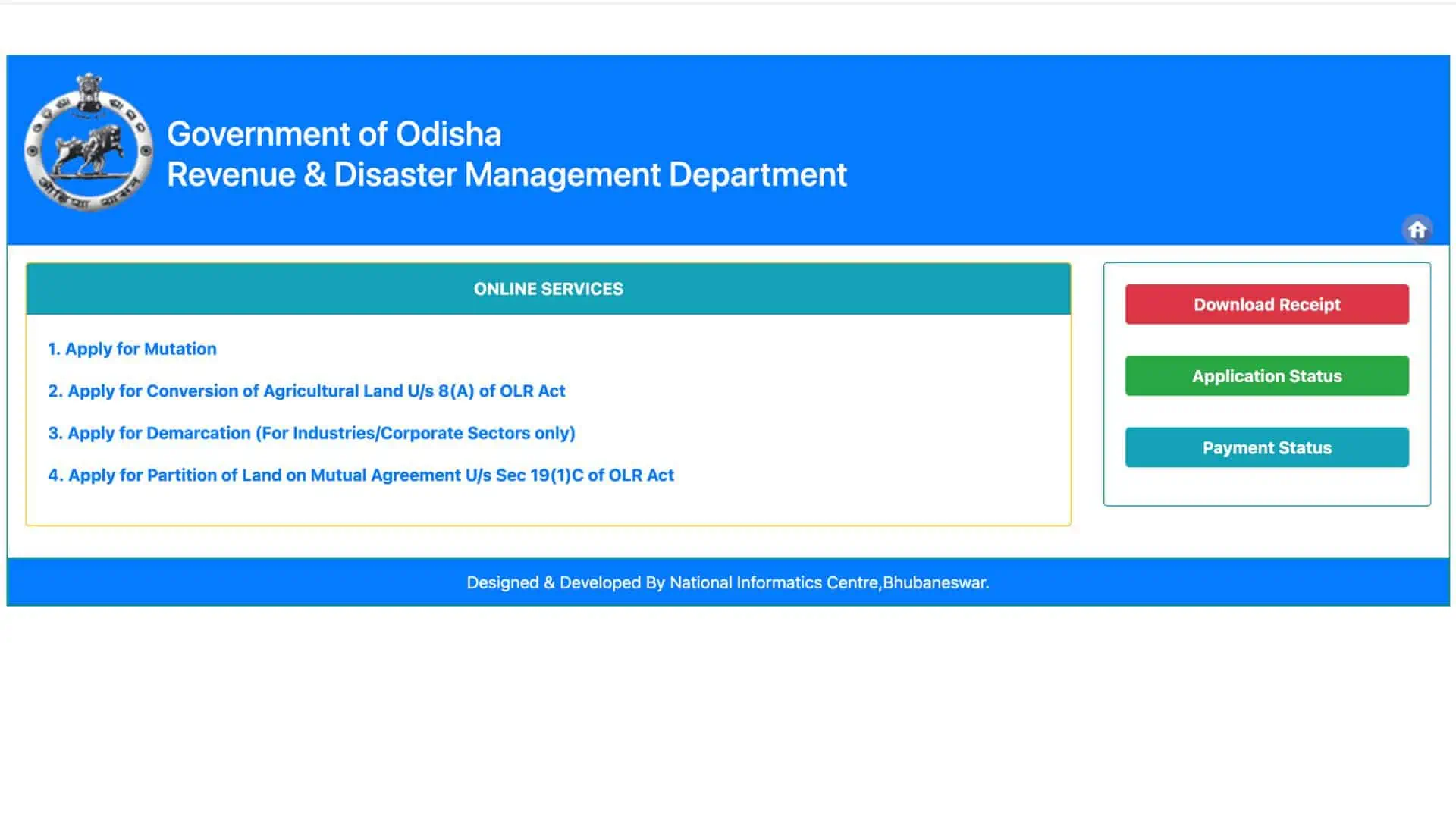
- Departmental Links: Seamless connection to the DWIST portal for Mutation and e-Pauti for revenue payments.
The portal covers approximately 51,727 villages, managing over 18 million khatiyans and 58 million plots. This scale makes it one of the largest digital land record systems in India.
Understanding the Record of Rights (ROR) / Patta
The ROR is the foundational document in the Bhulekh system. It contains the legal identity of a land parcel and its owner.
How to View ROR Online:
- Select Location: Choose the District, Tahasil, Village, and RI Circle from the dropdown menus.
- Search Criteria: Users can search by:
- Khatiyan Number: The account number of the landholding.
- Plot Number: The specific identifier for a land parcel.
- Tenant Name: Searching by the name of the registered owner.
- ROR Pages:
- Front Page: Contains the Khata/Plot numbers, area, and owner details.
- Back Page: Records details of mutations, encumbrances (liens/mortgages), and official remarks.
Understanding the columns in the ROR, such as the Kissam (land type) and Khajana (revenue), is essential for any property transaction. For those looking to understand the capital city’s administrative layout, the Bhubaneswar Tourist and District Guide provides context on urban land distribution.
Bhu-Naksha: The Cadastral Map System of Odisha
A significant feature of the Bhulekh portal is the Bhu-Naksha integration. This service provides digitized cadastral maps that show the physical boundaries and dimensions of every registered plot in the state.
Key Features of Bhu-Naksha Odisha:
- Vectorized Maps: Allows users to zoom into specific plots without losing clarity.
- Overlapping Layers: In 2026, the system integrates satellite imagery to provide a real-world view of the land’s topography.
- Plot Info Integration: Clicking on a plot in the map interface instantly displays the corresponding ROR details.
- Boundary Dimensions: Provides the exact linear measurements of plot boundaries as recorded during the latest settlement survey.
Accessing the map is critical for verifying that the physical possession of land matches the government’s records. This is particularly important in districts with complex terrain, as seen in the Odisha Map and Networks guide.
Plot Details by Unique Plot ID
Odisha has implemented a Unique Plot ID system to provide each land parcel with a distinct 16-digit alphanumeric code. This ID acts as a “digital identity card” for the plot.
Why the Unique Plot ID is Important:
- Standardization: Eliminates confusion arising from duplicate plot numbers across different villages.
- Transaction Efficiency: Used as a primary key in the Mutation process and for property registration.
- Bank Verification: Financial institutions use this ID to quickly verify the legal status of a property before sanctioning loans.
Users can find their Plot Unique ID by searching their ROR on the Bhulekh portal or by using the ‘Know Your Plot Unique ID’ tool on the homepage.
e-Pauti: Online Land Revenue Payment
Mutation and record maintenance are incomplete without the regular payment of land revenue (Khajana). The e-Pauti portal is integrated with Bhulekh Odisha to facilitate online payments.
Once the ROR is updated via mutation, the new owner can generate their revenue profile and pay taxes through:
- UPI
- Net Banking
- Debit/Credit Cards
This integration ensures that the land remains in “Good Standing” within the government’s fiscal records. For farmers, this status is crucial for accessing benefits listed on the Odisha Krushak Portal.
The Bhulekh Odisha Mobile App
For users requiring access on the go, the state has launched official mobile applications (and recognized third-party integrations) that provide ROR and Map data.
Key App Functionalities:
- Offline Viewing: Allows users to save ROR copies for offline reference.
- Location-Based Search: Uses GPS to identify the ROR of the plot the user is currently standing on.
- Direct Sharing: Facilitates the sharing of PDF records via messaging apps and email.
When downloading, users should ensure the app is from a verified government developer to maintain data security.
Correcting Errors in Digital Records: Case No. 1
Despite the transition to digital, clerical errors can occur during data entry or settlement. These are rectified through a Case No. 1 (Correction of Record) filing.
Common Correction Scenarios:
- Misspelling of names.
- Incorrect plot area calculation.
- Errors in land classification (Kissam).
The process involves filing an application at the Tahasil office with supporting evidence like original deeds or Aadhaar. Early correction is advised to prevent future title complications. For residents of Ganjam, visiting the Best Tourist Places in Berhampur provides a logistical opportunity to visit the local revenue offices.
Protecting Tribal and Scheduled Lands
Odisha’s land laws include strict protections under Sections 22 and 23 of the OLR Act. These laws prevent the unauthorized transfer of land from Scheduled Tribe (ST) individuals to non-ST persons.
The Bhulekh portal plays a critical role in this protection by clearly marking the Caste/Category of the owner in the ROR. During any transaction or mutation, the system flags these plots, requiring a mandatory “Permission Order” from the Sub-Collector before any record update can occur. This is an essential signal of administrative trustworthiness and social justice.
The Role of 5T Governance in Land Records
The 5T framework has significantly reduced the time required to update land records in Odisha.
- Time: Clear deadlines for ROR issuance.
- Technology: High-speed servers and satellite-linked maps.
- Transparency: Publicly accessible logs of all record changes.
- Teamwork: Better coordination between the Sub-Registrar and Tahasil.
- Transformation: A paperless revenue court and digital certificate delivery.
This initiative has made Odisha a leader in land record modernization in India. For more on government health initiatives that complement these administrative services, see the BSKY Card guide.
Expert Technical Guidelines for Portal Use
To ensure a successful search on the Bhulekh portal, users should follow these technical tips:
- Browser Compatibility: Use the latest version of Chrome or Firefox for optimal map rendering.
- Odia Typing: When searching by name, ensure the spelling matches the ROR’s Odia script.
- PDF Saving: Always save a ‘Digital Copy’ of the ROR for your records after every successful mutation.
- Satellite Overlay: Use the Bhu-Naksha satellite layer to verify physical structures (houses, wells) on the plot.
Advanced Search: Finding Land Records by Name
One of the most used features of Bhulekh Odisha is searching for land by the tenant’s name. This is particularly useful for inheritance cases where descendants may not know the Khata or Plot numbers of ancestral property.
Procedural Steps:
- Navigate to the ROR section.
- Select ‘Tenant Name’ from the search options.
- Enter the name in Odia (recommended) or English.
- Browse the results to find the correct father’s name and address.
This feature ensures that no land remains “hidden” or lost over generations. For those exploring ancestral roots in Keonjhar, the Waterfalls of Keonjhar guide may offer travel inspiration while you conduct your research.
Distinguishing Between ‘Hal’ and ‘Sabak’ Records
A frequent source of confusion is the distinction between ‘Hal’ (Current) and ‘Sabak’ (Old) settlement records.
- Sabak Records: Reflect land as it was during the major settlement of the 1960s-80s.
- Hal Records: Reflect the current surveyed state of the land.
The Bhulekh portal primarily displays ‘Hal’ records. However, ‘Sabak’ data is often required to prove the historical chain of title during litigation or inheritance disputes.
Land Classification (Kissam) and Its Implications
Every plot in Odisha is assigned a Kissam. This classification determines:
- Tax Rate: Commercial land pays higher revenue than agricultural.
- Conversion Feasibility: It is easier to convert Saradhya (Agricultural) land than Gochar (Grazing) land.
- Valuation: Bank loans and government compensations are calculated based on this status.
Accurate verification of the Kissam on the Bhulekh portal is the first step in any property valuation exercise.
Administrative Hierarchy in Odisha Land Records
Understanding who manages the records is key to resolving issues.
- Revenue Inspector (RI): The primary record keeper at the village level.
- Ameen: The technical official responsible for maps and measurements.
- Tahasildar: The judicial authority for ROR updates and mutations.
- Sub-Collector: The authority for appeals and land protection permissions.
- Collector: The district-wide head of revenue administration.
Each official interacts with the Bhulekh database, ensuring a multi-level check on data integrity.
Digital Maps and Rural Development
The Bhu-Naksha system is not just for individual owners; it is a tool for rural development. Gram Panchayats use these digital maps for:
- MGNREGA Planning: Identifying sites for community ponds and roads.
- Disaster Management: Mapping flood zones and cyclone-prone coastal areas.
- Infrastructure: Planning for electricity grids and water pipelines.
The precision of Bhulekh Odisha maps directly impacts the quality of life in rural areas. While visiting rural Puri for such purposes, the Puri Beach and Water Sports guide offers recreational options.
The Role of the IGR Odisha Portal in Land Records
While Bhulekh provides the records, the IGR Odisha (igrodisha.gov.in) portal provides the deeds.
- Bhulekh: Shows current status (The ROR).
- IGR: Shows the history of transactions (The Sale Deeds).
For a complete title search, property owners must check the ROR on Bhulekh and obtain the Encumbrance Certificate (EC) from IGR Odisha.
Benchmark Valuation and Land Records: The Financial Link
In the realm of real estate in Odisha, the ROR from Bhulekh is only half of the story. The other critical component is the Benchmark Valuation. This refers to the minimum value of a property as determined by the state government for the purpose of calculating stamp duty and registration fees.
How Bhulekh Data Influences Valuation: The classification of land (Kissam) on the Bhulekh portal—whether it is Gharabari (homestead) or Saradhya (agricultural)—directly dictates the benchmark rate. Urban plots in growing areas of Khurda or Cuttack are re-evaluated periodically, and these updates are synced with the land records to ensure that the revenue department captures the correct tax. For potential buyers, checking the Kissam on Bhulekh is the first step in estimating the total cost of acquisition.
e-District Integration: A Unified Service Delivery Model
Odisha’s e-District portal is another essential digital service that works in tandem with Bhulekh. While Bhulekh provides the view of the land record, e-District is where citizens can apply for certified copies of the ROR that carry a digital signature and QR code for verification.
The Application Workflow:
- Identity Verification: Applications on e-District often require the Plot Unique ID from the Bhulekh portal.
- Payment: Nominal fees for certified copies can be paid online.
- Delivery: Once the Tahasildar approves the request, the digitally signed ROR is sent to the user’s account and can also be collected from a ‘Mo Seba Kendra’ (Common Service Centre).
This integration ensures that citizens do not need to physically visit the Tahasil office for verified documents, significantly reducing the “Time” component of the 5T initiative.
Technical Breakdown: Land Unit Conversions in Odisha
One of the most complex aspects of interpreting Bhulekh Odisha records is the variety of measurement units used across different districts. While the portal standardizes data, the underlying records often reflect local systems.
| Unit | Metric Equivalent | Regional Context |
|---|---|---|
| 1 Acre | 4,047 sq. meters | Universal standard |
| 1 Hectare | 2.47 Acres | Modern metric standard |
| 1 Decimal | 435.6 sq. feet | Standard for small plots |
| 1 Guntha | 121 sq. yards | Predominant in Ganjam and Western Odisha |
| 1 Mana | 100 Decimals | Traditional unit in coastal districts |
For accuracy during property transactions or while filling out Mutation applications, it is vital to use the exact decimal count shown on the Bhulekh portal. Small rounding errors in conversion can lead to technical rejections of legal petitions.
Tahasil-Level Dispute Resolution and Record Maintenance
The Tahasildar’s office is not just a repository of records; it is a quasi-judicial court. Disputes arising from incorrect entries on the Bhulekh portal are handled through specific revenue cases.
Types of Cases:
- Partition Cases: When a single Khata is legally divided among heirs or partners.
- Correction of Records: Rectifying clerical errors in name or area.
- Encroachment Proceedings: Handling illegal occupation of government land (Anabadi).
The Bhulekh system tracks these cases in real-time, ensuring that once a judgment is passed, the digital ROR is updated within a strict timeframe. This prevents the “record-reality gap” that historically plagued land administration.
Bhu-Naksha’s Role in Urban Planning and Infrastructure
The digitized maps on the Bhu-Naksha platform are essential tools for urban planning in cities like Bhubaneswar, Cuttack, and Rourkela. Development authorities (like BDA or CDA) overlay these cadastral maps with zoning plans to determine where new roads, parks, and housing projects can be located.
For a homeowner, the Bhu-Naksha map is the ultimate proof that their building matches the government’s layout. Before purchasing any developed plot, verifying it against the Bhu-Naksha is as important as visiting the Best Restaurants in Bhubaneswar—it’s an essential part of the local experience!
Historical Digitization: Preservation of ‘Sabak’ Records
A monumental task undertaken by the Odisha Revenue Department is the digitization of ‘Sabak’ (Old) records. These are records from the pre-revisional settlement era. While the portal displays ‘Hal’ (Current) records, the ‘Sabak’ records are often required to establish a clear “Chain of Title” for properties that have been in a family for generations.
In 2026, these historical documents are being scanned and indexed, allowing for a comprehensive search of land history. This transparency is a safeguard against land scams where the same plot might be sold multiple times using different settlement numbers.
Frequently Asked Questions (FAQ)
1. How often is the Bhulekh Odisha portal updated?
The portal is updated in real-time as Tahasil offices finalize mutation cases. However, there may be a 24-48 hour delay for the digital ROR to reflect the latest changes.
2. Can I download a certified copy of the ROR from Bhulekh?
The portal provides a ‘viewing’ copy. For a legally certified copy with a government seal, you must apply through an e-District center or the Tahasil office, though the digital ROR is increasingly accepted by many institutions.
3. What should I do if my plot is missing from the Bhu-Naksha?
This usually occurs if the latest survey data hasn’t been vectorized. You should file a petition with the Tahasildar to include the plot in the digital map database.
4. Is the Plot Unique ID the same as the Khata Number?
No. A Khata Number represents an account that can hold multiple plots. The Plot Unique ID is specific to a single land parcel.
5. Can a tenant’s name be removed from an ROR online?
Removal of a name requires a legal process (Mutation or Court Order). You can initiate the application online via the DWIST portal, but the ROR will only change after the Tahasildar’s final order.
6. What is the ‘Remarks’ column in the ROR?
This is a critical section that lists bank liens, court stays, or special status (like Debottar land). Always check this before purchasing property.
7. How do I find my RI Circle name?
Your RI Circle name is usually mentioned in your previous land tax receipt or can be found by searching your village name in the Bhulekh dropdown menu.
8. Can I view land records of other districts from my home?
Yes, the Bhulekh Odisha portal is centralized. You can view records for any of the 30 districts from any location worldwide.
9. What is ‘Bhoodan’ land in Bhulekh?
Land donated during the Bhoodan movement. Its transfer is subject to specific state laws and the Bhulekh ROR will reflect this status in the Kissam or Remarks column.
10. Can I search for land by my Aadhaar number?
No. Currently, the portal supports searches by Khatiyan Number, Plot Number, or Tenant Name to protect privacy.
11. What is an ‘Abada Jogya Anabadi’ plot?
It refers to government land that is cultivable but currently unsettled. These plots are owned by the state.
12. How can I get my Plot Unique ID?
Use the ‘Know Your Plot Unique ID’ link on the Bhulekh homepage and enter your Khata and Plot numbers.
13. Is the Bhu-Naksha map valid for bank loans?
Yes, banks use the Bhu-Naksha to verify the boundaries and location of the property being used as collateral.
14. What is the ‘Kissam’ for homestead land?
In Odisha, homestead land is typically classified as Gharabari.
15. How do I correct a misspelling in my father’s name on the ROR?
File a ‘Correction of Record’ (Case No. 1) at the Tahasil office with proof of the correct spelling.
16. Can I view ‘Settlement’ maps online?
Yes, the Bhu-Naksha portal includes maps generated during the latest revisional settlement.
17. What is ‘Encumbrance’ in land records?
It refers to any legal liability or claim on the property, such as a mortgage or a pending court case.
18. Does Bhulekh show the value of my land?
The portal shows the area and classification, but the ‘Benchmark Valuation’ (for tax/sale purposes) is found on the IGR Odisha website.
19. Can I print the ROR in English?
The portal displays data in the language of the original record (mostly Odia), but the interface labels can be toggled to English.
20. What is ‘Mutation Number’?
A unique number assigned to a specific instance of ownership change. It is recorded on the back page of the ROR.
21. What is the difference between ‘Gharabari’ and ‘Saradhya’ kissam?
Gharabari is land classified for homestead/residential use, while Saradhya is land classified for agricultural use. The benchmark valuation and taxes differ significantly between these two.
22. Can I view land records of a plot if I only have the owner’s name?
Yes, use the ‘Tenant Name’ search option on the ROR page. It is recommended to enter the name in Odia for more accurate results.
23. What does ‘Encumbrance’ mean in the context of land records?
It refers to any legal liability on the property, such as a bank mortgage or a pending court case, which might affect the owner’s ability to transfer the title.
24. How do I find the RI Circle for my village?
On the Bhulekh homepage, after you select the District, Tahasil, and Village, the RI Circle will be automatically identified in the dropdown menu.
25. What is the ‘Halkabandi’ system?
It is the administrative division of a Tahasil into smaller circles (Halkas), each managed by a Revenue Inspector. This system ensures localized maintenance of land records.
26. Can I use a Bhulekh ROR printout for bank loan applications?
While a simple printout is good for information, banks usually require a ‘Certified Copy’ from the e-District portal or Tahasil office, though some modern banks now verify digital RORs directly.
27. What is ‘Bhoodan’ land?
Land donated during the Bhoodan movement. These plots have specific restrictions on sale and mutation, which are noted in the Remarks column of the ROR.
28. How do I update my mobile number in the Bhulekh records?
This is typically done through a formal application at the Tahasil office or during the Mutation process.
29. Can I see the shape of my plot on a mobile phone?
Yes, the Bhu-Naksha website and official mobile apps allow you to view the map and dimensions of individual plots.
30. What is ‘Abada Jogya Anabadi’ land?
This is cultivable government land that is currently unsettled. It remains property of the state until formally leased or settled in favor of an individual.
31. What is the ‘Khatian Number’?
It is another term for the Khata Number, representing the account of a tenant within a specific village.
32. Is ‘Pakhala Bhata’ or any local food related to land records?
While not directly related to records, many traditional festivals like Utkal Divas celebrate the agrarian culture of Odisha, where the ‘Patta’ is a symbol of a farmer’s pride and security.
33. How do I get my Plot Unique ID?
Use the ‘Know Your Plot Unique ID’ tool on the Bhulekh homepage and provide your Khata and Plot numbers.
34. Can I search for land records in my district if it was recently divided?
The Bhulekh database is updated to reflect new district and tahasil boundaries. Ensure you select the current administrative district name.
35. What is a ‘Mutation Case Number’?
A unique identifier for an application to change the name on a land record. You can track this on the DWIST portal.
36. How are forest lands handled on the portal?
Forest lands are categorized under specific Kissams and are managed in coordination with the Forest Department. These are usually non-transferable.
37. Can I view the map of my village as a whole?
Yes, the Bhu-Naksha portal allows you to view the entire village map, showing the relationship between different plots, roads, and water bodies.
38. What is the ‘Benchmark Rate’?
The minimum price per decimal/acre set by the government for land in a specific area, used for tax calculation.
39. How do I correct a name misspelling?
File a ‘Correction of Record’ (Case No. 1) at the Tahasil office with proof of the correct name.
40. Can I access Bhulekh Odisha from outside India?
Yes, the portal is accessible globally, allowing Non-Resident Odias (NROs) to monitor their ancestral property records.
Conclusion: Empowering Citizens Through Transparency
The Bhulekh Odisha portal is more than just a website; it is an instrument of empowerment for every citizen of Odisha. By providing transparent, real-time access to land records, the government has moved towards a more equitable and efficient administrative system. From the Ancient Temples of Odisha to the modern industrial hubs, the security of land records is what enables growth and stability.
For property owners, staying informed and regularly checking their records on the portal is the best way to safeguard their assets. As the state continues to integrate more services into the digital ecosystem, Bhulekh Odisha remains the bedrock of land governance, ensuring that the legacy of the land is preserved for future generations.
Disclaimer: This guide is intended for informational purposes based on the administrative procedures of the Government of Odisha as of 2026. For specific legal advice, property disputes, please consult with a qualified revenue advocate or visit your local Tahasil office.