Featured image for HRMS Odisha Login, Payslip Download & 2026 Property Guide
Government · · 23 min read

HRMS Odisha Login, Payslip Download & 2026 Property Guide

Master the HRMS Odisha portal in 2026. Learn how to download payslips, update e-Service books, and submit your 2025 property statement by the Jan 31 deadline.

HRMS OdishaOdisha Government ServicesEmployee PortalProperty Statement 2026

The Human Resource Management System (HRMS) Odisha stands as the cornerstone of digital governance for state government employees in 2026. As a centralized application designed to streamline personnel transactions, it plays a pivotal role in the state’s 5T (Teamwork, Technology, Transparency, Time, and Transformation) framework. For more than four lakh employees across various departments, this portal is the primary interface for managing their entire professional lifecycle, from initial appointment to post-retirement benefits.

With the integration of advanced cloud computing and real-time data synchronization with the Integrated Financial Management System (IFMS), the HRMS portal has transformed traditional administrative processes into efficient, paperless workflows. Whether it involves the monthly download of payslips, the submission of annual property statements, or the management of electronic Performance Appraisal Reports (e-PAR), understanding the technical nuances of the system is essential for every government servant in Odisha.

This article provides an authoritative analysis and instructional overview of the HRMS Odisha portal, incorporating the latest 2026 updates, security protocols, and procedural requirements for state employees.

HRMS Odisha Login and Security Protocols

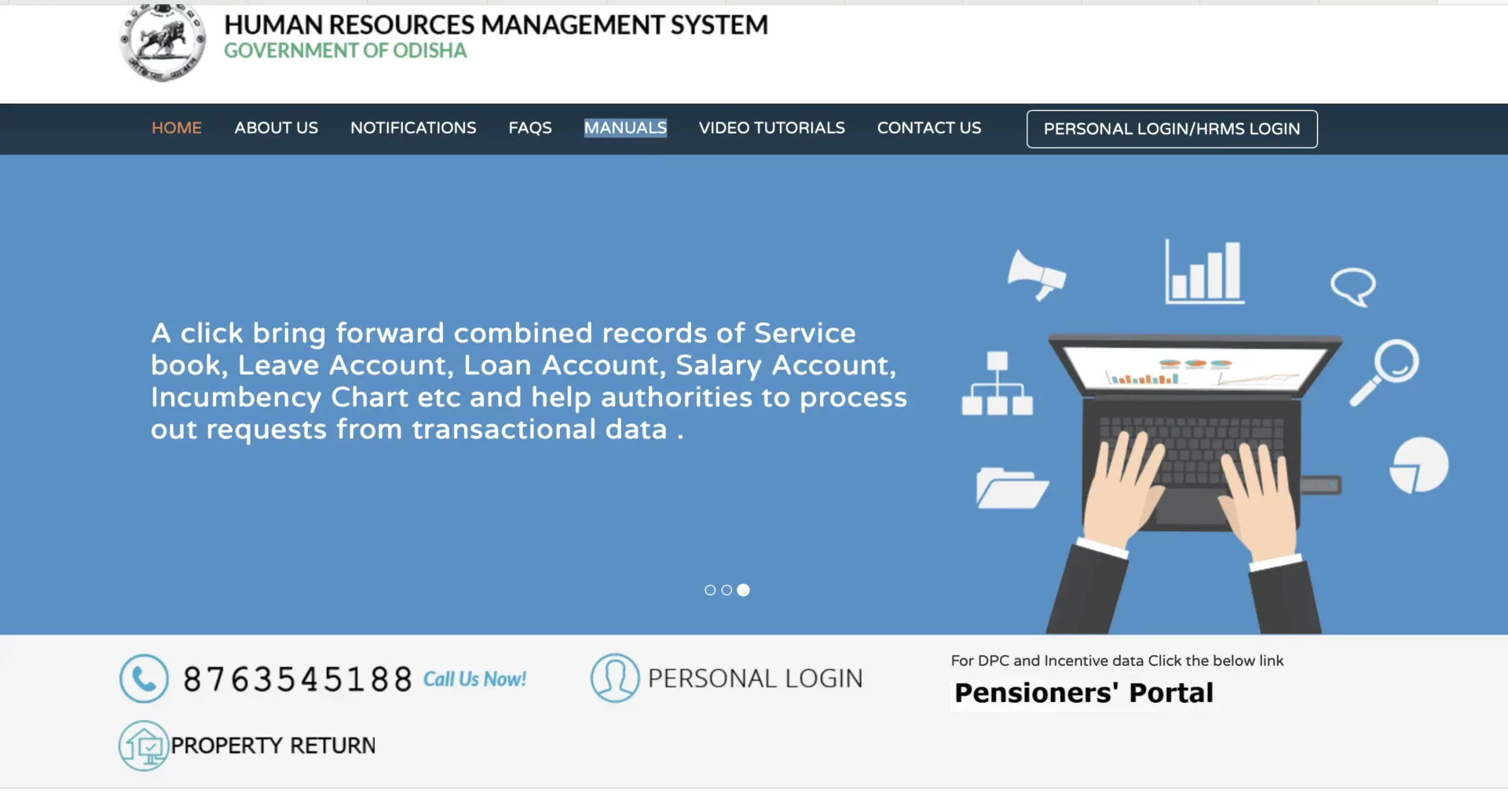
Accessing the HRMS portal requires adherence to specific security measures to protect sensitive personal and financial data. The official portal is accessible at hrmsorissa.gov.in.

Personal Login Procedures

The login process is designed to be secure yet accessible. Employees must utilize their unique HRMS User ID and a complex password to gain entry.

  1. Portal Access: Navigate to the official HRMS Odisha homepage.
  2. Authentication Interface: Select the ‘Personal Login’ or ‘HRMS Login’ option.
  3. Credential Entry: Input the User ID and the current password.
  4. Security Verification: Enter the alphanumeric CAPTCHA precisely as displayed. The system utilizes case-sensitive CAPTCHA to prevent automated unauthorized access.
  5. Dashboard Access: Upon successful authentication, the user is directed to a personalized dashboard containing links to all available services.

Cyber Security Best Practices for 2026

Given the increasing sophistication of digital threats, employees are advised to follow rigorous security protocols:

  • Password Rotation: Passwords should be updated every 90 days to minimize the risk of credential compromise.
  • Credential Privacy: User IDs and passwords must never be shared. The HRMS helpdesk and DDOs will never request an employee’s password.
  • Secure Access Points: Accessing the portal via public or unsecured Wi-Fi networks is strongly discouraged. Employees should utilize the HRMS Odisha mobile app (v3.4) only on devices with active screen locks and biometric security.

Procedural Guide for HRMS Odisha Payslip Download

The monthly payslip is a vital document for financial planning and is frequently required for income tax filing and loan applications. The HRMS portal provides a streamlined method for generating these documents in a portable format.

Step-by-Step Download Instructions

  1. Authenticated Entry: Log in to the personal HRMS dashboard.
  2. Navigation: Locate the “My Page” or “Request/Submission” section.
  3. Service Selection: Select the “HRMS Salary Slip” utility.
  4. Parameter Definition: Choose the specific Year and Month for which the record is required.
  5. Generation: Click the “Download” button to generate a PDF version of the payslip.

It is recommended that employees store digital copies of their payslips in secure repositories like DigiLocker to ensure easy access during tax assessment periods.

Analytical Breakdown of the 2026 Payslip

Understanding the components of a payslip is essential for verifying salary accuracy.

  • Basic Pay: The fundamental salary component based on the employee’s pay scale and level.
  • Allowances: This includes the Dearness Allowance (DA), which is adjusted periodically for inflation, and the House Rent Allowance (HRA), which is determined by the posting location.
  • Statutory Deductions: Contributions to the General Provident Fund (GPF) or the National Pension System (NPS).
  • Professional Tax and Income Tax: Mandatory tax deductions as per current state and central regulations.

Any discrepancies in the earnings or deductions should be formally communicated to the respective Drawing and Disbursing Officer (DDO) for rectification.

Mandatory Annual Property Statement 2025 (Deadline: January 31, 2026)

In accordance with the Odisha Government Servants’ Conduct Rules, the submission of an annual property statement is a mandatory requirement for all state employees. For the reporting year 2025, the submission deadline is set for January 31, 2026.

Compliance and Accountability

Timely submission of the property statement is a prerequisite for the sanctioning of annual increments and is a critical factor in promotion reviews. The 5T initiative has made the property statement process entirely online to enhance accountability.

Comprehensive Property Declaration Checklist

When preparing the declaration for the period of January 1, 2025, to December 31, 2025, employees must include all assets held by themselves, their spouses, and dependent family members.

Immovable Assets

  • Land and Real Estate: Details of residential plots, agricultural land, and commercial properties. Declaration must include the location, Khata number, and Plot number.
  • Residential Buildings: Ownership details of houses and apartments, including those under construction.
  • Inherited Properties: All ancestral properties legally vested in the employee’s name.

Movable Assets

  • Valuables: Significant holdings of gold, silver, and precious stones purchased or acquired during the reporting year.
  • Automobiles: Details of all motorized vehicles, including registration numbers You can also explore HSRP number plate registration.
  • Financial Instruments: Long-term investments such as Fixed Deposits, Mutual Funds, and Shares.
  • Bank Holdings: Significant balances maintained across all bank accounts.
  • Insurance: Premiums and valuations of life and general insurance policies.

Submission Workflow

  1. Access the “Property Statement” link within the HRMS portal.
  2. Define the reporting period as 01-Jan-2025 to 31-Dec-2025.
  3. Update the existing asset list or add new acquisitions.
  4. Utilize the “No Change” utility if the asset status remains identical to the previous year’s declaration.
  5. Submit the declaration and secure the digital acknowledgment receipt.

Early submission is advised to avoid potential server congestion as the January 31 deadline approaches. For additional land-related details, employees may refer to the Bhulekh Odisha portal.

Management of the Electronic Service Book (e-Service Book)

The e-Service Book is the definitive digital record of an employee’s professional history. It serves as the single source of truth for retirement benefits, seniority lists, and career progression.

Verification of Service Records

Regular auditing of the e-Service Book is essential for ensuring long-term administrative accuracy. Employees should verify:

  • Personal Data: Date of birth, permanent address, and contact information.
  • Professional History: Dates of joining, promotion orders, and transfer details.
  • Leave Records: Accurate recording of Earned Leave (EL), Half Pay Leave (HPL), and Commuted Leave.
  • Nomination Data: Current status of nominees for GPF, Pension, and Group Insurance.

The Correction and Update Protocol

Errors in the e-Service Book can be addressed through the portal’s integrated grievance system:

  1. Navigate to the “My Page” section.
  2. Select the “Lodge Complaint” option.
  3. Clearly articulate the error and provide the correct data based on official office orders.
  4. Upload supporting documentation as required by the CMGI.

Corrections are typically processed within a standard window of 7 to 10 working days following verification by the Establishment Officer.

Online Leave and Loan Management Systems

The HRMS portal has modernized the process of applying for leave and government-sanctioned loans, making them more transparent and efficient.

Leave Application Process

  1. Balance Check: Before applying, users can view their current leave balances (CL, EL, HPL) within the “Leave” module.
  2. Application Entry: Select the leave type and specify the start and end dates.
  3. Workflow Routing: The application is automatically routed to the reporting officer for approval.
  4. Notification: Applicants receive automated SMS alerts upon the approval or rejection of their request.

This system ensures that leave records are always up-to-date, which is crucial for planning visits to various tourist places in Odisha.

Loan and Advance Applications

The portal facilitates applications for various government advances, including House Building Advance (HBA) and Computer Loans.

  • Digital Submission: Forms are filled out and submitted electronically.
  • Document Upload: Scanned copies of required documents are attached directly to the application.
  • Recovery Tracking: The system automatically tracks the recovery of the loan through monthly salary deductions, providing a transparent view of the outstanding balance.

Performance Appraisal and the e-PAR System

The electronic Performance Appraisal Report (e-PAR) is a critical component for Group A and Group B officers, determining their eligibility for promotions and specialized postings.

Annual Appraisal Timelines for 2026

To ensure timely processing, the government adheres to a strict appraisal calendar:

  • Self-Appraisal Initiation: April 1 to May 31.
  • Reporting Officer Assessment: June 1 to August 31.
  • Review and Acceptance: Completed by December 31 of the same year.

Failure to submit self-appraisals within the stipulated timeframe can result in a “No Report Certificate,” which may adversely affect future career milestones.

The HRMS Odisha Mobile Application (v3.4)

The official mobile application provides a portable interface for essential HRMS services. As of early 2026, version 3.4 is the current stable release, offering improved performance and security features.

Core Functionalities of the App

  • Real-time Notifications: Instant alerts for salary credits and office orders.
  • Leave Management: Ability to apply for and track leave status from mobile devices.
  • Profile Management: Quick access to basic employee details and the Incumbency Chart.
  • Document Preview: Rapid viewing of recent payslips.

The app is particularly useful for employees serving in field offices who may have limited access to desktop computing resources.

Aadhaar Integration and Pension Processing

A significant milestone in the 2026 digital roadmap is the full integration of Aadhaar with the HRMS database to facilitate “Pension on the Day of Retirement.”

Impact on Superannuation

By linking Aadhaar numbers and ensuring that bank details are correctly recorded in the HRMS, the system can auto-generate pension papers. This integration eliminates the need for physical file movement and reduces the wait time for the first pension payment to nearly zero.

Data Synchronization Requirements

To benefit from auto-generated pension papers, employees must:

  • Verify that their name matches the Aadhaar record exactly.
  • Ensure the Aadhaar-linked mobile number is registered in the HRMS.
  • Update family and nominee details in the e-Service Book.

Correct nomination is also vital for accessing benefits under the Biju Swasthya Kalyan Yojana (BSKY).

Troubleshooting and Technical Support

Despite the portal’s robustness, technical issues may occasionally arise. The government provides multiple channels for grievance redressal.

Common Technical Issues

  • Authentication Failures: Often caused by incorrect CAPTCHA entry or expired passwords. The “Forgot Password” utility can be used for self-service resets.
  • Connectivity Delays: Peak periods like the property statement deadline can lead to slower response times.
  • Data Inconsistencies: Errors in payslips or service records should be reported via the “Lodge Complaint” feature or to the departmental HRMS coordinator.

Support Channels

  • CMGI Helpline: 8763545188.
  • Technical Email: admin@cmgi.org.in.
  • Physical Helpdesk: Toshali Bhavan, Satyanagar, Bhubaneswar.

Comparative Analysis: Administrative Evolution

The impact of the HRMS can be best understood by comparing current digital workflows with traditional paper-based administration.

MetricTraditional EraDigital HRMS Era (2026)
Record AccessibilityManual retrieval of physical files.Instant digital access 24/7.
Leave ProcessingMultiple days for physical file transit.Real-time digital routing and approval.
Data SecuritySusceptible to physical damage or loss.Encrypted cloud storage with backups.
TransparencyRestricted access to personal records.Full visibility into the e-Service Book.
Retirement PlanningManual preparation of pension papers.Automated, Aadhaar-integrated generation.

Future Outlook: HRMS in 2027 and Beyond

The Government of Odisha continues to innovate within the HRMS ecosystem. Future developments are expected to include:

  • Artificial Intelligence (AI): Predictive tools for workforce management and automatic error detection in service records.
  • Blockchain Technology: Implementing decentralized ledgers for service history to ensure absolute data immutability.
  • Enhanced Integration: Further synchronization with state health portals and educational systems like SAMS Odisha.

Technical Integration: HRMS, IFMS, and the Odisha Treasury

The seamless operation of HRMS Odisha in 2026 is largely due to its deep technical integration with other critical government portals. The most significant of these is the Integrated Financial Management System (IFMS). This connection ensures that human resource data and financial transactions are always in perfect synchronization.

When a Drawing and Disbursing Officer (DDO) prepares a monthly pay bill, the system pulls live data from the HRMS database. This includes any changes in basic pay due to promotions or increments, as well as adjustments in allowances like DA and HRA. This automated data flow eliminates the manual errors that were common in the pre-digital era.

Furthermore, the integration with the Odisha Treasury ensures that once a bill is passed by the DDO, it is electronically transmitted to the treasury for disbursement. The employee receives their salary directly into their linked bank account, and the HRMS system is updated with the payment status in real-time. This “Direct Benefit Transfer” (DBT) model for salaries is a benchmark of the 5T initiative’s success in leveraging technology for transparency.

Recruitment Management and Data Onboarding

The HRMS portal’s role begins even before an individual officially joins the government service. The Recruitment Management module streamlines the transition from a candidate to an employee.

Data Capture during Induction

Upon selection by bodies like the Odisha Public Service Commission (OPSC) or the Odisha Staff Selection Commission (OSSC), the recruitment data is imported into the HRMS. This ensures that the employee’s basic details, such as educational qualifications and category, are accurate from day one.

The Employee ID Assignment

Every new recruit is assigned a unique Employee ID through the portal. This ID serves as the primary key for all future transactions. The onboarding process also includes the digital capture of fingerprints and other biometric data in some departments, adding a layer of security to the personnel records.

Disciplinary Proceedings and Administrative Actions

The HRMS portal is also the official repository for records related to disciplinary proceedings. This module ensures that all administrative actions are documented and that the “due process” of law is followed.

Recording of Charges and Explanations

When a disciplinary action is initiated, the details of the “Show Cause” notice and the employee’s explanation are uploaded to the system. This provides a transparent timeline of the proceedings.

Impact on Service Records

Final orders, whether they involve exoneration or the imposition of penalties, are recorded in the e-Service Book. This is crucial because administrative penalties can affect future promotions, transfers, and retirement benefits. By having these records in a centralized system, the government ensures that “Punishment and Reward” records are consistently maintained across different postings.

Training and Skill Development Module

In 2026, the Odisha government places a high priority on the continuous skill development of its workforce. The HRMS Training Module is designed to track and manage these efforts.

Scheduling and Nominations

Departments can use the portal to announce upcoming training programs at institutes like the Gopabandhu Academy of Administration. Employees can be nominated online, and their attendance is verified through the system.

Skill Mapping

The portal maintains a “Skill Map” for each employee, listing the specialized trainings they have completed. This data is invaluable for the government when selecting officers for specialized assignments or technical projects. It ensures that the right person is placed in the right role based on their demonstrated expertise.

Detailed Procedural Analysis: Loan Recovery and Interest Calculation

Managing government loans, such as the House Building Advance (HBA), involves complex calculations of principal and interest. The HRMS portal automates this entire process.

Principal Recovery

The system calculates the monthly installment based on the total loan amount and the repayment period. This amount is automatically deducted from the employee’s salary until the principal is fully recovered.

Interest Amortization

Once the principal is recovered, the system begins the recovery of the interest. In 2026, the HRMS utilizes sophisticated amortization schedules to ensure that interest calculations are accurate and comply with current government rules. Employees can view their “Loan Ledger” at any time to see the remaining balance and the history of their repayments.

Instructional Analysis: The “Lodge Complaint” Utility

The “Lodge Complaint” utility is the primary interface for employees to request corrections in their digital records. Understanding how to use this tool effectively is essential for maintaining an accurate e-Service Book.

Categorization of Complaints

Complaints are categorized into various types, such as:

  • Personal Data Errors: Incorrect name spelling, date of birth, or permanent address.
  • Service Record Discrepancies: Missing promotion orders, incorrect joining dates, or missing increments.
  • Leave Account Issues: Discrepancies in the balance of Earned Leave or Medical Leave.
  • Technical Issues: Problems with login, password reset, or payslip generation.

Documentation Requirements

To ensure a speedy resolution, employees must upload scanned copies of official documents. For example, if a promotion is missing, the official “Office Order” or “Gazette Notification” must be attached.

Tracking and Escalation

Each complaint is assigned a unique ticket number. Employees can track the status of their request—whether it is “Pending,” “Under Process,” or “Resolved.” If a complaint is not addressed within the stipulated timeframe, the system allows for escalation to the higher administrative levels within the department.

The Role of the DDO in the HRMS Ecosystem

The Drawing and Disbursing Officer (DDO) is the pivot around which the HRMS system revolves at the office level. Their responsibilities include:

Payroll Finalization

The DDO is responsible for the accuracy of the monthly pay bills. They must ensure that all increments, leaves, and deductions for the employees under their jurisdiction are correctly reflected in the system before the bills are submitted to the treasury.

Service Book Authentication

While employees can view their e-Service Books, the “Update” and “Authentication” rights are typically held by the DDO or the Establishment Officer. They must verify any changes against physical office orders before committing them to the digital record.

Grievance Handling

The DDO serves as the first point of contact for HRMS-related issues. They are responsible for investigating complaints lodged by employees and coordinating with the CMGI helpdesk for technical resolutions.

Future Projections: AI-Driven Personnel Management

As we look toward 2027, the Government of Odisha is exploring the integration of Artificial Intelligence (AI) and Machine Learning (ML) into the HRMS portal.

Predictive Analytics for Workforce Planning

AI models can analyze retirement patterns and historical recruitment data to predict future vacancies in critical departments. This will allow the government to initiate recruitment processes well in advance, ensuring that there is no service vacuum.

Automated Error Detection

Machine Learning algorithms can be trained to identify anomalies in service records. For example, if an employee’s pay scale doesn’t align with their designation and seniority, the system can automatically flag this for review, preventing long-term administrative errors.

Personalized Career Portals

Future iterations of the HRMS may include “Career Portals” that provide employees with personalized recommendations for training and skill development based on their current roles and career goals.

Strategic Impact of HRMS on Odisha’s Governance

The HRMS portal is more than just a personnel tool; it is a strategic asset for the state. Its impact is felt across multiple dimensions of governance:

Fiscal Discipline and Resource Allocation

By automating salary and pension calculations, the system ensures that the state’s largest expenditure—personnel costs—is managed with extreme precision. It prevents duplicate payments and ensures that all recoveries, such as for loans and advances, are made on time. Furthermore, the portal provides decision-makers with real-time data on staffing levels across different districts. This allows the government to allocate human resources more strategically, ensuring that underserved areas like the tribal-dominated southern districts receive the necessary administrative attention.

Enhanced Employee Morale and Empowerment

The transparency and ease of access provided by the portal have significantly boosted the morale of the state’s workforce. Employees feel empowered when they have control over their own professional records. The ability to verify service book entries, apply for leave from a mobile device, and see the status of grievances reduces institutional frustration. This empowerment leads to a more engaged civil service, which is critical for the success of development programs like the “Ama Odisha Nabin Odisha” initiative.

Improved Public Service Delivery

An efficient and motivated workforce is essential for the delivery of high-quality public services. By reducing the administrative burden on its employees, the HRMS portal allows them to focus more on their primary duties—serving the citizens of Odisha. Whether it’s a doctor in a primary health center or a revenue officer in a tehsil, less time spent on personal paperwork means more time spent on public welfare.

Data-Driven Policy Making

The centralized database of HRMS provides a wealth of information for long-term policy making. The government can analyze trends in recruitment, attrition, and retirement to design better human resource policies. For instance, data-driven insights into the age profile of the civil service can help in planning for future skill gaps and developing targeted training programs for younger officers.

Expanded FAQ: Advanced User Queries

How does the HRMS handle “Inter-Departmental” transfers?

When an employee is transferred from one department to another, their HRMS record is “Relieved” by the parent department and “Joined” by the new department. All service records, including leave balances and loan ledgers, are automatically transferred, ensuring continuity. This seamless transition is critical for maintaining the accuracy of the e-Service Book throughout an employee’s career.

What is the protocol for recording “Foreign Service” or “Deputation”?

Records of employees on deputation to the Central Government or other state organizations are maintained in a specific “Deputation” module. The borrowing organization provides the salary and leave details, which are periodically updated in the main HRMS database. This ensures that the employee’s seniority and service benefits are protected even when they are serving outside the state government.

Can I view my “Seniority Position” in my cadre through HRMS?

Many departments have integrated “Civil Lists” or “Gradation Lists” into the portal. Employees can view their position relative to their peers, which is crucial for understanding promotion timelines. This feature enhances the transparency of the promotion process, reducing the need for manual inquiries at the departmental headquarters.

How is “Suspension” handled in the system?

During a period of suspension, the employee’s status is updated in the system. The HRMS automatically calculates the “Subsistence Allowance” as per the rules and limits access to certain self-service features. Once the suspension is revoked, the service book is updated to reflect the outcome of the disciplinary proceedings.

Is my HRMS data used for the “Odisha One” portal services?

Yes, the HRMS database is increasingly being used as a source of truth for various citizen-centric services on the “Odisha One” portal, particularly for services that require verification of government employment status. This cross-portal integration is a key component of the state’s “Single Sign-On” vision for governance.

What happens to my HRMS account if I resign from government service?

Upon acceptance of resignation, the account is deactivated for regular transactions. However, a read-only version of the service record is maintained in the archive for future reference or for the processing of any terminal benefits. This ensures that the professional history of the individual is preserved as part of the state’s permanent records.

Can I update my “Emergency Contact” details?

Yes, the self-service module allows employees to update their emergency contact information at any time. It is highly recommended to keep this data current to ensure that the office can reach out to family members in case of any medical or administrative emergencies.

How does the system manage “LTC” (Leave Travel Concession)?

The LTC module allows employees to apply for the concession, record their travel details, and submit their claims online. The system checks for eligibility based on the employee’s service history and previous LTC usage. This automation prevents errors in claim processing and ensures that employees receive their reimbursements faster.

Is there a “Mobile App” for iOS (iPhone) users?

While the primary focus has been on the Android platform (v3.4), the government is working on an iOS version to ensure all employees have mobile access regardless of their device type. In the meantime, iOS users can access the full portal through a secure mobile browser.

How are “Ad-hoc” or “Contractual” employees recorded?

Separate modules exist for non-regular employees. While their records are less extensive than those of permanent staff, the portal still tracks their joining dates, remuneration, and contract renewals. This centralized tracking ensures that the rights and payments of contractual staff are also managed efficiently.

Can I track the “Pension Paper” movement through HRMS?

Yes, superannuating employees can track the stage-by-stage movement of their pension papers through the HRMS-Pensioners portal integration. This reduces the anxiety associated with retirement and allows the employee to address any queries from the AG office proactively.

What is the “Digital Signature” integration in HRMS?

In 2026, many administrative orders and payslips are being issued using digital signatures. This further enhances the security and authenticity of government documents, making them universally acceptable for official and financial purposes.

How are “In-service Training” nominations handled?

The system allows departments to nominate employees for specific technical and soft-skill training programs. Once the training is completed, the “Skill Map” in the employee’s profile is automatically updated, reflecting their enhanced competencies.

Can I access the HRMS portal from outside Odisha?

Yes, the portal is accessible from any location with a secure internet connection. This is particularly useful for employees on leave or those serving on deputation in other states or at the center.

What is the process for “e-Nomination” for family pension?

The portal allows employees to digitally submit and update their nominations for family pension. This ensures that the benefits reach the intended family members without any legal or administrative disputes in the future.

Conclusion

The HRMS Odisha portal represents the pinnacle of digital administrative transformation in the state. By centralizing personnel data and automating critical workflows, the system has achieved unprecedented levels of efficiency and transparency. As we move through 2026, the portal’s role in the 5T initiative continues to expand, offering government employees a robust and secure platform for managing their professional lives. Adherence to the latest security protocols and timely submission of mandatory declarations remain the responsibility of every individual in the state’s service. Through these digital advancements, Odisha continues to set a benchmark for state-level human resource management in India.