Puri District: History, Jagannath Temple, Konark, Chilika & Guide
Explore Puri district in Odisha. Discover Shree Jagannath Temple, Konark Sun Temple, Chilika Lake at Satapada, Golden Beach, blocks, culture, and travel facts.
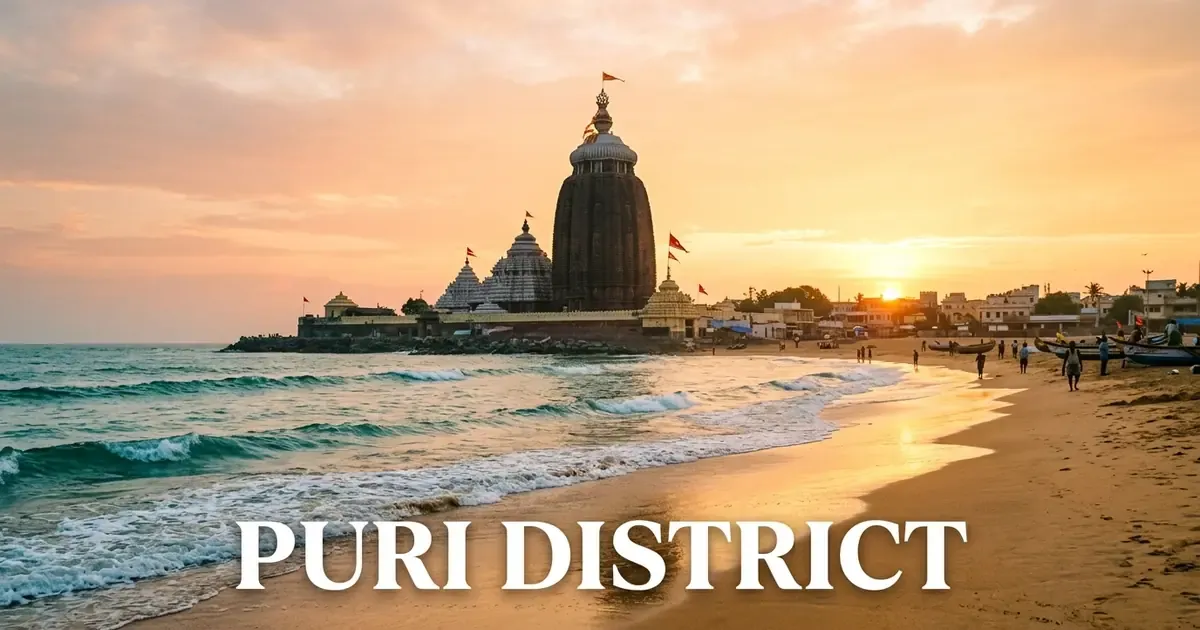
Puri district represents the spiritual, cultural, and architectural soul of Odisha. Historically revered across classical Sanskrit scriptures as Srikshetra, Purusottama Kshetra, and Shankha Kshetra, this coastal district along the Bay of Bengal has attracted millions of pilgrims, saints, and travelers for over a millennium.
The district houses two of India’s most celebrated architectural monuments: the sacred twelfth-century Shree Jagannath Temple (one of the four supreme Char Dham sanctuaries of Hinduism) and the monumental thirteenth-century Konark Sun Temple, recognized by UNESCO as a World Heritage Site.
Beyond its world-famous stone temples, Puri encompasses exceptional ecological and artistic treasures. It spans the eastern waters of Chilika Lake where endangered Irrawaddy dolphins swim near Satapada, stretches along miles of eco-certified Blue Flag beaches, and nurtures living artisan villages where traditional Pattachitra painters and Pipili applique masters preserve centuries of heritage.
Key Takeaways
- Puri district covers 3,479 square kilometers across eleven community development blocks, eleven tehsils, and one revenue subdivision.
- The district recorded a population of 1,698,730 in Census 2011, with an 84.67 percent literacy rate and a population density of 488 persons per square kilometer.
- Shree Jagannath Temple in Puri anchors the sacred Char Dham circuit, world-renowned for the annual Ratha Yatra and the 56 Bhoga Mahaprasad prepared in the world’s largest traditional kitchen.
- The UNESCO-inscribed Konark Sun Temple stands along the coastline as a crowning masterpiece of classical Kalinga architecture.
- The district includes the Satapada sector of Chilika Lake, home to wild Irrawaddy dolphins and major migratory bird wintering grounds.
- Puri features Blue Flag certified Golden Beach, the heritage crafts village of Raghurajpur, and the GI-tagged applique craft center of Pipili.
Demographic & Geographic Profile of Puri District
Puri district occupies the central coastal littoral of Odisha, situated between 19° 28’ N to 20° 10’ N latitude and 85° 09’ E to 86° 25’ E longitude. The district is bounded by Khordha and Cuttack districts to the north, Jagatsinghpur district to the northeast across the Devi River, the Bay of Bengal to the south and east, and Ganjam district across Chilika Lake.
The landscape consists predominantly of low-lying coastal alluvial plains formed by the deltaic distributaries of the Mahanadi river system. The coastline extends across an impressive 155 kilometers along the Bay of Bengal, characterized by wide sandy beaches, coastal sand dunes, tidal creeks, and casuarina shelterbelts.
The demographic benchmarks below reflect official figures verified through the Puri District Administrative Records.
| Demographic / Geographic Indicator | Official Statistical Value | Administrative Notes & Verification |
|---|---|---|
| Total Geographic Area | 3,479 sq km | Represents 2.23% of Odisha’s total geographical area |
| Total District Population (2011) | 1,698,730 persons | 865,380 males and 833,350 females |
| Population Density | 488 persons per sq km | Densely settled coastal agricultural and pilgrim belt |
| Decadal Population Growth (2001-2011) | 13.05% | Steady demographic stabilization |
| Sex Ratio | 963 females per 1,000 males | Child sex ratio (0-6 years) stands at 932 |
| Overall Literacy Rate | 84.67% | Male literacy: 90.85%; Female literacy: 78.28% |
| Administrative Headquarters | Puri Town | Located directly on the Bay of Bengal coast |
| Revenue Division | Central Revenue Division | Headquarters situated at Cuttack |
| Revenue Subdivisions | 1 (Puri Sadar) | Overseeing eleven administrative blocks |
| Community Development Blocks | 11 CD Blocks | Administering 268 Gram Panchayats |
| Revenue Tehsils | 11 Tehsils | Cadastral revenue administration |
| Urban Local Bodies (ULBs) | 4 Urban Centers | Puri Municipality, Konark NAC, Pipili NAC, Nimapara NAC |
| Motor Vehicle Registration (RTO) | OD-13 | Regional Transport Office, Puri |
| Coastline Length | 155 kilometers | Longest continuous oceanfront of any coastal district |
The climate is warm, humid, and maritime. Summers extend from March to June with high humidity tempered by ocean breezes. The southwest monsoon brings abundant rainfall between June and October, averaging 1,408 millimeters annually. Winters from November to February are pleasantly cool and dry, with daytime temperatures averaging 22°C to 28°C.
Historical Evolution: Sacred Srikshetra to Modern Pilgrim Capital
Puri possesses an unbroken historical lineage dating back more than two thousand years. Early Buddhist and Jain scriptures suggest the coastal tract functioned as a significant religious sanctuary long before classical temple construction began.
The recorded architectural era commenced under the Eastern Ganga dynasty. In the twelfth century, Emperor Anantavarman Chodaganga Deva laid the foundation of the current monumental Shree Jagannath Temple, a project completed by his descendant King Anangabhima Deva III.
The Ganga monarchs and subsequent Suryavamshi Gajapati emperors declared themselves Raut (servants or deputies) of Lord Jagannath, governing their vast empire stretching from the Ganges to the Kaveri in the deity’s sacred name.
In the thirteenth century, King Narasimhadeva I constructed the colossal Sun Temple at Konark, commemorating military triumphs and creating a monumental stone chariot dedicated to the Sun God Surya. European mariners navigating the Bay of Bengal referred to Konark as the “Black Pagoda” due to its dark weathered stone, contrasting it with Puri’s white-plastered temple tower known as the “White Pagoda.”
During the sixteenth and seventeenth centuries, Puri survived numerous invasions by the Bengal Sultanate and Mughal generals. The hereditary Gajapati kings and dedicated Sevayats repeatedly hid the sacred wooden idols in secret locations around Chilika Lake and the hills of southern Odisha to preserve them from desecration.
Following Maratha rule, the British East India Company captured Puri in 1803. The colonial authorities retained administrative control while recognizing the unique religious authority of the Gajapati Maharaja of Puri as the hereditary superintendent of the temple.
After independence, Puri emerged as the central cultural symbol of Odisha. In recent years, the completion of the 75-meter Srimandir Parikrama Prakalpa (Heritage Corridor) has modernized pilgrim circulation, surrounding the ancient temple walls with landscaped promenades, security facilities, and pilgrim reception halls.
Administrative Framework: Subdivisions, Blocks & Constituencies
Puri district operates under a structured administrative framework designed to handle general rural development, coastal disaster protection, and heavy pilgrim traffic. The Collector and District Magistrate directs administrative departments from the collectorate complex situated on VIP Road in Puri town.
The district comprises one revenue subdivision (Puri Sadar) containing eleven community development blocks and eleven tehsils. Urban civic administration is managed by Puri Municipality alongside three Notified Area Councils: Konark NAC, Pipili NAC, and Nimapara NAC.
The table below outlines the eleven community development blocks of Puri district, their headquarters, and primary economic activities.
| CD Block | Block HQ | Gram Panchayats | Primary Economic Drivers | Key Geographic Characteristics |
|---|---|---|---|---|
| Puri Sadar | Puri Town | 30 GPs | Tourism, hospitality, handicrafts, fisheries | Surrounds the municipal city and Golden Beach |
| Satyabadi | Sakshigopal | 24 GPs | Coconut plantations, temple tourism, trade | Historic center hosting Sakshigopal temple |
| Brahmagiri | Brahmagiri | 26 GPs | Brackish fisheries, agriculture, pilgrimage | Adjoins northern Chilika and Alarnath temple |
| Krushnaprasad | Krushnaprasad | 20 GPs | Lake fisheries, tourism logistics, salt pans | Island strip situated inside Chilika lagoon |
| Kanas | Kanas | 28 GPs | Rice cultivation, betel vine farming, trade | Inland agricultural plain watered by the Daya River |
| Delanga | Delanga | 21 GPs | Dairy cooperatives, paddy farming, vegetable trade | Railway junction belt along the Khordha-Puri line |
| Pipili | Pipili | 25 GPs | Applique embroidery, brass craft, agro-trade | Gateway highway town famous for artisan markets |
| Nimapara | Nimapara | 29 GPs | Milk processing, confectionery, sugarcane | Prosperous dairy hub famous for Chenna Jhili |
| Gop | Gop | 31 GPs | Betel vines, paddy farming, river trade | Central junction connecting Puri to Konark |
| Kakatpur | Kakatpur | 17 GPs | Pilgrim tourism, agriculture, freshwater fishery | Sacred riverside town hosting Maa Mangala temple |
| Astaranga | Astaranga | 17 GPs | Marine fish landing, salt farming, casuarina | Coastal terminal belt near the Devi river mouth |
For legislative representation, Puri district contains six single-member Odisha Legislative Assembly constituencies:
- AC-105 Kakatpur: Reserved for Scheduled Castes (SC), encompassing Kakatpur and Astaranga blocks.
- AC-106 Nimapara: General category, covering Nimapara and Gop blocks.
- AC-107 Puri: General category, comprising Puri Municipality and surrounding coastal urban wards.
- AC-108 Brahmagiri: General category, encompassing Brahmagiri and Krushnaprasad blocks along Chilika Lake.
- AC-109 Satyabadi: General category, covering Satyabadi and Kanas blocks.
- AC-110 Pipili: General category, encompassing Pipili and Delanga blocks.
At the parliamentary level, four assembly segments (Puri, Brahmagiri, Satyabadi, Pipili) form part of the Puri Parliamentary Constituency (PC-17) alongside adjoining segments from Khordha and Nayagarh. The remaining two segments (Kakatpur and Nimapara) belong to the Jagatsinghpur Parliamentary Constituency under the Election Commission of India Assembly Delimitation Profile.
Coastal Hydrology & Lagoons: Bay of Bengal, Chilika & Sacred Rivers
Puri’s physical geography is defined by its intimate relationship with the ocean, coastal lagoons, and the deltaic river branches of the Mahanadi.
Chilika Lake forms the southwest boundary of the district. Spanning more than 1,100 square kilometers during the monsoon, Chilika is Asia’s largest brackish water lagoon. The Krushnaprasad and Brahmagiri blocks form the outer lagoon channel that links the central lake with the Bay of Bengal.
This brackish coastal habitat supports a thriving population of endangered Irrawaddy dolphins (Orcaella brevirostris), alongside millions of migratory waterfowl that arrive each autumn from Siberia, Mongolia, and the Caspian Sea.
The district is crisscrossed by a network of perennial rivers and distributaries. The Daya and Bhargavi rivers descend from Khordha to drain into Chilika Lake, carrying vital freshwater and nutrient-rich silt that nourishes the lagoon’s aquatic ecosystem.
Other major rivers include the Kushabhadra, which flows toward Konark; the Prachi River, an ancient sacred waterway lined with early medieval temple ruins; and the Devi River, forming the northeastern border with Jagatsinghpur.
Along the immediate coastline, vast coastal sand dunes and planted casuarina forests act as natural storm barriers. The Balukhand-Konark Wildlife Sanctuary stretches over 71 square kilometers along the Marine Drive between Puri and Konark, providing a protected coastal forest sanctuary for endangered blackbucks (Antilope cervicapra), spotted deer, striped hyenas, and nesting sea turtles.
The Crown of Faith: Shree Jagannath Temple & the Char Dham Legacy
Shree Jagannath Temple in Puri is the spiritual centerpiece of the district and one of the most sacred pilgrimage destinations on earth. Standing in the heart of Puri town at the terminus of the Grand Road (Bada Danda), the temple is revered as one of the four principal Char Dham sanctuaries that every devout Hindu aspires to visit in their lifetime.
The grand temple rises 214 feet (65 meters) into the coastal sky, surmounted by the monumental eight-spoke wheel (Nilachakra) and the fluttering Patitapabana flag. Built in classical Kalinga style, the complex comprises four axial structures: the Vimana (inner sanctum), the Jagamohana (assembly hall), the Natamandapa (dancing hall), and the Bhogamandapa (hall of offerings).
Inside the sanctum sanctorum on an elevated stone platform known as the Ratnavedi sit the three wooden deities: Lord Jagannath, Lord Balabhadra, and Devi Subhadra, alongside the Sudarshana Chakra. Unlike traditional stone idols, these deities are carved from sacred Neem wood (Daru) and undergo a ritual transformation every twelve to nineteen years known as Nabakalebara.
The temple kitchen (Rosha Ghara) is celebrated as the largest traditional wood-fired kitchen in the world. Thousands of earthen pots stacked atop open hearths prepare the sacred Mahaprasad daily, offering 56 different cooked delicacies (Chhappan Bhoga) without onions, garlic, or foreign vegetables.
Once offered to the deities, the food is brought to Ananda Bazar, where devotees of all castes sit and eat together in spiritual equality. For complete ritual guidance, visit our definitive guide to Shree Jagannath Temple. Detailed epigraphical documentation is preserved in the Shree Jagannath Temple Epigraphical Survey.
World Heritage Wonder: The Sun Temple at Konark
Located approximately 35 kilometers east of Puri along the scenic Marine Drive, the Sun Temple at Konark stands as a towering pinnacle of human artistic achievement. Conceived as a colossal stone chariot for the Sun God Surya, the entire monument was constructed in the thirteenth century by King Narasimhadeva I of the Eastern Ganga dynasty using khondalite stone.
The monument features twelve pairs of intricately carved stone wheels representing the twenty-four hours of the day, pulled by seven spirited stone horses symbolizing the days of the week.
Each nine-foot-wide wheel functions as an astronomical sundial, with sculpted spokes and rims that allow observers to calculate precise time by observing shadow patterns cast by the central hub.
The exterior walls of the Jagamohana and dancing pavilion (Natamandapa) feature thousands of stone reliefs depicting celestial dancers, musicians playing ancient instruments, royal processions, mythical beasts, and amorous couples (Mithunas).
Although the original main sanctuary tower collapsed centuries ago, the surviving assembly hall remains an awe-inspiring wonder. The monument is conserved under the care of the Archaeological Survey of India and is recorded in detail in the Konark Sun Temple Architectural Documentation. Travelers can explore our dedicated architectural guide to the Konark Sun Temple.
Ecological Treasures: Chilika Lagoon at Satapada & Marine Sanctuaries
At Satapada, located 50 kilometers southwest of Puri town at the tip of Chilika Lake, the marine environment offers world-class ecotourism. Satapada serves as the primary base for boat safaris to observe the rare Irrawaddy dolphins that inhabit the tranquil channel waters.
Eco-friendly motorized tourist boats operated by local boatmen take visitors across the calm lagoon waters. Dolphins frequently surface within meters of boats, arching gracefully above the water to breathe.
Safaris often stop at the Rajhans Island, a natural sandbar where visitors can walk between the tranquil backwaters of Chilika on one side and the surging waves of the Bay of Bengal on the other.
Along the northern reaches of the lagoon lies the Nalabana Bird Sanctuary, an inundated island that hosts one of the largest winter gatherings of migratory birds in Asia. Flocks of greater flamingos, northern pintails, bar-headed geese, and Brahminy shelducks carpet the shallow mudflats between November and February.
Spiritual Satellites: Brahmagiri Alarnath & Sakshigopal Temple
The religious geography of Puri extends far beyond the main temple walls, encompassing sacred shrines that play essential roles in Jagannath ritual traditions.
Alarnath Temple at Brahmagiri, situated 25 kilometers west of Puri, holds vital significance during the annual Anavasara period. Following the sacred bathing festival of Snana Yatra fifteen days before the Ratha Yatra, the deities of Puri remain in seclusion.
During this two-week period, pilgrims travel to Brahmagiri to seek the blessings of Lord Alarnath (a four-armed black stone manifestation of Vishnu), believing that darshan here yields the same spiritual merit as seeing Lord Jagannath himself. The temple is also famous for its sweet condensed-milk rice pudding (Kheer Bhoga).
At Satyabadi (Sakshigopal), located 18 kilometers north of Puri along the main highway, stands the celebrated temple of Lord Sakshigopal. Mythology relates that the stone deity traveled all the way from Vrindavan to Odisha to bear witness (Sakshi) to a promise made between two devotees.
Adjoining the temple lies the historic Bakula Bana, the open-air grove where nationalist leader Utkalmani Gopabandhu Das founded the historic Satyabadi Bana Bidyalaya in 1909, educating generations of Odia freedom fighters and scholars.
Living Artisan Villages: Raghurajpur Pattachitra & Pipili Applique
Puri district is internationally recognized for its exceptional living handicraft traditions, where entire villages dedicate themselves to ancient art forms.
Raghurajpur Heritage Crafts Village, situated just 14 kilometers from Puri town in Puri Sadar block, is an idyllic rural hamlet recognized as a national heritage village.
Every household in Raghurajpur is an artisan studio. Masters create exquisite Pattachitra paintings on treated tussar silk and cotton canvas, using natural stone pigments to depict intricate episodes from the Ramayana, Mahabharata, and Gita Govinda.
Artisans in the village also carve palm-leaf manuscripts (Talapatra Chitra), paint wooden toys, and make paper-mâché masks. Raghurajpur is also the birthplace of legendary Odissi dance maestro Guru Kelucharan Mohapatra and preserves the traditional acrobatic dance form of Gotipua, the precursor to modern Odissi.
At the entrance to Puri district along National Highway 316, the renowned market town of Pipili is globally synonymous with Pipili Applique Craft (Chandua), which holds a protected Geographical Indication (GI) tag.
Local tailor families have produced colorful applique cloth for centuries, originally stitching decorative canopies, umbrellas, and banners for the deities during Ratha Yatra. Today, Pipili’s main street is lined with workshops displaying colorful lanterns, wall hangings, beach umbrellas, and decorative bedspreads.
Coastal Leisure: Blue Flag Golden Beach & the Marine Drive
Puri’s coast offers some of the finest recreational beaches in India, having transformed from simple fishing shores into world-class seaside destinations.
Puri Golden Beach, stretching along the central town seafront, is internationally recognized for clean waters and exceptional amenities. A prime section of this beach holds prestigious Blue Flag Certification, an eco-label awarded by the Foundation for Environmental Education (FEE) in Denmark.
The Blue Flag zone features clean bathing water, trained lifeguards, solar lighting, paved walkways, outdoor fitness stations, and disabled-friendly beach access. Travelers can read our complete review of the Blue Flag certified Golden Beach.
Connecting Puri to Konark is the scenic Puri-Konark Marine Drive, a 35-kilometer coastal highway that ranks among India’s most scenic driving routes. The road runs parallel to the ocean, flanked by casuarina forests and quiet coastal estuaries.
Along this route, travelers can stop at Chandrabhaga Beach, famous for peaceful sunrise vistas and shallow waves; Ramachandi Beach, where the Kushabhadra River meets the sea; and the Lotus Resort, which offers aquatic sports such as surfing, sea kayaking, and boating.
Culinary Identity: Chhappan Bhoga Mahaprasad, Khaja & Coastal Flavors
The cuisine of Puri is renowned across India, shaped by ancient temple traditions, rich dairy production, and fresh coastal seafood.
The crown of Puri’s food culture is Mahaprasad. Prepared inside the sanctum kitchens using pure cow ghee in earthen pots without chili powder or modern spices, the food is offered to Lord Jagannath before being shared with devotees. Signature items include fragrant Kanika (sweet golden rice), Dalma (lentils simmered with winter vegetables and roasted cumin), Besara (vegetables in mustard paste), and Kheeri (slow-cooked rice pudding).
Outside the temple gates, Puri’s sweet shops on Bada Danda produce the legendary Khaja. This multi-layered, flaky pastry is prepared from refined flour dough, rolled into thin sheets, deep-fried in pure ghee, and drenched in aromatic sugar syrup. The resulting confection is crisp, brittle, and delicately sweet, remaining fresh for weeks.
Other regional culinary highlights include:
- Nimapara Chenna Jhili: Succulent, spongy cottage cheese dumplings fried until golden and steeped in warm, cardamom-infused sugar syrup, originating from Nimapara town.
- Puri Khua Peda: Rich, caramelized milk-fudge confections produced in traditional sweet shops around the temple perimeter.
- Coastal Seafood Platters: Freshly fried pomfret, sea prawns, and mud crabs caught daily by local Nolias (fishermen) and served with lemon and spices along the evening beach shacks.
- Chhenapoda: Traditional baked cottage cheese cake with a caramelized sugar crust, favored throughout festival seasons.
Festivals of Devotion: World-Famous Ratha Yatra & Chandrabhaga Mela
Puri district celebrates an extraordinary cycle of religious and cultural festivals that attract millions of international pilgrims throughout the year.
The undisputed centerpiece is the World-Famous Ratha Yatra (Car Festival), held during the bright fortnight of the Odia month of Asadha (June or July).
Lord Jagannath, Lord Balabhadra, and Devi Subhadra journey from Srimandir to the Gundicha Temple atop three colossal wooden chariots: Nandighosa, Taladhwaja, and Darpadalana.
Over a million devotees converge on Grand Road to pull the thick coir ropes of the chariots, believing that touching the ropes grants liberation from the cycle of rebirth. The festival features the ancient ritual of Chhera Pahanra, where the Gajapati Maharaja of Puri sweeps the chariot platforms with a golden broom, symbolizing humility before the Divine.
Other major festive gatherings include:
- Chandan Yatra: A 42-day summer festival where deities enjoy evening boat cruises across the sacred Narendra Tank.
- Konark Dance Festival: A five-day classical dance festival held every December against the illuminated stone backdrop of the Sun Temple, featuring India’s finest classical dancers.
- Magha Saptami / Chandrabhaga Mela: An auspicious winter gathering at Chandrabhaga beach in February, where hundreds of thousands of pilgrims take a holy dip in the sea before greeting the first rays of the rising sun.
- Puri Beach Festival: An annual tourism carnival featuring sand art exhibitions by Padma Shri Sudarsan Pattnaik, cultural music, and regional craft stalls.
Curated Travel Directory: Major Landmarks Across Puri District
Travelers organizing a journey through Puri district can reference the practical travel directory below for information regarding visiting hours, locations, and access guidelines.
| Landmark / Destination | Location & Distance | Primary Significance | Recommended Visiting Hours | Entry Fee |
|---|---|---|---|---|
| Shree Jagannath Temple | Grand Road, Puri Town | Ancient Char Dham sanctuary and Kalinga marvel | 5:00 AM – 11:00 PM daily | Free; traditional dress required |
| Konark Sun Temple | 35 km east of Puri | UNESCO World Heritage 13th-century Sun Chariot | 6:00 AM – 8:00 PM daily | ₹40 (Indians), ₹600 (Foreigners) |
| Satapada (Chilika Lake) | 50 km southwest of town | Irrawaddy dolphin boat safaris & lake estuary | 7:00 AM – 5:00 PM daily | Standard boat safari charges |
| Raghurajpur Crafts Village | 14 km north of Puri | Heritage artisan village (Pattachitra & Gotipua) | 8:00 AM – 6:30 PM daily | Free; artisan purchases welcome |
| Blue Flag Golden Beach | Puri Town Seafront | Eco-certified clean beach with modern amenities | 5:00 AM – 10:00 PM daily | ₹20 amenity maintenance fee |
| Pipili Applique Bazaar | 40 km north along NH-316 | GI-tagged traditional applique craft workshops | 9:00 AM – 9:00 PM daily | Free public shopping access |
| Alarnath Temple | Brahmagiri, 25 km west | Vishnu shrine revered during Anavasara period | 6:00 AM – 9:00 PM daily | Free admission |
| Sakshigopal Temple | Satyabadi, 18 km north | Krishna shrine and historic Bakula Bana grove | 6:00 AM – 1:00 PM; 4:00 PM – 8:30 PM | Free admission |
| Chandrabhaga Beach | 3 km east of Konark | Sunrise viewpoint and sacred bathing beach | 5:00 AM – 7:00 PM daily | Free public access |
For detailed multi-day touring options and neighborhood hotel recommendations, explore our curated guide to things to do in Puri.
Transportation & Transit Logistics: Reaching Puri District
Puri district possesses comprehensive transportation connectivity, linking it seamlessly with state capital Bhubaneswar and major metropolitan centers across India.
[!NOTE] Key Transit Access Points for Puri District:
- Railway Junction: Puri Railway Station (PURI) serves as a major terminal on the East Coast Railway, offering direct Superfast and Vande Bharat Express services to Kolkata, New Delhi, Chennai, and Mumbai.
- National Highway 316: A four-lane expressway connects Bhubaneswar directly to Puri (60 km), with typical driving times under 75 minutes.
- Air Connectivity: Biju Patnaik International Airport (BBI) in Bhubaneswar is located 60 kilometers north by road, with the upcoming Sri Jagannath International Airport (SJIA) in Puri under active development.
The transit table below outlines routes, modes, and typical travel times from major regional centers to Puri town.
| Origin City | Travel Mode | Route Details | Distance | Typical Travel Time |
|---|---|---|---|---|
| Bhubaneswar | Road / Car | Direct NH-316 four-lane expressway | 60 km | 1 hour 15 minutes |
| Bhubaneswar | Rail | Direct Vande Bharat / Intercity Express | 62 km | 1 hour 10 minutes |
| Cuttack | Road / Bus | NH-16 to Bhubaneswar bypass, then NH-316 | 85 km | 1 hour 50 minutes |
| Kolkata (Howrah) | Rail | Direct Vande Bharat Express / Howrah-Puri Express | 500 km | 6 hours 25 minutes |
| Konark | Road / Car | Direct coastal Puri-Konark Marine Drive | 35 km | 45 minutes |
| Satapada (Chilika) | Road / Bus | SH-13 southwest along coastal plains | 50 km | 1 hour 15 minutes |
Frequent state transport (OSRTC) buses and private deluxe coaches depart every ten minutes between Bhubaneswar (Baramunda bus terminal) and Puri’s central bus stand. Travelers can easily combine regional itineraries to visit the historic twin city hub of Cuttack district to the north or continue northeastward toward neighboring coastal Jagatsinghpur district.
Seasonal Weather & Optimal Travel Timings
Understanding coastal climate conditions is essential when planning a visit to Puri, as seasonal weather influences temple darshan queues, ocean swimming safety, and outdoor sightseeing.
The seasonal guide below outlines climate trends across the calendar year.
| Season | Calendar Months | Temperature Range | Weather Characteristics | Travel Feasibility & Advice |
|---|---|---|---|---|
| Winter | October to February | 16°C – 28°C | Pleasantly cool mornings; bright mild sunshine | Peak Travel Season: Ideal for beach walking, Konark tours, and Chilika boat safaris |
| Summer | March to June | 27°C – 38°C | Warm, humid afternoons; refreshing sea breezes | Suitable for early morning temple darshan and evening beach breezes |
| Monsoon | July to September | 26°C – 33°C | Heavy coastal rains; high surf; overcast skies | Coincides with Ratha Yatra; take care during rough ocean tides |
The optimal window for traveling to Puri is between October and February. During these winter months, comfortable temperatures make exploring open-air stone temples like Konark pleasant, while calm lagoon waters provide optimal conditions for spotting dolphins at Satapada.
Accommodation, Local Etiquette & Practical Travel Advice
Puri offers extensive hospitality options accommodating millions of travelers, ranging from budget pilgrim dharamsalas to upscale seaside beach resorts.
Luxury seaside hotels and modern resorts cluster along Chakratirtha Road (CT Road) and Marine Drive Road, offering swimming pools, private beach access, and sea-facing balconies. In the historic old town along Grand Road (Bada Danda), numerous traditional mathas, dharamsalas, and affordable lodges sit within easy walking distance of the temple lions’ gate (Singhadwara). At Konark and Satapada, the Odisha Tourism Development Corporation (OTDC) operates comfortable Panthanivas properties.
To ensure a respectful and rewarding journey, observe these practical travel guidelines:
- Srimandir Security Regulations: Mobile phones, cameras, leather belts, wallets, and electronic devices are strictly prohibited inside the Shree Jagannath Temple complex. Deposit all belongings at secure designated cloakrooms outside the Srimandir Parikrama perimeter.
- Temple Dress Code: Modest traditional attire (dhoti, kurta, pajama, saree, or salwar kameez) is mandatory for entering the sanctum. Shorts, sleeveless tops, and western beachwear are not permitted.
- Ocean Swimming Safety: The Bay of Bengal along Puri has strong undercurrents. Swim only in designated zones supervised by certified lifeguards along Golden Beach, and follow safety flags posted on the sand.
- Authorized Guides: When touring Konark Sun Temple or hiring boats at Satapada, engage government-approved guides with official identity badges to ensure accurate historical narration and regulated fee structures.
Frequently Asked Questions (FAQ) About Puri District
What is Puri district famous for?
Puri district is famous worldwide for the sacred 12th-century Shree Jagannath Temple (one of the four Char Dham sanctuaries of Hinduism), the annual Ratha Yatra (Car Festival), the UNESCO World Heritage Sun Temple at Konark, the Irrawaddy dolphins of Chilika Lake at Satapada, Blue Flag certified Golden Beach, and the heritage craft villages of Raghurajpur and Pipili.
Why is Shree Jagannath Temple considered a Char Dham pilgrimage site?
Shree Jagannath Temple in Puri is designated as one of Hinduism’s four sacred Char Dham shrines, alongside Badrinath, Dwarka, and Rameswaram. According to traditional theology, Lord Vishnu takes his bath at Rameswaram, meditates at Badrinath, sleeps at Dwarka, and takes his daily meals (Mahaprasad) at Puri.
What are the main attractions in Konark?
The principal attraction in Konark is the 13th-century Sun Temple, designed as a colossal stone chariot with 24 carved wheels pulled by seven horses. Nearby attractions include Chandrabhaga Beach, Ramachandi Beach, and the annual Konark Dance Festival held every December.
How can travelers visit Chilika Lake from Puri?
Travelers can easily reach Chilika Lake by taking a taxi or bus from Puri town to Satapada, located 50 kilometers southwest (about 1 hour 15 minutes by road). At Satapada, motorized tourist boats offer guided excursions to spot Irrawaddy dolphins and visit Rajhans Island.
What is the best time of year to visit Puri district?
The best time to visit Puri district is between October and February, when winter temperatures average a pleasant 16°C to 28°C. This period offers ideal weather for beach relaxation, boat safaris on Chilika Lake, exploring Konark Sun Temple, and attending cultural events like the Konark Dance Festival.