Boudh District: Star-Shaped Temples, Buddhist Heritage & Travel Guide
Comprehensive guide to Boudh district in Odisha. Discover 9th-century star-shaped temples, colossal Buddha, Gandharadi twin shrines, handlooms, and travel routes.
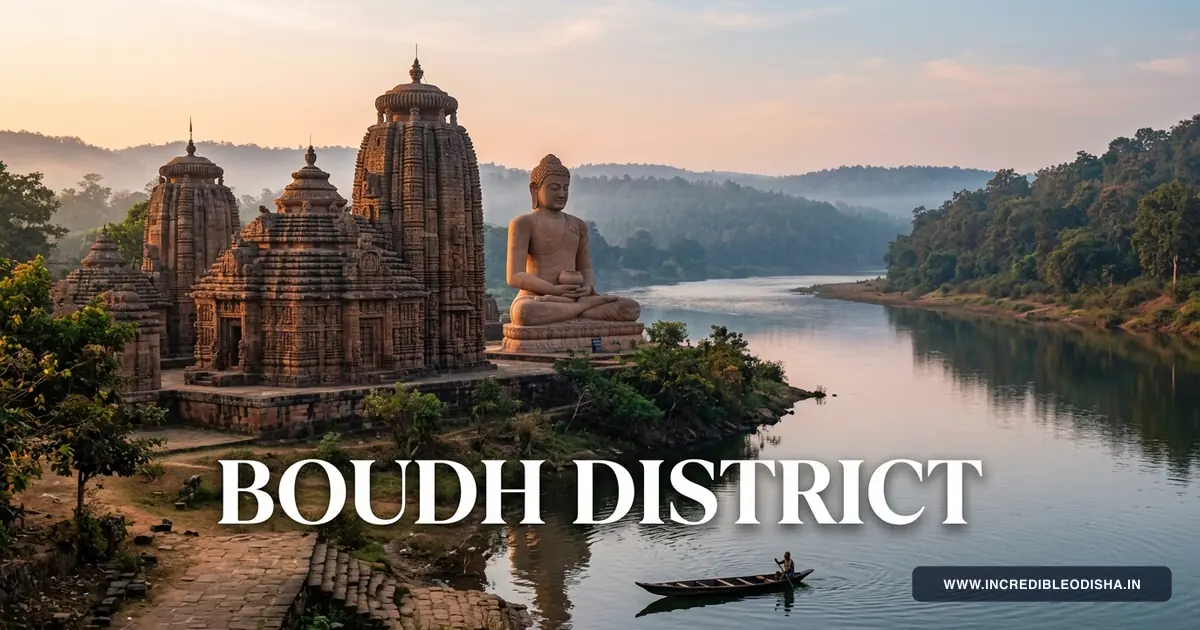
Boudh district occupies a historic riverine basin in central Odisha along the right bank of the Mahanadi River. Spanning 3,098 square kilometers between river plains and forested mountain tracts, the district is celebrated for its stone architecture and ancient religious crossroads. Formed as an independent administrative unit on January 2, 1994 upon the division of the historic Phulbani collectorate, Boudh serves as a cultural bridge connecting western and coastal Odisha.
The district possesses profound historical resonance as a center where Buddhism, Shaivism, and Vaishnavism flourished in remarkable harmony. In addition to its three ninth-century star-shaped temples, Boudh preserves colossal stone statues of Lord Buddha and the celebrated twin temples of Gandharadi.
Key Takeaways
- Boudh spans 3,098 square kilometers across three community development blocks and three revenue tehsils in central Odisha.
- The district recorded a population of 441,162 in Census 2011, with a literacy rate of 72.51 percent and a population density of 142 persons per square kilometer.
- Renowned for its three 9th-century star-shaped Shiva temples displaying unique stellate architecture rarely seen in eastern India.
- Preserves monumental 8th-century black chlorite seated Buddha sculptures representing Odisha’s historic Buddhist monastic era.
- Features the twin shrines of Gandharadi, an architectural marvel where Shiva and Vishnu are worshipped on a common stone platform.
Introduction and Geographic Setting
Boudh district is situated along the central course of the Mahanadi River, which delineates its northern and northwestern boundaries. The territory spans between 20°22’ N and 20°52’ N latitude and 83°34’ E and 84°37’ E longitude. The administrative headquarters is situated at Boudh town, located directly beside the flowing waters of the Mahanadi.
The district borders Subarnapur District northern riverine neighbor and Angul to the north across the river channel, Nayagarh to the east, Kandhamal to the south, and Balangir to the west. Elevations range from 110 meters along the river floodplains to over 600 meters across the southern hill tracts of Harbhanga and Kantamal.
The hydrological backbone of the region centers around the Mahanadi River, which sweeps along the northern boundary for over one hundred kilometers. Tributary streams including the Tel, Bagh, Salki, and Meherani rivers drain fertile valleys before joining the main river channel. These streams support extensive irrigation canals, intensive paddy farming, and traditional river fisheries.
Dense sal and mixed deciduous forests cover more than forty percent of the total district geography. Mountainous ridges south of the river basin form contiguous wildlife tracts connecting with the Satkosia gorge and central highland reserves. Travelers crossing Boudh experience rolling agricultural countryside, river ghats, and forested valley passes along historic highway routes.
At a Glance: District Profile and Key Metrics
A review of fundamental geographic, demographic, and civic metrics highlights Boudh’s identity as a compact agrarian and heritage center. Baseline statistics from Census 2011 and state administrative records outline this profile.
| Administrative Parameter | Official Metric | Governing Authority / Source |
|---|---|---|
| District Headquarters | Boudh Town | Government of Odisha |
| Establishment Date | January 2, 1994 | Revenue and Disaster Management Department |
| Total Geographic Area | 3,098 sq km | Boudh District Demographic Monograph |
| Population (2011 Census) | 441,162 | Registrar General and Census Commissioner |
| Population Density | 142 persons / sq km | Directorate of Census Operations, Odisha |
| Sex Ratio | 991 females per 1,000 males | Census of India 2011 |
| Literacy Rate | 72.51% (Male: 83.33%, Female: 61.64%) | State Literacy Mission Authority |
| Revenue Division | Northern Revenue Division (Sambalpur) | Government of Odisha Administrative Gazette |
| Administrative Subdivisions | 1 (Boudh) | District Collectorate Administration |
| Community Development Blocks | 3 Blocks (Boudh, Harbhanga, Kantamal) | Panchayati Raj Department, Odisha |
| Revenue Tehsils | 3 Tehsils | Board of Revenue, Odisha |
| Urban Local Bodies | Boudh NAC | Housing and Urban Development Department |
| Vehicle Registration Code | OD-27 | State Transport Authority, Odisha |
| Assembly Constituencies (MLA) | 2 Seats (Kantamal, Boudh) | Election Commission of India |
| Parliamentary Constituency (MP) | Kandhamal Lok Sabha (Seat 13) | Election Commission of India |
| Major River Systems | Mahanadi, Tel, Bagh, Salki | Department of Water Resources, Odisha |
With a balanced sex ratio of 991 females per thousand males, Boudh reflects strong social equity across rural communities. Official cultural events and travel updates are documented on the Odisha Tourism Official Portal and district archives. Agriculture and artisan handloom weaving form the twin pillars of local livelihoods.
Historical Evolution: Bhanja Kings, Somavamshi Dynasties and Buddhist Heritage
The territorial history of Boudh reveals a fascinating confluence of political dynasties and spiritual movements spanning more than fifteen centuries. Early inscriptions confirm that the region formed part of the ancient kingdom of South Kosala during the early centuries of the Common Era.
During the eighth and ninth centuries, Boudh became a prominent stronghold of Buddhism under the royal patronage of the Bhauma-Kara rulers. Buddhist monks established thriving viharas and monastic universities along the fertile riverbanks. Monumental stone sculptures of Lord Buddha dating from this era attest to the intellectual depth of Mahayana and Vajrayana philosophy in the valley.
Following the Buddhist period, the Bhanja royal dynasty established control over the region, ruling from their capital at Khinjali Mandala. Bhanja rulers patronized refined temple building, combining classic Kalinga architecture with innovative stellate ground plans. They consecrated the famous star-shaped shrines in Boudh town and the twin temples of Gandharadi, demonstrating remarkable syncretism between Shaivism and Vaishnavism.
In the eleventh century, the Somavamshi rulers expanded their influence across the Mahanadi valley, integrating Boudh into their broader administrative network. Later, the territory evolved into an independent princely state ruled by Chauhan and Bhanja scions. The feudatory state maintained its sovereign courts and cultural patronages until merging into the Indian Union in January 1948.
Administrative Framework: Subdivisions, 3 Blocks and Governance
Administrative management in Boudh is structured under a single revenue subdivision centered at the district headquarters town. The Collector and District Magistrate oversees public administration, disaster management, revenue collection, and rural development programs.
Rural grassroots administration is distributed across three community development blocks and three matching revenue tehsils: Boudh, Harbhanga, and Kantamal. The southern borders maintain administrative and forest coordination with the adjacent Kandhamal District southern highland range across shared watershed ridges.
The table below provides a detailed breakdown of the three administrative blocks and their operational details.
| Block Name | Headquarters | Gram Panchayats | Inhabited Villages | Dominant Economic Base |
|---|---|---|---|---|
| Boudh | Boudh Town | 23 | 248 | Handloom Weaving, Commercial Trade, Alluvial Paddy |
| Harbhanga | Purunakatak / Charichhak | 22 | 342 | Forest Produce, Sugarcane, Pulses, Silk Rearing |
| Kantamal | Kantamal | 24 | 398 | Tel Valley Agriculture, Oilseeds, Vegetable Farming |
Urban civic services are administered by the Boudh Notified Area Council (NAC), which oversees municipal roads, water distribution, sanitation, and street lighting. Two legislative assembly constituencies, Kantamal (Seat 82) and Boudh (Seat 83), represent the district in the Odisha Legislative Assembly, while the entire territory falls under the Kandhamal parliamentary constituency.
Top Tourist Attractions: Star-Shaped Temples, Gandharadi and Colossal Buddha
Boudh preserves an extraordinary collection of archaeological monuments that reflect exceptional artistic ingenuity. Visitors can explore unique geometric temple plans, tranquil monastic sculptures, and sacred river islands within a short radius of the district headquarters.
The Star-Shaped Temples of Boudh
Located within the compound of the Ramanath temple complex on the banks of the Mahanadi in Boudh town, these three ninth-century stone temples represent a pinnacle of early medieval architectural design. The shrines, dedicated to Lord Bhubaneswar, Lord Swapneswar, and Lord Paschimeswar, feature an extraordinary eight-pointed star ground plan known as stellate architecture.
Each temple stands on an elevated stone plinth shaped like a radiating eight-pointed star. The vertical walls of the sanctum rise in synchronized star angles, creating a dynamic play of light and shadow throughout the day. Intricately sculpted miniature figures, floral arabesques, and mythological panels adorn the sandstone exterior walls.
Scholars consider these temples unique in eastern India, showing close architectural parallels to distant monuments in central and western India. Devotees visit daily to offer prayers at the central Shiva lingas installed inside the star-angled sanctums.
The Colossal Buddha of Boudh
Situated in the heart of Boudh town near the Rajanagar locality, this monumental stone sculpture represents one of Odisha’s finest Buddhist masterpieces. Carved from a massive block of black chlorite stone in the eighth or ninth century, the image depicts Lord Buddha seated in deep meditation upon a lotus throne.
The deity rests in the Bhumisparsha mudra, with his right hand extending downward to touch the earth as witness to his enlightenment. The face radiates profound calm, with elongated earlobes, snail-shell curls, and a subtle smile. Two flying celestial attendants flank the upper halo, holding flower garlands.
The presence of this colossal monument confirms that Boudh flourished as an important monastic center along ancient trade routes connecting western Odisha with coastal ports. Archaeological excavations around the monument have revealed ancient bricks, terracotta figurines, and stone foundations belonging to a former monastic complex.
Gandharadi Twin Temples (Chari Sambhu)
Located sixteen kilometers northwest of Boudh town in the village of Gandharadi, the Gandharadi Twin Temples represent an architectural wonder from the ninth century. Known locally as the Chari Sambhu peetha, the complex houses two identical stone temples standing side by side upon a single rectangular platform.
The southern shrine is dedicated to Lord Siddheswar (Shiva), while the northern temple is consecrated to Lord Nilamadhaba (Vishnu). The architectural execution reflects classic early Kalinga design with unadorned vertical vimanas crowned by heavy amalakas. The simultaneous worship of Shiva and Vishnu on a common platform symbolizes ancient religious harmony between competing theological traditions.
The surrounding compound is maintained by the Archaeological Survey of India with manicured lawns and stone walkways. The village also preserves ancient sculptures of Ganesha, Kartikeya, and Mahishamardini Durga installed in secondary niches.
Marjakud Island Temple
Situated on a rocky river island in the middle of the Mahanadi River near Boudh town, Marjakud forms a scenic pilgrimage retreat. The island houses the ancient shrine of Maa Pitabali, the tutelary deity of local boatmen and fishermen.
Travelers take wooden ferry boats from the riverbank to reach the island during winter and summer months. The island offers panoramic views of river water channels, sandbars, and distant forest hills. During the festival of Chaitra Yatra, thousands of devotees cross the river to attend festive rituals and rural fairs on the island.
Ramanath Temple Complex
Standing on the high embankment of the Mahanadi in Boudh town, the Ramanath temple complex serves as the spiritual heart of the municipality. The temple complex houses ancient Shaivite shrines, stone courtyards, and broad bathing ghats leading down to the water.
Devotees gather on the river ghats at dawn to perform ceremonial ablutions and offer morning prayers. The temple comes alive during Kartik Purnima and Maha Shivratri, when rows of earthen lamps illuminate the stone pavilions and reflect across the river current.
Maa Bhairabi Temple at Purunakatak
Located along National Highway 57 approximately thirty kilometers east of Boudh town, Purunakatak hosts the historic shrine of Maa Bhairabi. This ancient Shakti peetha is revered as the guardian deity of travelers crossing the forested hill passes of central Odisha.
Truck drivers, bus operators, and private travelers routinely stop at the roadside shrine to seek blessings for safe journeys. The temple courtyard hosts large gatherings during Durga Puja and Chaitra festivals, accompanied by traditional folk drumming and animal offerings.
| Attraction Name | Location / Distance from HQ | Primary Heritage Value | Ideal Visiting Season |
|---|---|---|---|
| Star-Shaped Temples | Boudh Town (Mahanadi bank) | 9th-century stellate Kalinga architecture | October to March |
| Colossal Buddha | Boudh Town (Rajanagar) | 8th-century black chlorite meditating icon | Throughout the year |
| Gandharadi Twin Temples | Gandharadi (16 km) | Synchronized twin Shiva-Vishnu shrines | October to February |
| Marjakud River Island | Mahanadi River (3 km) | Maa Pitabali shrine, River views | November to March |
| Ramanath Temple Ghats | Boudh Town | Riverside ghats, Morning rituals | October to March |
| Maa Bhairabi Temple | Purunakatak (30 km) | Historic Shakti peetha, Highway stop | October to April |
| Nayakpada Caves | Harbhanga Block (25 km) | Natural rock shelters, Hermitage | November to February |
River Basins and Wildlife: The Mahanadi Gorge and Padmatola Forests
Boudh preserves rich natural ecosystems shaped by its long riverfront and expansive forest belts. The northern border follows the southern bank of the Mahanadi River as it flows toward the dramatic Satkosia gorge, adjoining the wildlife corridors of Angul District northern gorge sanctuary.
The southern half of the district encompasses the rugged Padmatola forest range, which features tropical dry deciduous trees, sal, teak, asan, and bamboo clumps. Perennial streams flowing from the hills maintain moisture in the valleys, creating favorable habitats for diverse wildlife populations.
Wildlife surveys in the Padmatola and Harbhanga forest ranges document Asian elephants, leopards, sloth bears, wild boars, barking deer, spotted deer, and sambar. The river pools along the Mahanadi provide critical habitats for freshwater turtles, otters, and mugger crocodiles. Birdwatchers can observe river terns, openbill storks, woolly-necked storks, and crested serpent eagles nesting in riverbank groves.
The forest department manages community protection beats and plantation reserves to curb illegal timber felling and protect elephant corridors. Eco-tourism initiatives along the riverbanks provide seasonal employment for rural youth through guided nature walks and boat operations.
Agriculture, River Irrigation and Forest Produce Economy
The economy of Boudh rests firmly upon agricultural production, canal irrigation, and the collection of minor forest produce. More than seventy percent of rural households depend directly on crop farming and allied rural activities for their livelihoods.
Alluvial soils along the Mahanadi and Tel river valleys provide rich conditions for multi-crop agriculture. Modern irrigation projects, including the Salki Medium Irrigation Project and numerous river lift-irrigation stations, supply dependable water to thousands of cultivated hectares. The western farming belts connect seamlessly with the agrarian trade networks of Balangir District western river plain.
Paddy represents the chief crop during both the monsoon and winter farming seasons. Farmers cultivate high-yielding rice varieties alongside traditional aromatic strains that supply district grain markets and government procurement centers.
Beyond rice, farmers produce pulses, including green gram (mung), black gram (biri), and pigeon pea (arhar), across the well-drained upland tracts of Kantamal. Sugarcane cultivation thrives along the riverbanks, supplying local jaggery processing units that produce organic brown sugar cubes. In forest-fringe villages, tribal families collect sal leaves, mahua flowers, kendu leaves, and wild honey, generating essential seasonal cash income.
Handloom Weaving, Bell Metal and Rural Craft Traditions
Boudh sustains deep artisan traditions that have been preserved through generations of village craft families. Chief among these cottage industries is the celebrated Sambalpuri handloom weaving tradition, practiced by master weavers of the Meher community.
Weaving clusters in Boudh town, Jagannathpur, and surrounding villages produce exquisite cotton and silk sarees using the traditional tie-and-dye (Bandha) technique. Artisans tie intricate patterns on yarn bundles with cotton threads before dipping them in natural and mineral dyes. Working on wooden pit looms, they weave intricate motifs depicting temple spires, fish, lotus flowers, and geometric bands into the fabric borders.
The district also maintains skilled metalworkers who cast traditional bell-metal and brass utensils. Artisans in rural pockets craft bowls, plates, and ritual oil lamps prized for their smooth finish and durability.
In forested villages, women collect fallen sal leaves and stitch them into eco-friendly dining plates and bowls used during temple feasts and public functions. Traditional potters shape clay water pots, terracotta cooking vessels, and decorative holiday lamps that supply local weekly haats.
| Artisan Craft | Principal Village Hub | Finished Products | Primary Materials |
|---|---|---|---|
| Bandha Handloom Silk | Boudh Town, Jagannathpur | Tie-and-dye sarees, Dupattas, Fabrics | Mulberry silk, Tussar silk, Dyes |
| Cotton Handloom Weaving | Harbhanga, Kantamal | Cotton sarees, Dhotis, Towels | Cotton yarn, Organic colors |
| Bell-Metal Casting | Boudh rural clusters | Traditional bowls, Plates, Tumblers | Bronze alloy (copper and tin) |
| Sal Leaf Utensils | Harbhanga forest villages | Biodegradable dining plates, Bowls | Sal leaves, Cotton thread |
| Terracotta & Pottery | Kantamal, Boudh periphery | Clay cooking pots, Deepa lamps, Pitchers | Alluvial clay, Natural glazes |
| Bamboo Basketry | Rural tribal hamlets | Winnowing fans, Storage baskets, Mats | Split bamboo reeds, Twine |
Folk Culture, Danda Jatra and Regional Festivals
The cultural life of Boudh reflects an active synthesis of classical Hindu traditions, Buddhist memories, and rural folk festivities. Throughout the calendar year, communities celebrate seasonal festivals with lively music, dramatic performances, and sacred fairs.
Danda Jatra
Observed during the hot month of Chaitra (April), Danda Jatra is the most popular folk festival in Boudh. Dedicated to Goddess Kali and Lord Shiva, this ancient penance ritual involves participants known as Danduas who undertake rigorous vows of physical discipline and fasting.
The festival features dramatic physical feats performed across three daily stages. The Dhuli Danda involves yogic postures on scorching ground in the afternoon sun. The Pani Danda consists of rhythmic dances performed in village ponds. The midnight Agni Danda features walking over beds of glowing charcoal embers accompanied by the energetic rhythms of dhola and mahuri instruments.
Nuakhai Festival
Nuakhai is celebrated with profound warmth across every village in Boudh as the principal agrarian festival of western Odisha. Observed on the fifth day of the bright fortnight of Bhadraba, the festival marks the formal consumption of the first harvested rice grain of the season.
Families clean their homes, wear new clothes, and gather together to partake of the consecrated Nabanna offered to household deities. Younger family members touch the feet of elders in the traditional gesture of respect known as Nuakhai Juhar, strengthening village harmony and familial bonds.
Ratha Yatra and Chaitra Mela
The annual Ratha Yatra of Lord Jagannath is celebrated with grand pageantry in Boudh town. Thousands of devotees pull the ornate wooden chariot through the main street from the Jagannath temple to the Gundicha temple.
During the month of Chaitra, large religious fairs assemble on the riverbanks at Gandharadi and Marjakud island. Local sweets makers set up stalls selling jalebi, chhena gaja, and roasted peanuts, while folk theater troupes entertain evening crowds with traditional pala and daskathia recitals.
Culinary Traditions and Western Odisha Flavors
The culinary culture of Boudh combines hearty agrarian staples with the distinctive flavors of western Odisha cuisine. Fresh river fish, seasonal greens, and fermented rice dishes form the foundation of daily home cooking.
Pakhala, fermented rice soaked in water and seasoned with roasted cumin, curd, and green chilies, is the staple comfort meal during warm months. It is traditionally served with crispy Badi Chura (crushed sun-dried lentil dumplings mixed with mustard oil, garlic, and onions), roasted brinjal, and stir-fried wild greens known as Saga Bhaja.
Being located along the wide Mahanadi, Boudh is celebrated for its fresh river fish preparations. Local cooks prepare Macha Besara, tender fish cutlets simmered in a fragrant mustard and garlic paste with dried mango slices (ambula). Another popular specialty is Chhencheda, a rich curry prepared with crushed fish heads, mixed vegetables, and chana dal.
Sweet shops across Boudh town craft mouth-watering milk sweets that delight travelers. Confectioners make succulent Chhena Gaja, fried cheese squares steeped in aromatic cardamom syrup, alongside golden Rasabali and tender Rasagola. During winter harvest festivals, households steam sweet Kakara Pitha and fry crispy Arisa Pitha made from fresh rice flour and jaggery.
Transportation Logistics, Highway Corridors and Rail Connectivity
Boudh functions as an accessible transit hub in central Odisha, connecting coastal metropolitan centers with the western districts. A network of national highways, state roads, and newly developing railway links ensures smooth travel throughout the year.
Highway Networks
National Highway 57 (NH-57) represents the primary transportation artery through Boudh district. Crossing directly through Purunakatak, Charichhak, and Boudh town, the highway links the district eastward with Nayagarh District eastern transit corridor and Bhubaneswar, and westward toward Subarnapur and Balangir. Private motorists can complete the 240-kilometer drive from Bhubaneswar to Boudh in approximately five hours along this well-paved corridor.
State Highway 30 connects Boudh town southward with Phulbani, providing an essential link between the river valley and the central highland plateaus of Kandhamal. Another key route connects Kantamal with Balangir, facilitating daily commuter and commercial goods transit.
Rail Connectivity
Rail connectivity is expanding through the landmark Khurda Road to Balangir broad-gauge railway project. The newly constructed rail line passes through the northern portion of the district, with railway stations planned to serve Boudh and Purunakatak.
Currently, the nearest fully operational major railway stations are Rairakhol (twenty-seven kilometers to the north across the Mahanadi on the Sambalpur-Bhubaneswar rail line) and Balangir (one hundred kilometers to the west). Passenger buses and private taxis run continuously between Boudh town and Rairakhol railway station.
Bus Services and Air Access
The Odisha State Road Transport Corporation (OSRTC) and private bus operators run frequent daily express buses linking Boudh town with Bhubaneswar, Cuttack, Sambalpur, Rourkela, Berhampur, and Balangir. Long-distance sleeper buses operate daily from the main municipal bus stand.
The nearest commercial airport is Biju Patnaik International Airport in Bhubaneswar, located 240 kilometers to the east. Veer Surendra Sai Airport in Jharsuguda, situated approximately 175 kilometers to the northwest, provides alternative domestic air connectivity to major Indian cities.
Curated Travel Itineraries for Boudh
Because Boudh combines unique architectural monuments, tranquil river islands, and ancient Buddhist heritage, organized itineraries help visitors experience the district smoothly. Below are three curated travel plans designed for different lengths of stay.
1-Day Heritage Highlights Tour
- Morning (08:00 AM – 11:30 AM): Begin your day in Boudh town by exploring the three ninth-century star-shaped temples in the Ramanath complex. Admire the unique stellate ground plans, take a peaceful walk along the Mahanadi riverbank, and visit the colossal black chlorite Buddha statue in Rajanagar.
- Midday (12:00 PM – 02:30 PM): Enjoy a traditional Odia lunch in Boudh town featuring fresh Mahanadi fish besara, pakhala, and fresh chhena gaja from a local sweets shop.
- Afternoon (03:00 PM – 05:30 PM): Drive sixteen kilometers to Gandharadi to explore the ancient twin temples of Siddheswar and Nilamadhaba. Marvel at the synchronized twin shrines standing on their common stone platform and photograph the surrounding rural countryside.
- Evening (06:00 PM onwards): Return to Boudh town for sunset views across the river from the Ramanath ghats, or continue your journey along NH-57.
2-Day Complete Cultural and River Valley Journey
- Day 1: Monastic Legacy, Stellate Shrines and Handlooms
- Morning: Visit the star-shaped temples, the colossal seated Buddha, and the historic Ramanath temple in Boudh town.
- Afternoon: Tour master handloom weaving workshops in Jagannathpur to watch artisans weave intricate Bandha silk patterns on wooden pit looms.
- Evening: Take a country boat ride to Marjakud island to visit the Maa Pitabali shrine and enjoy sunset over the water channels. Stay overnight in Boudh town.
- Day 2: Twin Temples, Highway Shrines and Forest Trails
- Morning: Drive to Gandharadi to explore the twin temples and study the ninth-century sculptural motifs.
- Afternoon: Travel east along NH-57 to Purunakatak to visit the roadside temple of Maa Bhairabi. Continue to the scenic Padmatola forest belt for a nature stroll.
- Evening: Sample warm evening snacks and sweets in Charichhak before departing toward your next destination.
3-Day Heritage, Wildlife and Valley Expedition
- Day 1: Explore the complete heritage circuit of Boudh town, including the star-shaped temples, colossal Buddha, handloom weaving clusters, and Marjakud river island.
- Day 2: Drive to Gandharadi twin temples in the morning, followed by a journey along scenic countryside roads through Kantamal block to explore rural craft hamlets along the Tel river.
- Day 3: Journey eastward into the forested hills of Harbhanga and the southern edges of the Satkosia gorge. Take a guided forest walk in Padmatola range before concluding your journey with prayers at Maa Bhairabi in Purunakatak.
Accommodation, Forest Lodges and Visitor Advisory
Boudh offers comfortable lodging options tailored for heritage enthusiasts, pilgrim groups, and highway travelers. While luxury resorts are limited, the district provides reliable budget hotels, government inspection bungalows, and riverfront resthouses.
In Boudh town, several private hotels and lodges line the main highway and College Road. These properties offer air-conditioned rooms, attached bathrooms, television, and in-house dining serving vegetarian and non-vegetarian meals.
Government inspection bungalows operated by the Works Department, Water Resources Department, and Forest Department provide well-maintained rooms in Boudh town, Purunakatak, and Kantamal. Visiting researchers and official travelers can reserve these rooms through the District Collectorate or respective executive engineers with advance notice.
| Accommodation Category | Notable Properties | Ideal For | Reservation Channel |
|---|---|---|---|
| Town Hotels | Hotel Pushpa, Hotel Royal, Highway Inn | Families, Commercial Visitors | Direct Walk-in / Phone Booking |
| Government Resthouses | Boudh Circuit House, Irrigation IB | Officials, Heritage Researchers | District Collectorate / SDO Office |
| Highway Lodges | Purunakatak Tourist Rest House | Transit Motorists, Pilgrims | Walk-in Booking |
| Temple Dharamshalas | Ramanath Temple Trust Guest House | Budget Pilgrims | Local Temple Management |
Seasonal Weather Guide and Travel Tips
The best period to travel through Boudh runs from October through March, when dry skies and cool breezes prevail across the river valleys. Daytime temperatures average between 22°C and 29°C, while winter nights can drop to 12°C, making warm light clothing advisable for evening walks.
Summers from April through mid-June bring intense heat, with daytime temperatures often exceeding 42°C in the interior river plains. If visiting in summer, schedule monument visits during the early morning hours and carry ample water and sun protection.
The southwest monsoon from mid-June through September brings generous rains that fill the Mahanadi River and turn the countryside deep green. While the flowing river provides scenic vistas, water levels can rise rapidly, requiring caution near unpaved river ghats and ferry crossings.
Healthcare, Educational Institutions and Civic Infrastructure
Civic infrastructure in Boudh has developed steadily, ensuring essential public services for resident communities and visiting travelers.
The District Headquarters Hospital in Boudh town serves as the primary public medical facility, providing twenty-four-hour emergency care, surgical units, pediatric wings, and diagnostic pathology services. Community Health Centres operate in block headquarters including Harbhanga and Kantamal, supported by the state ambulance networks accessible via telephone lines 108 and 102.
Boudh maintains strong educational foundations centered around historic colleges and schools. Established institutions include Government College Boudh, women’s degree colleges, industrial training institutes, and senior secondary schools across the three blocks.
Electrical power is supplied continuously through the state distribution network, while safe drinking water reaches municipal wards and rural village centers through piped water supply projects. High-speed 4G and 5G mobile network coverage from major national carriers covers all towns, highway corridors, and tourist destinations across the district.
Heritage Conservation, Sustainable Tourism and Future Growth
As Boudh prepares for future growth, regional authorities and local heritage groups are working to balance modern development with the preservation of its irreplaceable archaeological treasures. The district possesses immense potential to become a leading cultural tourism destination in eastern India.
The Archaeological Survey of India and the State Archaeology Department are actively conserving the stone structures of the star-shaped temples in Boudh town and the Gandharadi twin shrines. Conservation teams carry out structural grouting, chemical cleaning of weathered stone surfaces, and protective landscaping to safeguard monuments against environmental weathering.
In the handloom sector, weaver cooperatives are helping traditional Meher artisans access high-quality silk yarns, modern loom accessories, and direct e-commerce platforms. Promoting Boudh’s distinctive Bandha weaving designs alongside GI-tagged textiles expands household incomes for rural weaver families.
Community forest protection committees in the Padmatola range work with forest officials to prevent forest fires and preserve wildlife corridors. By integrating monument conservation, handloom promotion, and eco-tourism along the Mahanadi, Boudh demonstrates how ancient heritage can inspire sustainable rural prosperity.
Frequently Asked Questions About Boudh District
Why are the star-shaped temples of Boudh architecturally significant?
The three 9th-century star-shaped temples of Boudh dedicated to Lord Shiva feature unique eight-pointed stellate ground plans rarely seen in Indian temple architecture. Built during the Bhanja dynasty, these sandstone shrines feature exquisite decorative carvings, recessed angles, and miniature sculptures that distinguish them from standard Kalinga architectural forms.
What is the historical origin of the colossal Buddha statue in Boudh?
Carved during the 8th or 9th century under the patronage of the Bhauma-Kara rulers, the colossal black chlorite Buddha in Boudh town sits in the meditative Bhumisparsha mudra touching the earth. The monumental sculpture confirms that Boudh flourished as a major center of Vajrayana and Mahayana Buddhism before Vaishnavism and Shaivism dominated the Mahanadi valley.
What makes the Gandharadi twin temples architecturally unique?
The Gandharadi temple complex houses twin 9th-century shrines dedicated simultaneously to Lord Siddheswar (Shiva) and Lord Nilamadhaba (Vishnu) standing side by side on a single stone platform. This synchronized twin construction symbolizes the ancient harmonious synthesis of Shaivism and Vaishnavism within central Odisha’s temple traditions.
Which administrative blocks make up Boudh district?
Boudh district is administratively organized into three community development blocks, namely Boudh, Harbhanga, and Kantamal. These three blocks also correspond to the district’s primary revenue tehsils under a unified sub-divisional administration based at Boudh town.
How can travelers travel to Boudh from Bhubaneswar?
Boudh town is situated approximately 240 kilometers west of Bhubaneswar and is directly accessible via National Highway 57 through Nayagarh and Dasapalla in about five hours. Regular express and deluxe bus services connect Boudh with Bhubaneswar, Cuttack, Balangir, Sambalpur, and Berhampur.
Conclusion and Regional Travel Synthesis
Boudh district stands as an extraordinary treasure of Odisha’s sacred heritage, riverine geography, and artisan skill. From its star-shaped temples and colossal Buddha to the twin shrines of Gandharadi, the district offers a deeply rewarding journey. Travelers exploring its quiet riverbanks and historic monuments discover an enduring chapter of central Odisha.