Nayagarh District: Temples, Chhena Poda Heritage & Travel Guide
Comprehensive guide to Nayagarh district in Odisha. Discover Kantilo Nilamadhab temple, the birthplace of Chhena Poda, Baisipalli wildlife, and travel routes.
Nayagarh district occupies a strategic inland geographic territory in central Odisha. Spanning 3,890 square kilometers between coastal plains and central highland ridges, the region preserves deep spiritual sanctuaries, wildlife reserves, and culinary traditions. Formed as an autonomous revenue unit on April 1, 1993 during the reorganization of the historic Puri collectorate, the territory borders the Mahanadi River basin along its northern perimeter.
The district carries profound historical significance as the ancient cradle of Nilamadhab worship at Kantilo, linking tribal reverence with the Jagannath tradition. In addition to its sacred shrines, Nayagarh is celebrated across India as the birthplace of Chhena Poda, the iconic baked cottage cheese delicacy invented in Daspalla.
Key Takeaways
- Nayagarh covers 3,890 square kilometers across eight community development blocks and eight revenue tehsils in central Odisha.
- The district recorded a population of 962,789 in Census 2011, with an 80.42 percent literacy rate and a density of 248 persons per square kilometer.
- Kantilo Nilamadhab Temple on Brahmadri Hill along the Mahanadi River marks the sacred origin point of Lord Jagannath worship.
- World-renowned as the birthplace of Chhena Poda, invented in Daspalla in 1947 by confectioner Sudarshan Sahu.
- Baisipalli Wildlife Sanctuary spans 168.35 square kilometers on the southern bank of the Mahanadi gorge, protecting wild elephants, leopards, and crocodiles.
Introduction and Geographic Setting
Nayagarh district occupies a transitional ecological position between the coastal deltas of eastern Odisha and the mountainous interior plateaus. The district spans 3,890 square kilometers of fertile river basins, forested hills, and agricultural plains. The administrative headquarters is situated at Nayagarh town, located eighty-five kilometers west of the state capital.
The territory borders Cuttack to the north, Khordha District eastern capital plains to the east, Ganjam to the south, and Kandhamal and Boudh to the west. Elevations range from 45 meters along the Mahanadi floodplains to over 800 meters across the western mountain ridges of Dasapalla.
The hydrological backbone of Nayagarh centers around the Mahanadi River, which sweeps along the northern boundary. Tributaries including the Brutang, Dahuka, Kuanria, Kusabhadra, and Malaguni rivers flow through the central crop valleys. These watercourses sustain extensive canal networks, multi-crop paddy farming, and traditional fishing communities.
Protected forests cover approximately forty percent of the total land area. Dense stands of sal, teak, and bamboo mantle mountain ranges such as Baisipalli, forming unbroken corridors for wildlife. Travelers crossing Nayagarh encounter rolling countryside, forested mountain passes, rocky river bluffs, and busy market towns.
At a Glance: District Profile and Key Metrics
A review of fundamental geographic, demographic, and civic parameters highlights Nayagarh’s character as a progressive agrarian and heritage center. Official baseline statistics from the 2011 Census and district administration records outline this profile.
| Administrative Parameter | Official Metric | Governing Authority / Source |
|---|---|---|
| District Headquarters | Nayagarh Town | Government of Odisha |
| Establishment Date | April 1, 1993 | Revenue and Disaster Management Department |
| Total Geographic Area | 3,890 sq km | Nayagarh District Demographic Monograph |
| Population (2011 Census) | 962,789 | Registrar General and Census Commissioner |
| Population Density | 248 persons / sq km | Directorate of Census Operations, Odisha |
| Sex Ratio | 915 females per 1,000 males | Census of India 2011 |
| Literacy Rate | 80.42% (Male: 87.84%, Female: 72.05%) | State Literacy Mission Authority |
| Administrative Subdivisions | 1 (Nayagarh) | District Collectorate Administration |
| Community Development Blocks | 8 Blocks | Panchayati Raj Department, Odisha |
| Revenue Tehsils | 8 Tehsils | Board of Revenue, Odisha |
| Urban Local Bodies | Nayagarh Municipality, 4 NACs | Housing and Urban Development Department |
| Vehicle Registration Code | OD-25 | State Transport Authority, Odisha |
| Assembly Constituencies (MLA) | 4 Seats (Ranpur, Khandapada, Daspalla, Nayagarh) | Election Commission of India |
| Major Wildlife Sanctuary | Baisipalli Wildlife Sanctuary (168.35 sq km) | Principal Chief Conservator of Forests, Odisha |
| Major River Systems | Mahanadi, Brutang, Dahuka, Kuanria | Department of Water Resources, Odisha |
With a literacy rate surpassing eighty percent, Nayagarh ranks among the educationally advanced districts of rural Odisha. Official cultural events and travel updates are documented on the Odisha Tourism Official Portal and district archives. A balanced mix of agriculture, cottage crafts, and small-scale trade sustains the rural household economy.
Historical Evolution: Princely States, Prajamandal and Pathani Samanta
The modern district unites four historical feudatory princely states that flourished during the medieval era and British colonial period. These four principalities were Nayagarh, Khandapada, Ranpur, and Dasapalla. Each maintained independent royal courts, defensive hill forts, and distinct cultural patronages until merging with the Indian Union in 1948.
Nayagarh kingdom was founded around the thirteenth century by Suryavanshi rulers descended from the Rewa royal dynasty. Legendary records credit King Suryamani with establishing the capital near the Rukhi mountain ridge after consolidating local territories. The royal lineage fortified mountain defiles and consecrated stone shrines dedicated to Lord Jagannath and Lord Rama.
Khandapada emerged as an offshoot of Nayagarh during the late sixteenth century under King Jadunath Singh Mangraj. The principality gained everlasting intellectual renown as the birthplace of Mahamahopadhyaya Samanta Chandra Sekhar Simha, celebrated as Pathani Samanta. Born in Khandapada in 1835, this legendary naked-eye astronomer built accurate measuring tools from bamboo, measured orbital mechanics, and authored the monumental Sanskrit treatise Siddhanta Darpana.
Ranpur principality occupies an honored chapter in India’s freedom struggle through the heroic Prajamandal movement. In January 1939, local peasants rose against oppressive feudal taxes, leading to a confrontation with British Political Agent Major R.L. Bazelgette. Two young peasant leaders, Raghu Nayak and Dibakar Parida, were subsequently executed by colonial rulers in 1941, inspiring anti-colonial resistance across eastern India.
Dasapalla principality guarded the western forest passes leading toward the upper Mahanadi valley. Its rulers cultivated friendly relations with local forest communities, established the historic Lanka Podi theater festival, and maintained trade resthouses along traditional caravan routes.
Administrative Framework: Subdivisions, 8 Blocks and Governance
Administrative management in Nayagarh operates through a single revenue subdivision based at the district headquarters. The Collector and District Magistrate directs administrative coordination, revenue settlement, law enforcement oversight, and socio-economic welfare initiatives. Grassroots rural administration is organized across eight community development blocks and eight corresponding revenue tehsils.
Electoral representation connects the district with the Odisha Legislative Assembly through four constituencies: Ranpur, Khandapada, Daspalla, and Nayagarh. Because of parliamentary delimitation, these assembly segments connect to three separate Lok Sabha seats: Puri, Cuttack, and Kandhamal.
The southern border blocks share administrative coordination with the adjacent Ganjam District southern border tract through integrated transit corridors and cooperative forest beats. The following table outlines the administrative blocks and their operational details.
| Block Name | Headquarters | Gram Panchayats | Inhabited Villages | Dominant Economic Base |
|---|---|---|---|---|
| Nayagarh | Nayagarh Town | 25 | 162 | Commercial Services, Retail Trade, Small Manufacturing |
| Odagaon | Odagaon | 29 | 194 | Sugarcane, Betel Vine, Temple Tourism |
| Nuagaon | Nuagaon | 21 | 148 | Pulses, Rainfed Cereals, Dairy Farming |
| Khandapada | Khandapada | 22 | 143 | Bell Metal Craft, Paddy, Vegetable Crops |
| Bhapur | Bhapur | 19 | 125 | Alluvial Agriculture, Horticulture, River Fisheries |
| Ranpur | Ranpur | 31 | 216 | Cashew Processing, Forest Produce, Rural Tourism |
| Dasapalla | Dasapalla | 23 | 208 | Dairy Production, Agro-Forestry, Eco-Tourism |
| Gania | Gania | 10 | 88 | Forest Produce Gathering, River Fisheries, Oilseeds |
Civic governance in urban areas is managed by the Nayagarh Municipality alongside Notified Area Councils in Khandapada, Odagaon, Ranpur, and Dasapalla. These civic bodies oversee urban roads, water filtration, waste processing, and commercial market complexes.
Top Tourist Attractions: Kantilo Nilamadhab, Odagaon and Sacred Shrines
Nayagarh preserves an outstanding array of sacred shrines, historical palaces, and scenic viewpoints that attract travelers throughout the year. Seven centuries of temple building have endowed the district with refined stone architecture and deep living traditions.
Kantilo Nilamadhab Temple
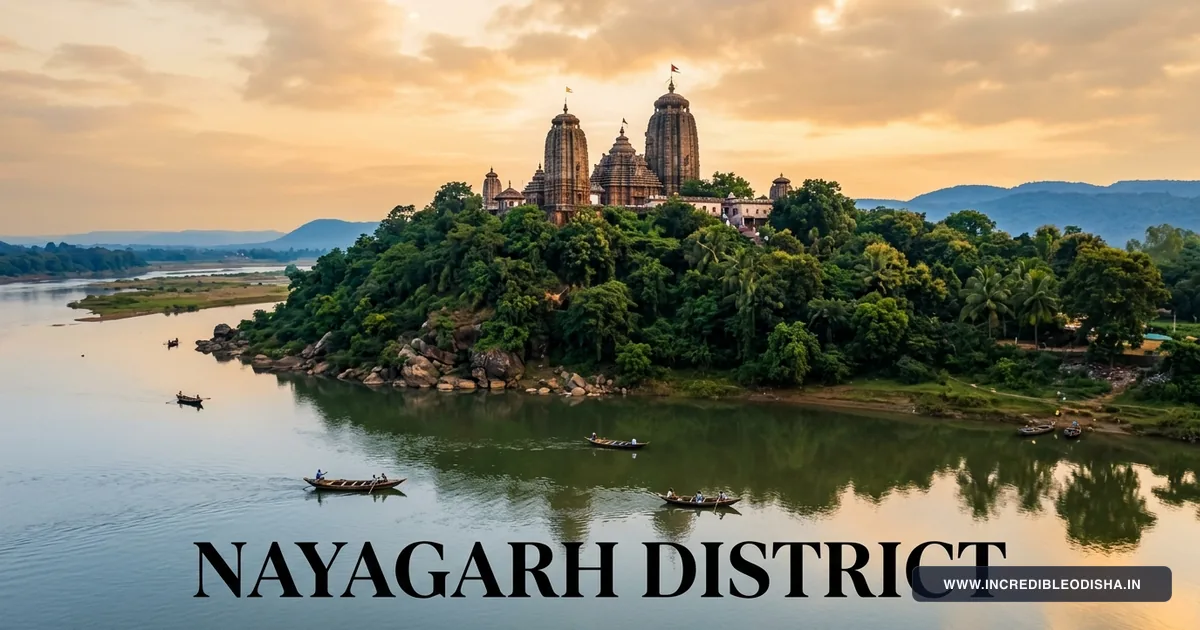
Perched on the rocky Brahmadri hill beside the Mahanadi River, the Kantilo Nilamadhab Temple represents an ancient sanctuary. Tribal king Viswavasu originally worshipped Lord Jagannath here in the form of Nilamadhab. When minister Vidyapati arrived to locate the deity, the blue stone dissolved, preceding the manifestation of Daru Brahma in coastal Puri District Jagannath pilgrimage center.
The present stone temple displays mature Kalinga architectural features, including an elevated sanctum, carved dancing hall, and broad stone stairs leading to the riverbank. Pilgrims take ceremonial baths in the Mahanadi before climbing the shady terrace to offer prayers. The summit offers sweeping vistas over broad sandbanks and passing fishing skiffs.
The shrine serves as an active center of community worship and daily Annadan hospitality. In neighboring lanes, traditional workshops hum with metalworkers crafting bell-metal dining sets. The temple draws massive gatherings during Magha Saptami, when pilgrims camp on the sandy river flats.
Odagaon Raghunath Jew Temple
Situated twenty-six kilometers south of Nayagarh town, Odagaon Raghunath Jew Temple ranks as Odisha’s foremost sanctuary dedicated to Lord Rama. Constructed around the turn of the twentieth century by the local royal court, the temple features a magnificent stone tower crowned by a gleaming gold-plated kalash.
The inner sanctum enshrines finely sculpted black stone deities of Lord Rama, Mata Sita, and Lakshmana carrying golden bows. The temple becomes the focus of massive celebrations during the annual Ramanavami festival. For nine continuous days, street theater troupes perform episodes from the Ramayana, accompanied by musical recitals and community feasts.
Sarankul Ladubaba Temple
Located fourteen kilometers from the district headquarters on the road to Odagaon, Sarankul houses the ancient temple of Lord Ladukeswar, affectionately known as Ladubaba. This sacred shrine functions as a Harihara peetha where devotees worship Lord Shiva and Lord Vishnu as a unified divine presence.
The central stone linga rests inside a low water-filled basin, where servitors perform traditional evening ablutions with milk and fresh bilva foliage. During Maha Shivratri, over two hundred thousand devotees assemble in the temple courtyard. Pilgrims fast through the night to witness the midnight raising of the sacred Mahadipa lamp atop the temple shikhara.
Ranpur Maninag Temple and Royal Palace
Ranpur town is situated beneath the wooded slopes of the Maninag hill, twenty-eight kilometers east of Nayagarh. At the hilltop sits the shrine of Maa Maninag, the ancient protective deity of the Ranpur royal house. Visitors climb winding stone steps through leafy woodland to reach the ridge, which commands wide panoramas across the countryside toward Chilika Lake.
At the foot of the hill stands the imposing brick and stone palace of the Ranpur rulers, beside an ornate Jagannath temple with its own annual car festival. Visitors can explore the town square where martyrs Raghu and Dibakar launched their historic resistance, commemorated by bronze memorials and civic parks.
Kuanria Dam and Deer Park
Located near Dasapalla on the Brutang river system, Kuanria Dam forms an expansive freshwater reservoir bordered by wooded hills and teak plantations. During the winter months from November to February, the lake attracts numerous migratory birds, including whistling ducks and bar-headed geese.
Adjoining the reservoir is an eco-park and deer rehabilitation center managed by the forest department. Spotted deer and sambar wander through spacious forest enclosures shaded by mature sal trees. Families frequent the complex for weekend outings, paddle boating, and calm woodland strolls.
Gokulananda Tourism Complex
Positioned on a high bluff overlooking a horseshoe bend of the Mahanadi River at Sidhamula, Gokulananda offers spectacular landscape panoramas. The site features a shrine dedicated to Lord Krishna, stone viewing gazebos, and shaded pathways set beneath old banyan trees.
Photographers visit during early morning hours to capture golden sunlight reflecting across the misty river waters. The local administration has added stone benches, solar lights, and covered rest shelters for motorists traveling along the riverside highway.
| Destination | Distance from HQ | Primary Attraction | Recommended Visiting Window |
|---|---|---|---|
| Kantilo Nilamadhab | 33 km (Khandapada) | Nilamadhab shrine, Mahanadi riverfront | October to March |
| Odagaon Raghunath Jew | 26 km (Odagaon) | Lord Rama temple, Gold Kalash tower | October to April (Ramanavami) |
| Sarankul Ladubaba | 14 km (Sarankul) | Harihara Shaivite linga, Maha Shivratri | November to March |
| Ranpur Maninag Hill | 28 km (Ranpur) | Hilltop temple, Royal palace, Freedom memorial | October to February |
| Kuanria Eco-Park | 45 km (Dasapalla) | Irrigation lake, Deer sanctuary, Birdwatching | November to February |
| Gokulananda Bluff | 42 km (Sidhamula) | River bend panorama, Krishna temple | October to March |
| Mahavir Kshetra | 3 km (Nayagarh) | Tall Hanuman sculpture, Hilltop viewpoint | October to March |
Ecological Wonders: Baisipalli Wildlife Sanctuary and Satkosia Gorge Southern Flank
Nayagarh preserves vital wilderness habitats that anchor wildlife corridors in central Odisha. The most significant among these is the Baisipalli Wildlife Sanctuary, established by official notification in May 1981 across 168.35 square kilometers of rugged terrain in Dasapalla block.
The sanctuary takes its name from the twenty-two ancestral tribal settlements scattered across its hills. Baisipalli lines the southern embankment of the Mahanadi River where the river carves through the thirty-kilometer Satkosia gorge. The reserve adjoins the Satkosia Tiger Reserve across the water and links southward with the forests of Kandhamal District highland plateau.
Mixed dry deciduous forests, sal, teak, and riverine bamboo clumps cover the sanctuary’s hills. Perennial forest streams wind through rocky gullies to feed the Mahanadi and Brutang rivers. These undisturbed tracts provide shelter for Asian elephants, leopards, sloth bears, spotted deer, barking deer, four-horned antelopes, and wild boars.
Deep, sheltered river pools flanked by quartzite walls support rare aquatic fauna, including breeding populations of mugger crocodiles and endangered gharials. Birdwatchers have identified more than two hundred avian species, including Malabar pied hornbills, crested serpent eagles, and Indian paradise flycatchers.
The forest department maintains eco-tourism cottages and guided nature camps in peripheral zones like Chhamundia and Kuanria. These small eco-resorts offer travelers guided jungle treks, bird observation, and cultural interactions that generate sustainable income for local tribal households.
Agriculture, Forest Economy and River Basins
The economy of Nayagarh rests upon crop farming, agro-forestry, and minor forest produce gathering. Over seventy percent of working families rely on agriculture for their livelihood. Deep alluvial soils in the Mahanadi, Brutang, and Dahuka river valleys support multi-crop rotations, while upland red soils yield robust pulses and oilseeds.
Paddy represents the chief agricultural crop across both autumn and spring farming cycles. Dependable water from the Kuanria Irrigation Project, the Brutang reservoir, and hundreds of minor lift-irrigation stations has stabilized crop yields across thousands of cultivated hectares.
Sugarcane farming flourishes across Odagaon, Nayagarh, and Nuagaon blocks, benefiting from fertile soils and experienced growers. Harvested cane feeds small-scale jaggery units that produce unrefined brown sugar cubes and liquid molasses sold throughout state markets.
Commercial horticulture has grown significantly in recent years. Farmers cultivate mango orchards, guava, green vegetables, and high-yielding cashew plantations across rolling lands in Ranpur and Khandapada. Minor forest produce collected by forest-fringe communities includes sal leaves, tendu leaves, wild honey, and medicinal herbs gathered from the slopes of Baisipalli.
Handloom, Brass Metal Crafts and Rural Artisan Traditions
Nayagarh preserves historic artisan clusters that have sustained multigenerational families for centuries. Foremost among these cottage trades is the famous bell-metal and brass craft of Kantilo, known as Kansa-Pitala Karigari.
Metalworkers from the hereditary Kansari community melt bronze alloys of copper and tin in clay furnaces. Working in coordinated groups of four to six craftsmen, they forge glowing metal ingots on heavy stone anvils using iron sledges. They produce traditional dinner plates, water ewers, bowls, and temple lamps valued for their golden gleam, resonant sound, and durability.
In Khandapada and Nayagarh town, skilled woodcarvers fashion traditional painted toys, miniature wooden chariots, and folk masks from lightweight gambhari timber. Artisans apply bright mineral paints to depict epic heroes and local animals.
Weaving hamlets in Ranpur and Nuagaon produce soft cotton dhotis, towels, and lightweight sarees on traditional pit looms. In forest villages, women press fallen sal leaves into sturdy dining plates and utility containers that serve catering needs throughout coastal Odisha.
| Craft Line | Principal Manufacturing Hub | Finished Goods | Primary Raw Materials |
|---|---|---|---|
| Kansa-Pitala (Bell Metal) | Kantilo (Khandapada Block) | Plates, Bowls, Tumblers, Deepa | Copper, Tin Alloy, Hardwood Charcoal |
| Traditional Brassware | Kantilo, Khandapada | Puja Vessels, Gadas, Temple Bells | Brass Sheets, Foundry Scrap |
| Wood Carving & Toys | Khandapada, Daspalla | Folk Animal Figures, Divine Idols | Gambhari Timber, Mineral Paints |
| Cotton Handloom Weaving | Ranpur, Nuagaon | Cotton Sarees, Gamuchhas, Chadars | Cotton Yarn, Vegetable Dyes |
| Sal Leaf Utensils | Dasapalla, Gania | Disposable Dinner Plates, Bowls | Dry Sal Leaves, Cotton Thread |
| Bamboo Crafts | Odagaon, Ranpur | Storage Baskets, Winnowing Trays | Green Bamboo Reeds, Natural Twine |
Cultural Heritage, Danda Nata and Temple Festivals
Cultural life in Nayagarh finds vivid expression in dramatic folk dances, royal carnivals, and ancient seasonal rituals. These performances blend classical Hindu temple rites with rural folklore and communal celebrations.
Danda Nata Festival
Nayagarh is recognized as a major center for Danda Nata, an ancient penance ritual dedicated to Goddess Kali and Lord Shiva held during the summer heat of April. Devotees, called Danduas, observe strict twenty-one-day vows, daily fasting, and rigorous physical penances.
The performances unfold across three distinct stages. The Dhuli Danda features acrobatic yogic postures executed on hot ground beneath the midday sun. The Pani Danda takes place in village tanks where performers dance submerged in water. The Agni Danda ends at midnight with fire-walking over glowing charcoal embers to the rhythm of traditional drums.
Mahavir Lanka Podi Festival of Dasapalla
Observed with great theatrical flair in Dasapalla town, the Lanka Podi Yatra begins on Ramanavami and runs for over two weeks. This festival stages dramatic episodes from the Ramayana, centering on Lord Hanuman setting fire to Ravana’s citadel of Lanka.
Local craftspeople build towering effigies of Ravana and Kumbhakarna loaded with fireworks. Performers depicting Hanuman rush through the market carrying flaming torches while musicians play energetic rhythms on heavy drums. Crowds travel from across the region to watch the spectacular burning of the Lanka fort on the festival’s final night.
Magha Saptami at Kantilo
On the seventh day of the bright fortnight in the month of Magha, thousands of pilgrims travel to the banks of the Mahanadi at Kantilo. Worshippers take dawn purification dips in the river before ascending Brahmadri hill to pray at the Nilamadhab shrine. A large open-air fair spreads along the riverbanks, offering sweet stalls, folk music performances, and brassware stalls.
Culinary Heritage: The Epic Story of Chhena Poda and Traditional Sweets
Nayagarh holds an illustrious position in Indian culinary heritage as the undisputed birthplace of Chhena Poda, Odisha’s celebrated baked sweetmeat. The name literally means “baked cheese,” describing fresh cottage cheese caramelized over hours in a charcoal hearth.
The invention of this famous dessert took place in 1947 in the town of Dasapalla. A confectioner named Sudarshan Sahu ran a small tea and sweets shop in the bazaar. Finding a surplus of fresh cottage cheese at closing time, Sahu mixed the cheese with coarse sugar, cardamom, and semolina, wrapped the batch in sal leaves, and left it overnight in his cooling charcoal hearth.
The following morning, Sahu uncovered a dessert with a deep golden caramelized crust and a moist, smoky interior. The baked treat quickly gained passionate local popularity. In later decades, prominent leaders like former Chief Minister Biju Patnaik regularly ordered fresh Dasapalla Chhena Poda for state receptions, helping establish the dessert as a symbol of Odia culinary art across India.
Beyond Chhena Poda, Nayagarh sweetmakers craft an assortment of delicious milk confections. Confectioneries in Nayagarh town and Odagaon produce soft Chhena Gaja, golden Rasabali, and syrupy Khira Gaja. During agrarian holidays, households bake traditional Poda Pitha, seasoned with crushed black pepper, ginger, and grated coconut.
Transportation Logistics, Highway Corridors and Rail Connectivity
Nayagarh features dependable road and rail links, serving as an accessible transport corridor between the coastal plains and western districts. A network of national highways, state routes, and newly built rail lines facilitates smooth year-round travel.
Highway Networks
National Highway 57 (NH-57) functions as the central road artery through Nayagarh district. Originating near Khordha on the Golden Quadrilateral, it passes through Nayagarh town, Nuagaon, and Dasapalla before continuing toward Boudh and Balangir. This four-lane highway lets travelers complete the 85-kilometer drive from Bhubaneswar to Nayagarh in about two hours.
State Highway 1 (SH-1) connects the district through Odagaon and Sarankul, offering direct links southward toward Aska and Berhampur. Secondary paved roads connect Khandapada and Kantilo with the Banki-Sidhamula highway, crossing the Mahanadi valley toward Cuttack District downstream delta gateway.
Rail Connectivity
Nayagarh is served by the ongoing Khurda Road to Balangir broad-gauge railway project. Nayagarh Town Railway Station operates regular passenger services connecting the district with Bhubaneswar, Khurda Road Junction, and Puri.
Construction on this rail line continues westward through Dasapalla and Boudh, connecting inland western valleys directly with coastal ports and industrial corridors. Khurda Road Junction, seventy kilometers to the east, provides comprehensive train links to Kolkata, Chennai, Mumbai, and New Delhi.
Air and Local Transit
Biju Patnaik International Airport in Bhubaneswar, eighty-five kilometers away, is the closest commercial airport, offering frequent daily flights to all major Indian cities. Within Nayagarh, local transit relies on auto-rickshaws, shared taxis, and regular bus services operated by the Odisha State Road Transport Corporation from the main municipal bus terminal.
Curated Travel Itineraries for Nayagarh
Because Nayagarh combines ancient temples, forest sanctuaries, and historic crafts, organized itineraries help visitors make the most of their journey. Here are three recommended travel plans designed for different lengths of stay.
1-Day Spiritual Heritage Circuit: Kantilo and Odagaon
- Morning (07:30 AM – 11:30 AM): Drive from Bhubaneswar along NH-57 to Kantilo Nilamadhab Temple on Brahmadri hill. Stroll beside the Mahanadi River, attend morning prayers, and visit the bell-metal craft workshops in Kantilo village.
- Midday (12:00 PM – 02:30 PM): Continue to Nayagarh town for a traditional Odia lunch with fresh seasonal vegetable curries and warm Chhena Poda from a local sweet shop.
- Afternoon (03:00 PM – 05:30 PM): Travel to Sarankul to visit the historic Harihara shrine of Ladubaba, then drive south to Odagaon Raghunath Jew Temple to admire the gold-plated kalash and join the evening arati.
- Evening (06:00 PM onwards): Return to Bhubaneswar or stay overnight in Nayagarh town.
2-Day Complete Heritage and Nature Tour
- Day 1: Royal Legacy and Sacred Shrines
- Morning: Travel from Bhubaneswar to Ranpur. Climb the stone steps of Maninag hill to visit the summit temple, then tour the royal palace below.
- Afternoon: Visit Sarankul Ladubaba temple and Odagaon Raghunath Jew temple, then check into your hotel in Nayagarh town.
- Evening: Walk up to Mahavir Kshetra on the town outskirts to see the colossal Hanuman sculpture and enjoy panoramic views of the sunset.
- Day 2: River Panoramas, Crafts and Forest Parks
- Morning: Drive to Kantilo to explore the Nilamadhab shrine and watch artisans hammer bronze vessels in village forges.
- Afternoon: Follow scenic riverside roads to Sidhamula to visit the Gokulananda bluff for photography, then continue to Dasapalla to visit Kuanria Dam and Deer Park.
- Evening: Sample warm, freshly baked Chhena Poda in the original confectionery market of Dasapalla before heading back.
3-Day Eco-Wildlife and Cultural Expedition
- Day 1: Explore the southern temple circuit through Ranpur, Sarankul, and Odagaon, staying overnight in Nayagarh town.
- Day 2: Drive west along NH-57 into the forested hills of Dasapalla and check into eco-cottages at Chhamundia or Kuanria. Join an afternoon guided forest walk along the edges of Baisipalli Wildlife Sanctuary to spot elephants, deer, and hornbills.
- Day 3: Take an early morning boat trip near the southern entrance of the Satkosia gorge to observe river birds and basking crocodiles. Visit local woodcraft workshops in Dasapalla before returning home via Kantilo.
Accommodation, Guest Houses and Visitor Advisory
Nayagarh provides several accommodation choices suited to pilgrims, vacationers, and eco-tourists. While luxury hotels are concentrated in nearby Bhubaneswar, the district offers clean budget hotels, government inspection bungalows, and rustic forest lodges.
In Nayagarh town, comfortable private hotels and lodges are located along College Road and near the New Bus Stand. These properties provide air-conditioned rooms, vegetarian dining, and local sightseeing arrangements.
Government circuit houses and inspection bungalows run by the Works, Water Resources, and Forest departments offer clean lodging in Nayagarh, Dasapalla, Kantilo, and Odagaon. Visitors planning to stay in government resthouses should request reservations in advance through the District Collectorate.
Eco-travelers can book comfortable forest cottages at Chhamundia and Kuanria through the state eco-tourism portal. These nature camps include meals, basic amenities, and guided nature walks led by local community members.
| Accommodation Type | Notable Options | Best Suited For | Reservation Method |
|---|---|---|---|
| Town Hotels | Hotel Royal Nayagarh, Hotel Green Park, Highway Stays | Families, Business Visitors | Walk-in / Travel Portals |
| Eco-Nature Camps | Chhamundia Nature Camp, Kuanria Forest Cottage | Nature Lovers, Wildlife Trekkers | Odisha Eco-Tourism Portal |
| Government Bungalows | Nayagarh Circuit House, Dasapalla Irrigation IB | Researchers, Visiting Officials | Sub-Divisional Officer / Collectorate |
| Temple Rest Houses | Kantilo Nilamadhab Yatri Nivas, Odagaon Trust Lodge | Pilgrims, Budget Travelers | Temple Trust Office |
Seasonal Weather Guide and Travel Tips
The most pleasant period to visit Nayagarh runs from October through March, when dry weather and cool breezes prevail across both river valleys and forested hills. Daytime temperatures stay between 20°C and 28°C, while winter evenings drop to around 12°C.
Summers from April through mid-June bring intense heat, with daytime temperatures often climbing above 42°C in rocky inland basins. If traveling in summer, plan temple visits during early morning or twilight hours and carry ample water.
The southwest monsoon from mid-June to September brings heavy rains that feed local streams, filling lakes and turning the countryside deep green. Forest roads inside Baisipalli can turn slippery, so four-wheel-drive or high-clearance vehicles are recommended on unpaved routes.
Healthcare, Educational Institutions and Civic Infrastructure
Civic infrastructure in Nayagarh has expanded steadily in recent years, providing reliable public services for residents and visitors alike.
The District Headquarters Hospital in Nayagarh town serves as the principal public medical facility, offering emergency trauma units, maternity wards, intensive care, and diagnostic laboratories. Community Health Centres operate in block centers including Odagaon, Khandapada, Ranpur, and Dasapalla, backed by state ambulance services accessible via telephone hotlines 108 and 102.
The district has a strong tradition of public education. Established institutions include Nayagarh Autonomous College, founded in 1961, and Ranpur College, alongside government polytechnic institutes and training schools. The Pathani Samanta Science Center in Khandapada honors the native astronomer and encourages scientific learning among regional youth.
Power supply is managed through the state electricity distribution grid, while drinking water reaches urban wards and village centers via piped water projects. High-speed mobile network coverage from major national carriers extends across all towns, highway corridors, and tourist centers.
Eco-Tourism Prospects, Heritage Protection and Sustainable Future
As Nayagarh balances modernization with environmental conservation, planners are prioritizing sustainable tourism, artisan support, and the preservation of historic monuments. The district is well positioned to become an eco-tourism destination connecting the coastal pilgrimage circuit with western wildlife sanctuaries.
State authorities have taken active steps to protect historical temples. The State Archaeology Department and local temple committees are restoring stone facades, ancient carvings, and river ghats at Kantilo and Odagaon to shield them from natural weathering.
In the artisan sector, village cooperatives are helping bell-metal workers in Kantilo acquire modern smelting facilities, protective gear, and broader exhibition opportunities. Efforts to secure Geographical Indication registration for Dasapalla Chhena Poda will help protect traditional dairy farmers and sweetmakers against commercial imitations.
Community forest protection committees patrol Baisipalli Wildlife Sanctuary to deter poaching and forest fires. By directing eco-tourism earnings into tribal village development funds, Nayagarh shows how conservation and cultural tourism can support local communities.
Frequently Asked Questions About Nayagarh District
Why is Kantilo Nilamadhab Temple historically significant to Lord Jagannath worship?
Kantilo Nilamadhab Temple on the banks of the Mahanadi River is revered as the original sacred site where the tribal king Viswavasu worshipped Lord Jagannath in the form of Nilamadhab. According to ancient temple chronicles, King Indradyumna dispatched the Brahmin minister Vidyapati to locate this sacred hill before the divine log journeyed downriver to Puri.
Where and how did the iconic Odia dessert Chhena Poda originate?
Chhena Poda originated in 1947 in Daspalla when local confectioner Sudarshan Sahu accidentally left sweetened fresh cottage cheese, sugar, and cardamom in a cooling wood-fired hearth wrapped in sal leaves overnight. The resulting caramelized crust and moist, smoky core created Odisha’s signature baked sweetmeat that now holds nationwide renown.
What wildlife species can travelers encounter in Baisipalli Wildlife Sanctuary?
Spanning 168.35 square kilometers on the southern bank of the Mahanadi River gorge, Baisipalli Wildlife Sanctuary protects elephants, leopards, spotted deer, barking deer, and Indian giant squirrels. The sanctuary also safeguards nesting habitats for mugger crocodiles and gharials in the adjacent river pools.
What was the historic contribution of Pathani Samanta to Nayagarh’s heritage?
Born in the Khandapada princely state of Nayagarh, Mahamahopadhyaya Samanta Chandra Sekhar Simha, popularly known as Pathani Samanta, was an exceptional naked-eye astronomer who charted celestial orbits using simple bamboo instruments. His magnum opus Siddhanta Darpana precisely measured planetary movements and traditional Hindu lunar calendar cycles without modern optical telescopes.
How can travelers travel to Nayagarh from Bhubaneswar?
Nayagarh town is located approximately 85 kilometers west of Bhubaneswar and can be reached in less than two hours via National Highway 57 or State Highway 1. Regular passenger trains and daily express buses operate continuously between Bhubaneswar railway station, Baramunda bus terminal, and Nayagarh.
Conclusion and Regional Travel Synthesis
Nayagarh district stands as a memorable crossroads of sacred heritage, natural reserves, and culinary artistry. From the riverside heights of Kantilo Nilamadhab to Baisipalli and Daspalla, the district offers an enriching travel circuit. Visitors exploring its shrines and forests discover an authentic slice of central Odisha.