Charisambhu Temple Gandharadi Boudh: Twin Shrines & Guide
Explore Charisambhu Temple Gandharadi Boudh. Discover the 9th-century twin temples of Siddheswar and Nilamadhaba, history, architecture, and visitor tips.
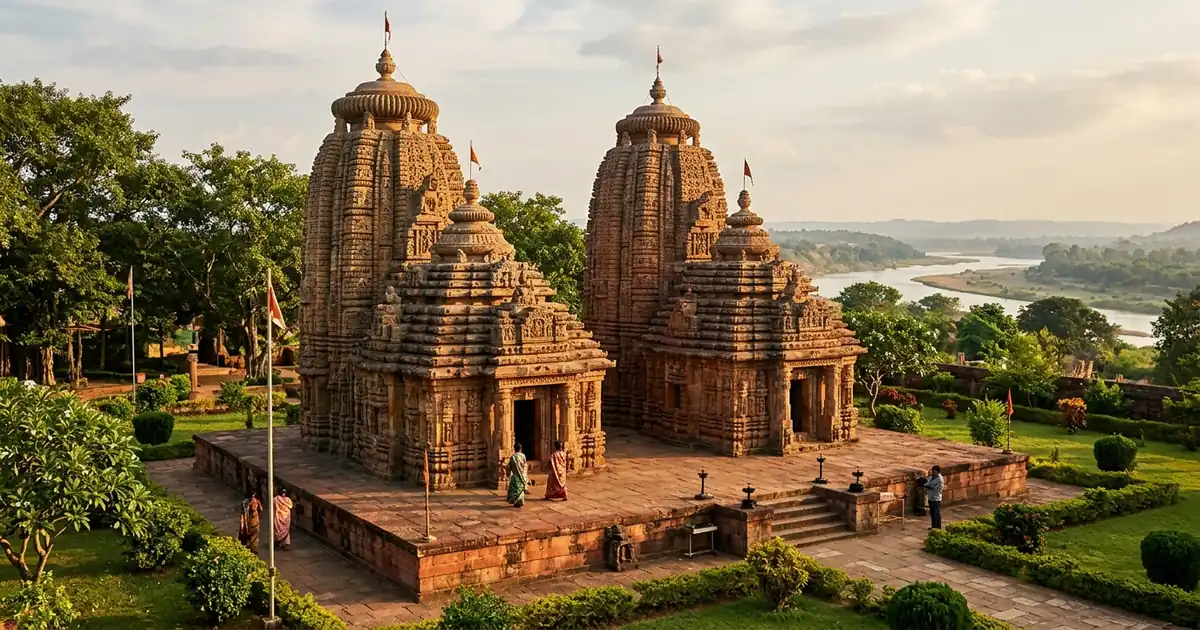
Charisambhu Temple Gandharadi Boudh stands as one of the most remarkable architectural achievements in medieval Indian temple design. Located near Jagati village along the tranquil southern bank of the Mahanadi River within Boudh district travel guide, this protected national monument features twin sandstone temples standing side-by-side on a single elevated terrace. Scholars and heritage travelers also celebrate the site under the name Gandharadi twin temples Boudh.
What makes this sacred complex extraordinary is its harmonious balance of two major Hindu traditions. The southern shrine is dedicated to Lord Siddheswar, embodying Lord Shiva, while the northern shrine venerates Lord Nilamadhaba, embodying Lord Vishnu. This unified sanctuary represents an enduring symbol among the sacred famous temples in Odisha.
Key Takeaways
- Rare Twin Architecture: Two identical 9th-century Kalinga-style sandstone deulas standing side-by-side on a shared stone terrace.
- Unified Harihara Worship: Dedicates one shrine to Lord Siddheswar (Shiva) and the adjacent twin shrine to Lord Nilamadhaba (Vishnu).
- Bhanja Dynasty Legacy: Constructed during the Khinjali Mandala era, predating the famous medieval temple boom of Bhubaneswar.
- Protected ASI Monument: Preserved by the Archaeological Survey of India with free daylight public admission and landscaped lawns.
- Easy Road Access: Situated sixteen kilometers northwest of Boudh town along the scenic highway corridor connecting to Sonepur.
Charisambhu Temple Gandharadi Boudh at a Glance
Travelers venturing through central Odisha often overlook the quiet riverside settlements of Boudh, yet Gandharadi preserves some of the finest classical stone masonry in eastern India. The complex is formally designated as an Archaeological Survey of India protected monument, surrounded by neat boundary walls and manicured green lawns.
The two shrines share nearly identical architectural proportions, rising elegantly with graceful curvilinear spires known as rekha deulas. Their warm ochre and reddish sandstone facades reflect the soft light of the surrounding rural landscape, creating an inspiring visual atmosphere for visiting historians and pilgrims.
| Feature | Verified Information | Visitor Notes |
|---|---|---|
| Temple Complex | Gandharadi Twin Temples (Charisambhu) | Dedicated to Lord Siddheswar & Lord Nilamadhaba |
| Geographic Setting | Southern bank of Mahanadi River, near Jagati | 16 km northwest of Boudh town |
| Historical Era | 8th to 9th Century CE | Built under Bhanja kings of Khinjali Mandala |
| Architectural Order | Early Kalinga Style (Triratha Rekha Deula) | Built upon a common raised stone platform |
| Preservation Authority | Archaeological Survey of India (ASI) | Central protected heritage site |
| Entry Ticket | Free admission for all domestic and foreign guests | Open from sunrise to sunset daily |
| Nearest Railhead | Rairakhol Railway Station (RAIR) | 45 km north across the Mahanadi bridge |
The site remains peaceful throughout the day, providing an ideal setting for careful study of ancient sculptural details away from urban rush.
Architectural Marvel: Twin Temples on a Shared Stone Terrace
The engineering layout of Charisambhu Temple Gandharadi Boudh represents an architectural departure from standard Odissan temple planning. In conventional complexes, auxiliary shrines are built at separate courtyard corners. Here, master masons erected two full-fledged rekha temples upon a shared rectangular stone platform known as a jagati.
The southern sanctuary houses Lord Siddheswar in the form of a polished black chlorite Shiva Lingam set within an ancient circular argha. The northern sanctuary enshrines Lord Nilamadhaba, represented by an ornate standing four-armed Vishnu icon holding the conch, mace, lotus, and discus.
Even the finials crowning the spires display unique symbolic choices. Rather than featuring a large metallic trident or wheel, the Siddheswar deula terminates with a miniature stone Shiva Linga set atop its fluted amalaka.
Correspondingly, the spire of the Nilamadhaba deula is crowned by a diminutive stone statuette of Lord Madhaba standing in meditation. This meticulous symmetry illustrates the deliberate theological parity crafted by the ancient architects.
Bhanja Dynasty History and the Khinjali Mandala Legacy
Historical inscriptions and copper plate charters indicate that the Gandharadi temples were commissioned during the reign of Ranabhanja, a prominent monarch of the early Bhanja dynasty. The Bhanjas governed the sovereign kingdom of Khinjali Mandala throughout the 8th and 9th centuries CE, maintaining their political capital at Dhritipura in the upper Mahanadi valley.
The name Charisambhu translates in ancient Odia texts to Four Sambhus or Four Manifestations of Shiva. Regional temple records note that Lord Siddheswar at Gandharadi formed the primary pillar of a sacred Shaivite quadrant across the realm, alongside the related shrines of Jogeshwara, Kapileshwara, and Somnatha.
Simultaneously, the Bhanja royal family held deep reverence for Vaishnavite traditions. By commissioning a magnificent image of Lord Nilamadhaba directly alongside Lord Siddheswar on the same terrace, King Ranabhanja demonstrated state patronage that united distinct spiritual communities.
Scholars link the Nilamadhaba image of Gandharadi to the broader evolution of Jagannath worship across western Odisha, bearing clear iconographic kinship with the celebrated Kantilo Nilamadhaba Temple in Nayagarh.
Intricate Stone Sculptures, Jali Work, and Wall Reliefs
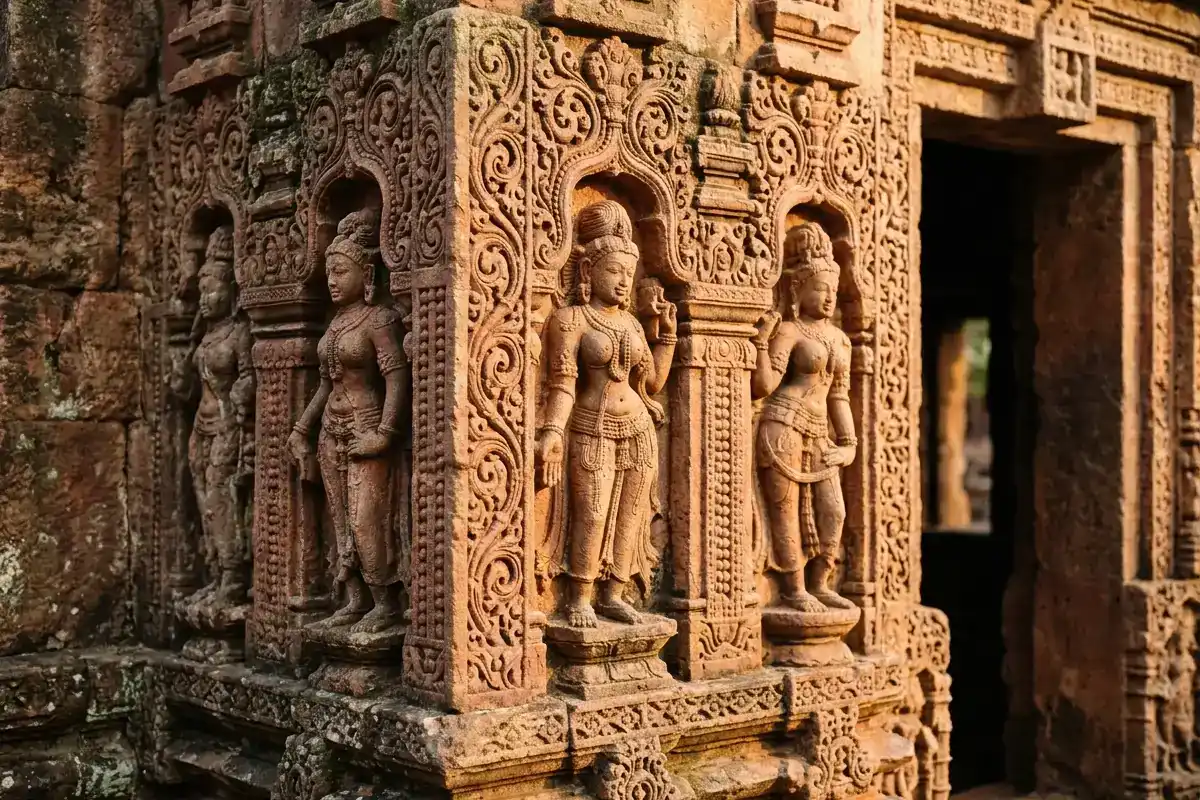
The stone carvings adorning the outer walls of Gandharadi exhibit the refined craftsmanship characteristic of pre-Somavamsi art. The lower bada portions of both shrines are divided into balanced horizontal registers decorated with miniature chaitya motifs, decorative scrollwork, and diamond patterns.
On the jangha niches, visitors can admire graceful female figures known as alasakanyas or nayikas. These sculptures portray women applying vermilion to their foreheads, playing stringed instruments, and adjusting delicate foot ornaments with remarkable natural poise.
| Sculptural Detail | Iconographic Theme | Architectural Position |
|---|---|---|
| Alasakanya Figures | Celestial maidens engaged in daily rituals | Carved pilasters along exterior wall niches |
| Gaja-Simha Reliefs | Rampant lions leaping over recumbent elephants | Projecting wall brackets and cornerstone facets |
| Navagraha Architraves | Nine planetary deities in seated posture | Lintel beam positioned above the sanctum portal |
| Dvarapala Wardens | Armed celestial sentinels flanking the entry | Base panels of the ornate stone door jambs |
| Scrollwork (Kuda) | Foliage tendrils populated by birds and squirrels | Framing bands surrounding window jali screens |
The doorway jambs feature multiple overlapping relief bands embellished with entwined serpents, miniature floral rosettes, and dancing ganas. The master sculptors selected high-quality local red sandstone, allowing sharp chisel details to survive centuries of weathering.
Temple Timings, Daily Rituals, and ASI Visitor Guidelines
Charisambhu Temple Gandharadi operates under the protective stewardship of the Archaeological Survey of India. The outer heritage grounds and monument gates open at 6:00 AM each morning and close at 6:00 PM at dusk.
| Time Window | Activity | Visitor Guideline |
|---|---|---|
| 6:00 AM to 8:30 AM | Dawn arati and local village morning worship | Optimal natural sunlight for architectural photos |
| 8:30 AM to 12:00 PM | General public visits and heritage exploration | Quiet courtyard walks across the raised platform |
| 12:00 PM to 3:00 PM | Midday rest period | Open grounds; bright overhead tropical sun |
| 3:00 PM to 5:30 PM | Afternoon photography and sunset darshan | Warm golden glow illuminates the sandstone facades |
| 6:00 PM | Monument closure | Site gates locked by ASI conservation staff |
There is no entry fee or ticket counter at Gandharadi. Visitors may freely walk across the landscaped garden premises and climb the original stone steps leading onto the terrace.
Personal handheld photography and videography for educational or travel documentation are permitted throughout the open complex. Professional commercial film crews or drone operators must obtain prior formal clearance from the Archaeological Survey of India.
How to Reach Gandharadi from Boudh, Subarnapur, and Bhubaneswar
Gandharadi is located in the northwestern corner of Boudh district, sixteen kilometers from the district headquarters town of Boudh and approximately thirty-two kilometers southeast of Sonepur.
| Starting Location | Distance | Travel Time | Recommended Travel Route |
|---|---|---|---|
| Boudh Town Center | 16 km | 25 minutes | State Highway via Jagati village approach |
| Subarnapur (Sonepur) | 32 km | 45 minutes | National Highway 57 eastward across Tel bridge |
| Rairakhol Railway Station | 45 km | 1 hour | NH-57 southward via Kiakata Mahanadi bridge |
| Phulbani (Kandhamal) | 85 km | 2 hours | SH-1 highway northward through sal forests |
| Bhubaneswar Airport | 240 km | 5 hours | NH-57 westward via Nayagarh and Charichhak |
Transit by Road
National Highway 57 runs close to the site, providing smooth paved connections between western and coastal Odisha. Travelers can easily hire private taxis or auto-rickshaws from the Boudh bus terminal for a round-trip excursion to Gandharadi.
Transit by Rail
Rairakhol Railway Station (RAIR) on the Sambalpur-Bhubaneswar rail line serves as the closest convenient railhead, located forty-five kilometers north. Taxis are available outside the station to cross the Mahanadi River into Boudh.
Transit by Air
Biju Patnaik International Airport in Bhubaneswar (240 km east) offers the closest scheduled flight connectivity. Travelers can reserve a private highway car or travel by express train to Rairakhol. Official regional tour guides are accessible on the Odisha Tourism Portal.
Nearby Heritage Attractions in the Central Valley
A visit to Gandharadi forms an essential component of an unforgettable central Odisha heritage trail. The upper Mahanadi valley preserves a rich cultural legacy of Buddhist, Shaivite, and Shakta monuments.
Star-Shaped Temples of Boudh Town
Located in the heart of Boudh town, three 9th-century Shiva shrines feature unique eight-pointed star ground plans found nowhere else in Odisha. Their intricate geometric projections present rare early medieval creativity.
Colossal Buddha Statues
Boudh served as an influential center of Vajrayana Buddhism from the 7th through 10th centuries. Giant seated stone statues of Lord Buddha in the bhumisparsha mudra survive at Boudh town, Shyamsundarpur, and Pragalapur.
Subarnapur Handloom and Heritage
Located just thirty-two kilometers northwest across the Tel River, Sonepur is known as the temple city of western Odisha and the home of world-famous Bomkai silk handlooms. Plan your onward connection with our Subarnapur district travel guide.
Western Eastern Ghats Circuits
Travelers heading south can ascend into the forested plateaus of Kandhamal district travel guide, or journey northeast into Angul district travel guide and scenic Nayagarh district travel guide.
Practical Travel Tips for Visiting Gandharadi
- Golden Hour Photography: Visit between 3:30 PM and 5:00 PM when the western sun casts deep amber tones across the red sandstone carvings and highlights the delicate alasakanya reliefs.
- Footwear Etiquette: The ASI terrace is regarded by local residents as an active consecrated sanctuary; please remove your shoes at the base steps of the stone platform before walking between the shrines.
- Carry Hydration and Snacks: Gandharadi is a peaceful rural village with limited commercial amenities; carry drinking water and light refreshments from Boudh town.
- Combine with Boudh Town Attractions: Plan a half-day itinerary that includes morning visits to the star-shaped temples in Boudh, lunch at a local Odia dhaba, and an afternoon excursion to Gandharadi.
- Respect Archaeological Masonry: Do not touch or climb upon the fragile exterior friezes or corner pilasters to help preserve this national treasure for future generations.
Frequently Asked Questions
Where is Charisambhu Temple Gandharadi located?
Charisambhu Temple is located in Gandharadi village near Jagati in Boudh district, Odisha. It sits approximately sixteen kilometers northwest of Boudh town along the southern bank of the Mahanadi River.
What makes the Gandharadi temples architecturally unique?
Gandharadi features twin identical 9th-century Kalinga-style stone temples erected side-by-side upon a single raised rectangular terrace. One shrine is dedicated to Lord Shiva (Siddheswar) and the other to Lord Vishnu (Nilamadhaba).
Who built the twin temples of Gandharadi?
The complex was constructed in the 9th century CE during the reign of King Ranabhanja of the early Bhanja dynasty of Khinjali Mandala. The temples demonstrate peaceful royal patronage of both Shaivite and Vaishnavite faiths.
What are the opening timings of the Gandharadi temples?
The monument is maintained by the Archaeological Survey of India and remains open daily from sunrise to sunset (6:00 AM to 6:00 PM). Admission is completely free for all domestic and international travelers.
What are the nearest railway stations to Gandharadi?
Rairakhol Railway Station, located forty-five kilometers north across the Mahanadi bridge, is the most convenient railway station. Sambalpur Junction and Balangir Railway Station also serve the broader western region.
Can visitors take photographs at the temple complex?
Yes, non-commercial photography is permitted throughout the monument grounds and exterior terraces. Commercial video productions and drone operations require prior written authorization from the Archaeological Survey of India.