Subarnapur District: Sonepur Temples, Silk Heritage & Travel Guide
Comprehensive guide to Subarnapur (Sonepur) district in Odisha. Discover the Second Varanasi of India, Sonepuri silk sarees, river confluences, and travel routes.
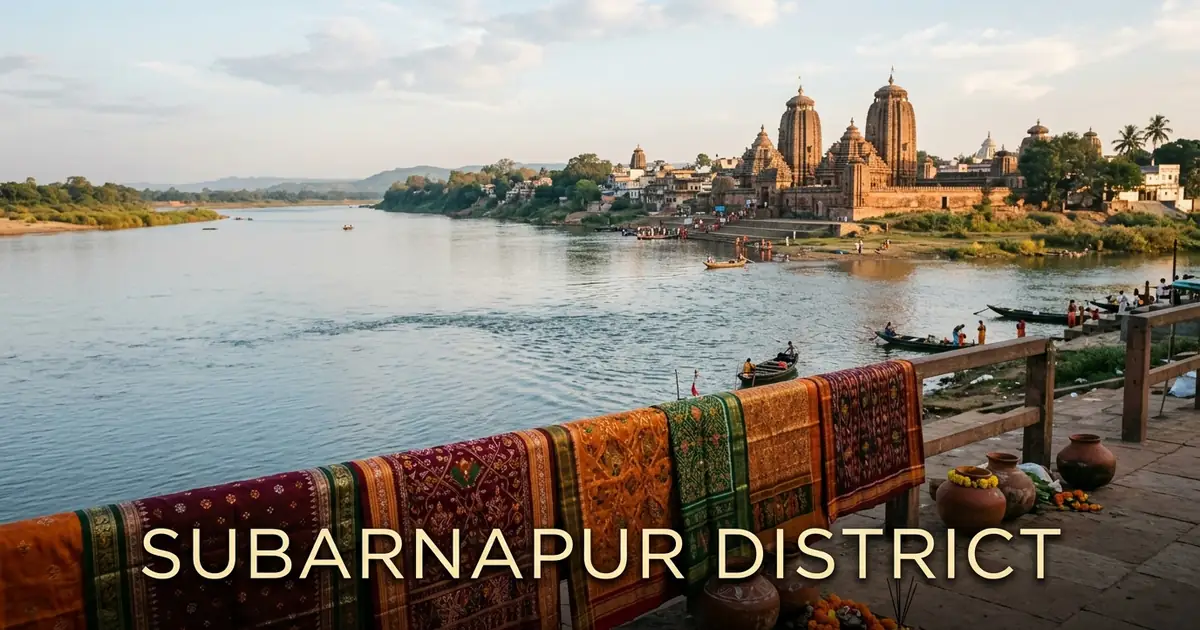
Subarnapur district, traditionally known as Sonepur, occupies a central riverine plateau in western Odisha. Spanning 2,337 square kilometers along the sacred confluence of the Mahanadi and Tel rivers, the territory has long flourished as a celebrated center of classical art, sacred architecture, and textile craftsmanship. The district derives its historic name from Suvarnapura, meaning the Golden City, referencing both its ancient prosperity and its golden river sands.
The spiritual identity of the district has earned it widespread renown as the Second Varanasi of India (Dwitiya Varanasi). With dozens of medieval stone temples lining its sacred riverfronts, the town replicates the spiritual geography of Kashi. Ancient rulers of the Somavamshi, Bhanja, and Chauhan dynasties built magnificent stone shrines dedicated to Shiva, Vishnu, and Tantric mother goddesses.
Alongside its spiritual monuments, Subarnapur is celebrated globally as a primary center of handloom artistry. The district is the birthplace of world-renowned Sonepuri silk sarees, including Bomkai and Pasapalli tie-and-dye textiles, crafted by master weavers whose techniques have been passed down through generations.
Key Takeaways
- Subarnapur covers 2,337 square kilometers across two administrative subdivisions, six community development blocks, and six revenue tehsils.
- The district recorded a population of 610,183 in Census 2011, with a high literacy rate of 74.42 percent and a population density of 261 persons per square kilometer.
- Revered as the Second Varanasi of India, the district headquarters houses historic stone shrines including Suvarnameru, Rameswar Sangam, and Sureswari temples.
- World-famous for GI-tagged Sonepuri Bomkai and Pasapalli handloom silk sarees, the district sustains thousands of traditional master weaver families.
- Landmark attractions include the river confluence at Rameswar, the island shrine of Maa Lankeswari in the Mahanadi River, and the 9th-century Kosaleswar Temple at Baidyanath.
Introduction to Subarnapur: The Golden City of Rivers, Shrines & Silk Looms
Subarnapur is situated in western Odisha, bordered by Sambalpur district to the north, Boudh District ancient star-shaped temple territory to the east, Balangir district to the south and west, and Bargarh district to the northwest. The administrative headquarters is Sonepur town, situated along the direct meeting point of the Mahanadi and Tel rivers.
Historically an integral portion of the undivided Balangir district parent territory, Subarnapur was formally established as an independent revenue district on 27 March 1993. The district spans 2,337 square kilometers, with an average elevation of 121 meters above sea level. This compact, low-lying river valley topography provides rich alluvial soils, dependable irrigation, and scenic riverfront landscapes.
Motor vehicle administration is managed by the Regional Transport Office under the registration code OD-31, headquartered in Sonepur town.
| Geographic Metric | Canonical Statistic | Regional Context |
|---|---|---|
| Total Geographical Area | 2,337 sq km | Compact riverine plain in western Odisha |
| District Headquarters | Sonepur Town | Historic temple city at the Mahanadi-Tel confluence |
| Sub-Divisional Administrative Centers | Sonepur, Birmaharajpur | Twin administrative centers dividing the territory |
| Geographic Coordinates | 20°30’ N – 21°11’ N, 83°27’ E – 84°16’ E | Central Mahanadi river basin and Tel confluence |
| Average Elevation | 121 meters (397 feet) | Fertile alluvial floodplains and low rolling terraces |
| Forest Cover | Approximately 18% of total landmass | Tropical dry deciduous woods and riverine sal groves |
| Motor Vehicle Registration (RTO) | OD-31 | Regional Transport Office, Sonepur |
The climate of Subarnapur is typical of the western Odisha interior, featuring hot summers, a plentiful southwest monsoon, and pleasant winter months. During the peak summer season from April to June, temperatures frequently reach 42°C across the rocky river basins. In contrast, winter months from November through February offer mild days and cool nights, making it the ideal season for travel.
The southwest monsoon delivers an average annual precipitation of roughly 1,418 millimeters between June and September. This rainfall recharges the expansive Mahanadi and Tel river systems, supplying vital water to downstream canals and agricultural fields.
Official administrative announcements, cultural events, and travel updates are documented on the Odisha Tourism Official Portal and district administration archives.
Geographical Landscape, Mahanadi-Tel Confluence & River Basins
The topography of Subarnapur is defined by broad river floodplains, gentle laterite ridges, and fertile alluvial terraces. The central geographical feature of the district is the sacred confluence (sangam) where the mighty Mahanadi River absorbs the Tel River, creating an expansive aquatic expanse framed by granite ledges.
To the northwest, the plains merge with the fertile canal-fed agricultural belt of Bargarh district. To the south, the landscape rises into the rolling agricultural plateaus of Balangir.
The hydrological network of Subarnapur is dominated by two primary interstate rivers and several supporting streams:
- Mahanadi River: The largest river in Odisha, flowing through the heart of the district from north to east, carving deep river gorges and supporting vital inland fisheries.
- Tel River: The principal southern tributary, originating in the Kalahandi hills and joining the Mahanadi at Sonepur after flowing along the southern district boundary.
- Suktel River: A prominent tributary of the Tel that flows through Tarbha block, providing crucial water for seasonal irrigation.
- Harihar Jhor: A regional hill stream in Birmaharajpur block that feeds the Hariharjhor medium irrigation reservoir.
- Papakshya Ghat: A sacred granite rock formation along the Mahanadi at Binka, where natural river eddies create historic bathing pools.
- Lankeswari Gorge: A rocky river gorge in the Mahanadi River near Sonepur, housing a sacred island shrine dedicated to Goddess Lankeswari.
Forest cover accounts for roughly eighteen percent of the district, composed of northern dry deciduous species including Shorea robusta (sal), Madhuca longifolia (mahua), and bamboo thickets.
These woodlands provide seasonal non-timber forest produce, including tendu leaves, mahua flowers, and wild honey that supplement rural agricultural incomes.
Historical Evolution: Somavamshi Golden Age to Princely Sonepur State
The historical heritage of Subarnapur extends back over two millennia, with ancient coins, terracotta figurines, and stone seals confirming continuous royal patronage. Archaeological excavations along the Tel riverbed have yielded punch-marked coins dating to the Mauryan and post-Mauryan eras.
During the early medieval era from the 8th to 10th centuries CE, Sonepur served as a prominent political capital under the Bhanja rulers and later the imperial Somavamshis. Known in copper plate charters as Suvarnapura, it was the ceremonial seat of King Janamejaya I and his successors before their eastward expansion toward coastal Kalinga.
The Somavamshi rulers built magnificent stone shrines dedicated to Shiva and Shakta deities. These royal foundations introduced refined Kalingan temple architecture to western Odisha, shaping the spiritual skyline of the river confluence.
In the 17th century, Sonepur became an independent princely state ruled by a branch of the Chauhan dynasty founded by Raja Madan Gopal Singh, brother of the Maharaja of Sambalpur. The Chauhan rulers maintained royal courts that patronized Sanskrit scholarship, Odia literature, and temple craftsmanship. Sonepur formally merged with the Indian Union in January 1948.
Key historical milestones in Subarnapur’s development include:
- 8th to 10th Century CE: Golden age under Somavamshi kings, establishing Suvarnapura as a major political and architectural center.
- 11th Century CE: Rule of the Telugu Chodas and later the Kalachuris of Ratanpur over the Mahanadi-Tel confluence region.
- 1650 CE: Foundation of the princely state of Sonepur by Chauhan prince Raja Madan Gopal Singh.
- 1857 CE: Participation of local patriots in the western Odisha anti-colonial uprisings supported by Veer Surendra Sai.
- 1948 CE: Integration of the princely state of Sonepur into independent India, initially included within Balangir district.
- 1993 CE: Reorganization of the territory into an independent administrative entity, officially named Subarnapur district on 27 March.
The royal lineage of Sonepur is reflected in the stately Chauhan Palace complex, ancient stone stepwells, and monumental riverside shrines.
Today, preserved copper plate charters, medieval temple friezes, and handloom weaving guilds provide travelers with fascinating cultural insights. A detailed administrative history is preserved on the Subarnapur District Profile.
Administrative Framework: Subdivisions, 6 Blocks, Tehsils & Governance
Subarnapur is governed under the administrative jurisdiction of the Revenue Divisional Commissioner of the Northern Division, stationed at Sambalpur. The Collector and District Magistrate directs executive administration, welfare programs, and infrastructure execution in coordination with the Superintendent of Police.
To ensure efficient public administration across its compact riverine territory, the district is organized into two administrative subdivisions: Sonepur and Birmaharajpur. These subdivisions encompass six community development blocks, six revenue tehsils, and 96 gram panchayats.
Urban civic administration is managed by three urban local bodies that maintain roads, public lighting, sanitation, and municipal health services.
| Administrative Unit | Classification | Key Centers & Geographic Coverage |
|---|---|---|
| Sonepur Subdivision | Administrative Subdivision | Sonepur, Binika, Tarbha, Dunguripali blocks |
| Birmaharajpur Subdivision | Administrative Subdivision | Birmaharajpur, Ullunda blocks across eastern Mahanadi |
| Sonepur Municipality | Urban Local Body (ULB) | District headquarters, commercial hub, and historic temple center |
| Binika NAC | Urban Local Body (ULB) | Northern riverside commercial center on Mahanadi River |
| Tarbha NAC | Urban Local Body (ULB) | Southwestern artisan center famous for brass and bell metal craft |
| Dunguripali Block | Community Development Block | Intensive handloom silk weaving and paddy agricultural center |
| Gram Panchayats | Rural Governance | 96 village clusters coordinating grassroots welfare delivery |
Democratic representation is organized through two legislative assembly constituencies: Sonepur (General) and Birmaharajpur (SC). In Parliament, the district forms an integral portion of the Balangir Lok Sabha constituency.
Decentralized governance has accelerated rural connectivity through new bridges over the Mahanadi and Tel rivers, linking isolated rural hamlets to central grain and textile markets.
Government programs have also modernized silk weaver cooperative facilities, upgraded the district headquarters hospital in Sonepur, and developed dedicated handloom craft villages.
Demographic Profile & Weaver Communities: Census 2011 Analysis
According to the official Census 2011, Subarnapur district has a total population of 610,183 persons, comprising 313,291 males and 296,892 females. The sex ratio stands at 948 females per 1,000 males.
The population density is recorded at 261 persons per square kilometer, reflecting the fertile agricultural soils along river floodplains and the high concentration of rural artisan villages.
A notable strength of Subarnapur is its high literacy rate of 74.42 percent, well above the state average. Male literacy stands at 84.40 percent, while female literacy has advanced to 63.85 percent through sustained public education programs.
| Demographic Metric | Canonical Statistic | Regional Context |
|---|---|---|
| Total Population | 610,183 persons | Compact, culturally rich population in western Odisha |
| Male Population | 313,291 | 51.34% of total district population |
| Female Population | 296,892 | 48.66% of total district population |
| Sex Ratio | 948 females / 1,000 males | Slightly below the southern highland average |
| Population Density | 261 persons per sq km | Dense settlement along fertile riverbanks |
| Overall Literacy Rate | 74.42% | Among the highest literacy rates in western Odisha |
| Scheduled Caste Population | 25.43% (155,170 persons) | Substantial component of rural farming and artisan guilds |
| Scheduled Tribe Population | 9.84% (60,042 persons) | Predominantly Gond and Kandha communities in forest tracts |
The social fabric of Subarnapur is characterized by prominent artisan guilds, particularly the Meher weaver community (Bhulia weavers) who produce traditional handloom silks. These master craftsmen maintain generational knowledge of natural dyeing, tie-and-dye patterns, and pit loom weaving.
Sambalpuri Odia serves as the universal spoken language across all communities, characterized by its melodic intonation, rich folk idioms, and poetic oral literature. Standard Odia is used for administrative governance, literature, and formal schooling.
The cultural identity of the district centers on community devotion, artistic pride, and shared riverfront festivals. Families maintain strong ties to hereditary crafts, preserving centuries-old artistic traditions.
Top Tourist Attractions: Temples of the Second Varanasi
Subarnapur presents an extraordinary collection of ancient stone temples, sacred river confluences, and historic island shrines. Travelers exploring the town find a spiritual landscape rich with architectural elegance and living devotional traditions.
| Attraction Name | Classification | Location | Key Highlights |
|---|---|---|---|
| Suvarnameru Temple | Ancient Shiva Temple | Sonepur Town | Presiding Shaivite shrine near Tel riverbank, gold-coin legend |
| Rameswar Temple & Sangam | River Confluence Shrine | Mahanadi-Tel Sangam | Sacred confluence shrine where Lord Rama consecrated a Shiva linga |
| Sureswari Temple | 10th-Century Shakti Shrine | Sonepur Town | Presiding mother goddess of the town, ancient tantric complex |
| Kosaleswar Temple | 9th-Century Somavamshi Shrine | Baidyanath (14 km) | Intricate stone carvings, early Kalingan architectural masterpiece |
| Lankeswari Island Temple | River Island Shrine | Mahanadi Gorge | Sacred island shrine in deep river currents, protector of boatmen |
| Metakani Temple | Sacred Forest Shrine | Ullunda (25 km) | Revered mother goddess shrine situated inside a dense sal forest |
| Papakshya Ghat & Charisambhu | Sacred River Ghat | Binka (30 km) | Historic bathing ghat on Mahanadi with ancient Shiva shrines |
| Gokarneswar Temple | Riverside Heritage Shrine | Sonepur Town | Ancient Shiva temple on the elevated banks of the Mahanadi |
Suvarnameru Temple: The Jewel of Sonepur
Suvarnameru Temple stands as the foremost spiritual sanctuary of Sonepur. Situated on the left bank of the Tel River near the town center, the temple is dedicated to Lord Shiva as Suvarnameru, the Lord of the Golden Mountain. According to popular legend, Lord Shiva once showered golden coins across this holy ground to test the devotion of an impoverished local devotee.
The stone temple features a classic Rekha deula design with an intricately carved Jagamohana. Devotees gather here in large numbers every Monday and during Maha Shivratri, offering milk and bilva leaves at the sacred linga. The temple courtyard provides a quiet setting overlooking the peaceful river waters. Comprehensive architectural details are documented on the Sonepur Temple Architecture Profile.
Rameswar Temple and the Mahanadi-Tel Sangam
Located at the direct meeting point of the Mahanadi and Tel rivers, Rameswar Temple holds immense spiritual reverence. According to local lore, Lord Rama consecrated the presiding Shiva linga here during his exile, seeking divine guidance before his journey southward.
The temple sits atop an elevated stone platform that withstands seasonal monsoon floods. Devotees from across western Odisha visit the sangam during Kartik Purnima and Maha Shivratri to take sacred dips in the confluence waters. The view of the two mighty rivers merging beneath the temple spires provides a memorable visual experience.
Sureswari Temple: The Presiding Mother Goddess
Sureswari Temple is an ancient Shakti shrine situated near the royal palace grounds in Sonepur. Built originally by the Somavamshi kings in the 10th century and later renovated by the Chauhans, Goddess Sureswari is worshipped as the supreme protective deity of the town.
The goddess is depicted as a fierce multi-armed Mahishasuramardini slaying the demon Mahishasura. The shrine complex features an ancient sacrificial altar and stone sculptures of the Matrikas. During the autumn Durga Puja and Chaitra Navratri, the temple becomes the epicenter of elaborate tantric rituals and cultural festivities.
Kosaleswar Temple at Baidyanath
Located 14 kilometers from Sonepur in the village of Baidyanath, the Kosaleswar Temple is an architectural masterpiece of the early Somavamshi era. Built around the 9th century CE along the Tel riverbank, the temple displays refined stone carvings that rival early temple art in Bhubaneswar.
The temple is celebrated for its exquisitely sculpted doorframes, displaying depictions of celestial nymphs, mythological guardians, and intricate floral scrolls. The sanctum preserves a revered Shiva linga surrounded by beautifully preserved stone sculptures of Kartikeya and Ganesha.
Lankeswari Island Temple in the Mahanadi
Perched on a rocky island outcrop in the middle of the Mahanadi River gorge, the Lankeswari Temple is one of Odisha’s most unusual shrines. Worshipped as an ancient guardian goddess of river currents, boatmen and fishermen visit the shrine to pray for safe passage through treacherous river eddies.
Visitors reach the island via motorized country boats from the riverbank ghats of Sonepur. The ride across the open river offers wide panoramic views of the temple-studded skyline of Sonepur and the distant river hills.
River Confluence, Hydrology & Mahanadi Island Shrines
The hydrological character of Subarnapur is shaped by the convergence of the Mahanadi and Tel rivers. This confluence forms one of the largest river intersections in peninsular India, creating wide floodplains, rich fishing zones, and dramatic river landscapes.
Upstream along the Mahanadi, the river flows through deep rocky gorges that connect with the historic water corridors of Sambalpur district. At Sonepur, the river expands to over a kilometer in width, moving peacefully past ancient stone ghats.
The seasonal behavior of the rivers influences local life throughout the year. During the monsoon months from July to September, heavy rains in central India swell the rivers into wide sheets of water, requiring sturdy stone embankments along town ghats. In winter and summer, the waters recede, exposing broad sandy flats where farmers grow seasonal watermelons and peanuts.
The river ecosystem supports healthy populations of freshwater fish, including rohu, catla, and large river prawns. Migratory waterfowl, such as brahminy ducks, cormorants, and river terns, gather on the sandy shoals throughout the winter months, offering rewarding birdwatching opportunities.
Agriculture, Canal Irrigation & River Valley Harvests
Agriculture is the principal economic foundation of Subarnapur, supporting over sixty-five percent of the district’s working population. The confluence of major rivers provides rich alluvial topsoil and extensive surface water irrigation.
The district has benefited significantly from the Hirakud Dam canal network, which irrigates agricultural farmlands in Dunguripali and Binika blocks. Additional irrigation is provided by the Hariharjhor medium irrigation project in Birmaharajpur and numerous river lift irrigation schemes along the Tel and Mahanadi rivers.
| Agricultural Commodity | Farming System | Economic Impact & Market Role |
|---|---|---|
| Kharif & Rabi Paddy | Canal & lift-irrigated alluvial | High-yield double-crop rice production feeding state reserves |
| Commercial Sugarcane | River valley furrow irrigation | Feedstock for regional sugar processing and jaggery mills |
| Riverbed Vegetables | Sandbar seasonal farming | High-volume watermelon, cucumber, and vegetable harvests |
| Pulses (Moong & Biri) | Post-paddy residual moisture | Essential cash crops providing dietary protein and soil nitrogen |
| Oilseeds (Mustard & Groundnut) | Winter irrigated cropping | High-grade oilseed production traded through regional mandis |
| Inland Freshwater Fisheries | River & reservoir aquaculture | Abundant supply of sweetwater river fish distributed regionally |
Intensive double-crop paddy farming has established Dunguripali as a major grain center in western Odisha. Sugarcane is another valuable cash crop, grown widely across river valley fields to supply regional sugar mills and rural jaggery production units.
During the dry summer months, local farmers cultivate wide sandbars along the receding Mahanadi riverbed. These temporary plots produce large harvests of sweet watermelons, muskmelons, and fresh green vegetables that supply regional markets.
Sonepuri Silk Handlooms, Tarbha Bell Metal & Artisan Economy
Subarnapur is renowned worldwide as a celebrated center of traditional handloom weaving and metal craftsmanship. The district’s artisan economy represents a remarkable marriage of ancient technical skill and refined artistic expression.
The signature artistic achievement of the district is the Sonepuri handloom silk saree, celebrated globally under the Geographical Indication (GI) registration for Bomkai and Sambalpuri textiles. Weaving villages like Sagarpali, Kendupali, and Dunguripali are home to thousands of master weavers from the Bhulia community.
Working on traditional pit looms, artisans produce intricate extra-weft and extra-warp designs that incorporate fish motifs, lotus flowers, and temple spires. Comprehensive technical details are preserved on the Bomkai Handloom Overview.
In Tarbha block, traditional Kansari metal artisans practice hand-hammered brass and bell metal craft (Kansa). Craftsmen heat and shape bronze alloys on open charcoal hearths, producing durable dining plates, water pots, and ceremonial temple bells known for their resonant acoustic clarity.
Terracotta artisans in Sonepur town produce artistic pottery, animal figurines, and clay roof tiles decorated with traditional motifs. Weavers and craft cooperatives work through the state government’s Utkalika and Boyanika networks to market these creations, ensuring sustainable incomes for thousands of artisan families.
Folk Culture, Sambalpuri Music & Religious Festivals
The cultural identity of Subarnapur is steeped in the expressive folk traditions of western Odisha. The district is a major center for Sambalpuri music, folk dance, and seasonal religious festivals.
A highlight of the regional folk heritage is the Dalkhai dance, performed by young women during Dussehra and the autumn harvest season. Dressed in handwoven Sambalpuri sarees, performers dance to the rhythmic accompaniment of the Dhol, Nishan, Tasa, and Mahuri instruments. Other popular folk performances include the energetic Rasarkeli, Jaiphula, and Mailajada dances.
The district’s annual festival calendar is filled with grand religious events. The Sonepur Lok Mahotsav, celebrated during winter, brings together folk dancers, musicians, and handloom artisans from across India. Bali Yatra in Sonepur honors ancient maritime commerce with theatrical folk plays, open-air markets, and cultural recitals along the riverfront ghats.
Sitalsasthi Yatra, celebrating the divine wedding of Lord Shiva and Goddess Parvati, is observed with deep devotion across Sonepur town. Elaborate carnival processions feature decorated floats, folk music troupes, and joyous street dancing that lasts through the night.
Local Culinary Traditions & Western Odisha Flavors
The cuisine of Subarnapur reflects the agricultural abundance of its fertile river valleys, combining seasonal vegetables, fresh river fish, and cooling summer preparations. Dishes emphasize subtle seasoning, natural tanginess, and wholesome grains.
A beloved culinary staple across western Odisha is Pakhala, fermented cooked rice served in cool water with a pinch of rock salt and crushed roasted cumin. Enjoyed alongside fried greens (Saaga), mashed potatoes (Aloo Chokha), and crispy lentil fritters (Badi Chura), it provides cooling nourishment during hot summer afternoons.
The confluence of the Mahanadi and Tel rivers yields an abundant variety of freshwater fish that features prominently in local cooking. River fish curries, prepared with crushed mustard paste, green chilies, and sour dried mango (Ambula), offer a distinctive tangy and savory flavor profile.
Traditional festival sweets highlight regional rice and milk confectionery. Varieties such as Chaula Kheer, Arisa Pitha, and Chenna Poda feature during major celebrations. The famous Sonepuri Sarasatia, an exquisitely delicate sweet made from the bark resin of the Ganjer tree and rice flour, represents a rare confection made exclusively in Sonepur.
Transportation Logistics, Regional Highways & Connectivity
Subarnapur enjoys convenient highway connectivity, making it easily accessible from major commercial hubs and tourism destinations across western and central Odisha.
The district does not currently possess an active commercial railway passenger station within Sonepur town. The nearest major railway junctions are Balangir Railway Station, located 50 kilometers to the west, and Sambalpur Railway Junction, situated 80 kilometers to the north.
Both junctions handle daily express trains connecting toward Bhubaneswar, Kolkata, Mumbai, and Delhi. The closest airport is Veer Surendra Sai Airport in Jharsuguda, approximately 130 kilometers away, while Biju Patnaik International Airport in Bhubaneswar, situated within the capital transit center of Khordha district, lies 280 kilometers away.
Roadways provide the primary transportation network across the district. National Highway 57 runs through Subarnapur, linking Balangir, Sonepur, and Boudh before continuing toward Nayagarh and the coast. Modern concrete bridges spanning the Mahanadi and Tel rivers have eliminated seasonal ferry crossings, ensuring uninterrupted year-round highway travel.
Public express buses operated by OSRTC connect Sonepur town with daily services to Bhubaneswar, Cuttack, Sambalpur, Rourkela, Berhampur, and Raipur. Local private buses run between block headquarters and neighboring towns every twenty minutes.
| Route Corridor | Road Classification | Distance (km) | Driving Time & Route Highlights |
|---|---|---|---|
| Balangir to Sonepur | NH-57 | 50 km | 1.0 hour through flat agricultural plains |
| Sambalpur to Sonepur | SH-15 & NH-57 | 80 km | 1.75 hours via Ulunda through sal woods |
| Bhubaneswar to Sonepur | NH-57 | 280 km | 5.5 to 6.0 hours via Nayagarh, Boudh, and Mahanadi bridge |
| Bargarh to Sonepur | District Highway | 65 km | 1.5 hours via Dunguripali handloom belt |
| Sonepur to Baidyanath | Paved Rural Road | 14 km | 25 minutes along southern Tel riverbank |
| Sonepur to Binka | District Road | 30 km | 45 minutes along northern Mahanadi riverbank |
Recommended Travel Itineraries for Subarnapur
Exploring Subarnapur allows travelers to visit ancient stone temples, watch master silk weavers at their looms, and enjoy relaxing boat rides across wide river confluences. These structured travel plans offer practical schedules for experiencing the district’s highlights.
2-Day Temple and Handloom Heritage Tour
- Day 1: Confluence Shrines and Temple City. Arrive in Sonepur by morning from Balangir or Sambalpur. Visit Suvarnameru Temple, walk down to the sacred Mahanadi-Tel Sangam to explore Rameswar Temple, and take a country boat to the island shrine of Maa Lankeswari. In the evening, visit Sureswari Temple to attend the sunset aarti.
- Day 2: Somavamshi Art and Silk Looms. Take a short morning drive to Baidyanath to study the intricate 9th-century stone carvings of Kosaleswar Temple. In the afternoon, visit the master weaving cooperative in Sagarpali to observe the tie-and-dye process of Sonepuri silk sarees before your onward journey.
4-Day Comprehensive Western Odisha Discovery Circuit
- Day 1: Arrival and Confluence Architecture. Arrive in Sonepur, check into your hotel, and spend the day exploring the historical temples of Sonepur town. Enjoy the sunset over the broad waters of the Mahanadi-Tel confluence.
- Day 2: Ancient Baidyanath and Tarbha Crafts. Travel to Baidyanath to explore the Kosaleswar Temple. Continue southwest to Tarbha to visit the workshops of traditional bell-metal artisans shaping handcrafted bronze vessels. Return to Sonepur for the night.
- Day 3: Northern Mahanadi Ghats and Binka. Drive north along the Mahanadi to Binka to visit Papakshya Ghat and the Charisambhu temples. Continue to Ullunda to visit the sacred forest shrine of Maa Metakani before returning via the scenic river highway.
- Day 4: Handloom Weaving Village Immersion. Spend the day in Dunguripali and Sagarpali visiting the home workshops of national award-winning weavers. Shop for authentic Bomkai silk sarees and Pasapalli fabrics directly from artisan societies before departing toward Sambalpur or Balangir.
Accommodation, Visitor Logistics & Travel Advisory
Tourism facilities in Subarnapur have grown steadily, offering clean state-run guesthouses, private hotels, and budget lodges in town. Keeping key seasonal tips and travel guidelines in mind ensures a smooth and memorable stay.
Sonepur town features several private hotels, government circuit houses, and inspection bungalows that offer comfortable lodging and wholesome dining. OTDC tourist rest facilities and private lodges provide reliable options for families and heritage travelers. For a wider range of luxury hotels, visitors often base themselves in Balangir or Sambalpur and take day trips to Sonepur.
The best travel season extends from October through early March when daytime temperatures are mild and riverfront walks are enjoyable. Peak winter months from December to January offer pleasant sunny days and cool evenings, making it the ideal time for exploring heritage temples and artisan villages.
Summer months from April to June bring high heat with daytime temperatures exceeding 40°C. Outdoor sightseeing during summer should be restricted to early mornings and late afternoons.
Visitors should respect local customs when visiting active religious shrines. Remove shoes before entering temple premises and ask for permission before photographing worship rituals. Mobile phone coverage is strong across town and block centers. Carrying cash is advisable when shopping directly from rural weavers and village markets.
Healthcare, Education & Civic Infrastructure
Civic infrastructure across Subarnapur has seen continuous modernization designed to improve living standards for urban and rural residents alike. Upgraded medical and educational institutions now serve communities throughout the district.
Specialized medical care is centered at the District Headquarters Hospital in Sonepur, supplemented by the newly constructed Modern Sub-Divisional Hospital in Birmaharajpur. Community health centers in Binika, Tarbha, Dunguripali, and Ullunda provide maternal healthcare, emergency treatments, and immunization drives. Mobile medical units visit remote rural hamlets to deliver basic healthcare services.
Educational institutions include several respected regional colleges. The Sonepur Degree College and Birmaharajpur College provide undergraduate education, while government Industrial Training Institutes (ITIs) and polytechnics offer technical vocational training for local youth. Modernized schools have expanded secondary education access across rural panchayats.
Rural development missions have extended piped drinking water networks and upgraded rural electrical grids. High-capacity power lines ensure reliable electricity for homes, small businesses, and electric pit looms in handloom weaving villages.
Heritage Conservation, Handloom Sustainability & Future Outlook
Preserving the cultural monuments and traditional crafts of Subarnapur while fostering modern economic development is vital for the district’s sustainable future. Farsighted stewardship of heritage sites and artisan livelihoods will ensure lasting regional prosperity.
The ancient stone temples of Sonepur and Baidyanath face challenges from weathering and seasonal monsoon humidity. The State Archaeology Department and local temple trusts work together to carry out stone conservation, restore historical carvings, and improve drainage around riverside shrines.
Sustaining the handloom silk industry requires supporting the next generation of master weavers. The government provides subsidized silk yarn, interest-free credit, and modern design training to encourage young artisans to carry on their ancestral craft. Securing international marketing platforms for Sonepuri Bomkai sarees ensures that master weavers receive fair compensation for their artistic labor.
The future of Subarnapur lies in developing sustainable temple tourism, modernizing agro-industries, and promoting artisanal handlooms. Expanding riverfront promenades, developing eco-resorts along the Mahanadi-Tel confluence, and promoting artisan tourism will enable the Golden City to prosper while preserving its timeless heritage for generations to come.
Frequently Asked Questions About Subarnapur District
Why is Subarnapur (Sonepur) called the Second Varanasi of India?
Subarnapur earned the title of Dwitiya Varanasi due to its sacred location at the confluence of the Mahanadi and Tel rivers and its extraordinary concentration of historic Shiva, Vishnu, and Shakti temples. Medieval rulers of the Somavamshi and Chauhan dynasties consecrated stone shrines along its riverbanks, replicating the spiritual sanctity of Kashi in western Odisha.
What makes Sonepuri handloom silk sarees world-famous?
Sonepuri silk sarees, notably Bomkai and Pasapalli, are celebrated worldwide for their intricate extra-warp and extra-weft tie-and-dye weaving techniques and calligraphic borders. Master weavers in villages like Sagarpali incorporate mythological motifs and geometric temple borders on pure mulberry and tussar silks.
What is the spiritual significance of Rameswar Temple at the river confluence?
Rameswar Temple stands at the direct sacred meeting point of the Mahanadi and Tel rivers, where legend records that Lord Rama consecrated a Shiva linga during his Treta Yuga exile. Devotees perform holy dips at the confluence during Kartik Purnima and Maha Shivratri to seek spiritual absolution.
What is unique about the river island shrine of Maa Lankeswari?
Maa Lankeswari Temple is situated on a rocky river island in the middle of the deep Mahanadi River gorge, where boatmen and devotees pray for protection against treacherous river whirlpools. Worshipped as an ancient tantric guardian deity, the goddess holds profound reverence among local navigation communities.
How can travelers reach Subarnapur by train and road?
The nearest major railway junctions are Balangir located 50 kilometers to the west and Sambalpur situated 80 kilometers to the north along National Highway 57. Regular express buses link Sonepur town directly with Bhubaneswar, Cuttack, Rourkela, and Raipur.
Conclusion and Regional Travel Synthesis
Subarnapur district represents one of Odisha’s most culturally rewarding and historically rich travel destinations. From the sacred river confluence at Rameswar Temple and the gold-coin legends of Suvarnameru to the intricate artistry of master weavers in village pit looms, the district offers an inspiring blend of spiritual heritage and living artistic craftsmanship.
Travelers exploring ancient stone temples, witnessing the delicate creation of Sonepuri silk sarees, or watching peaceful river sunsets over the Mahanadi and Tel will find Subarnapur an unforgettable experience. Plan your journey with care, support local artisan communities, and discover the lasting enchantment of western Odisha’s Golden City.