Bargarh District: Rice Bowl of Odisha, Dhanu Yatra & Travel Guide
Explore Bargarh district in western Odisha. Discover open-air theater Dhanu Yatra, Nrusinghanath Temple, Sambalpuri Ikat handloom, and complete travel guide.
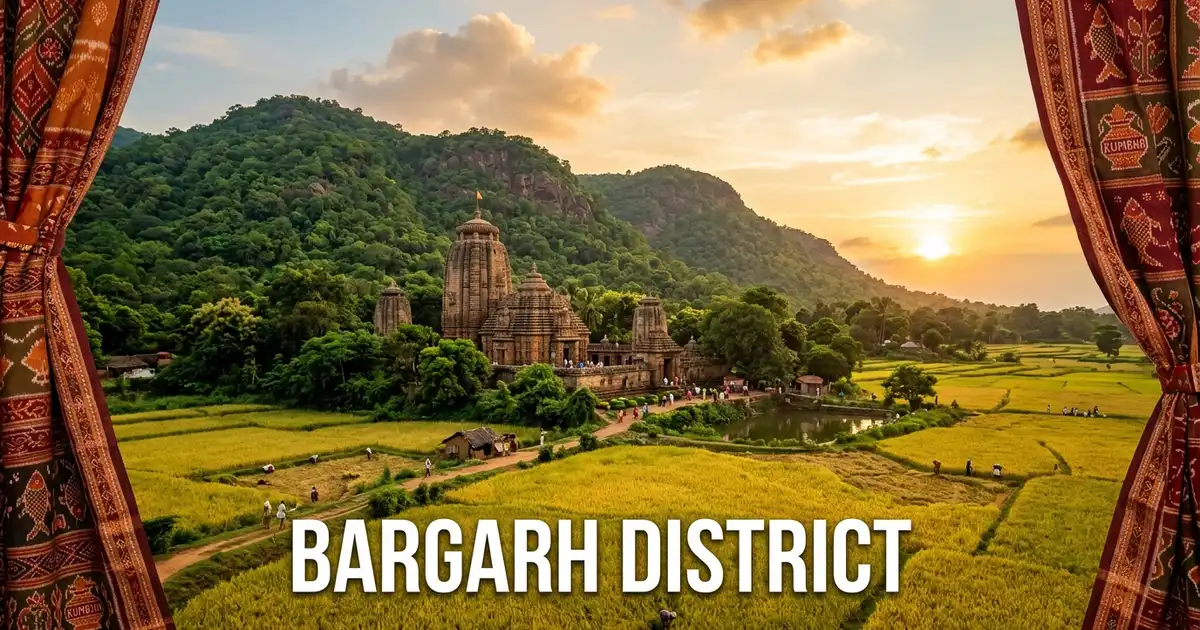
Bargarh district serves as the agricultural foundation and cultural theater of western Odisha. Known across eastern India as the primary Rice Bowl of Odisha, this fertile region owes its agrarian productivity to the extensive canal network fed by the Hirakud Dam. Vast expanses of emerald paddy fields define its countryside, creating one of the most reliable food granaries in the entire nation.
Beyond its agricultural supremacy, Bargarh commands global renown for hosting Dhanu Yatra, celebrated as the world’s largest open-air theatrical festival. Every winter, the entire municipal town transforms into the mythological city of Mathura, while the Jira River becomes the sacred Yamuna and King Kansa exercises absolute theatrical sovereignty.
The district also preserves spiritual sanctuaries and exquisite craftsmanship. At the forested base of the Gandhamardan hills stands the 14th-century temple of Nrusinghanath, while master weavers in Bargarh and Barpali produce world-renowned Sambalpuri Bandha tie-dye textiles.
Key Takeaways
- Bargarh covers 5,837 square kilometers across two administrative subdivisions, twelve community development blocks, and twelve tehsils.
- The district recorded a population of 1,481,255 in Census 2011, with an above-average literacy rate of 74.62 percent.
- Bargarh is recognized as the Rice Bowl of Odisha, supported by the perennial Bargarh Main Canal originating from the Hirakud Dam.
- Dhanu Yatra is the world’s largest open-air theater, spanning an 8-kilometer radius where mythological episodes of Krishna and Kansa come alive annually.
- Famous landmarks include Nrusinghanath Temple, Kapildhar waterfall, Debrigarh Wildlife Sanctuary fringes, and Sambalpuri Bastralaya handloom cooperative society.
Introduction to Bargarh: The Granary of Western Odisha, Open-Air Theater & Textile Heritage
Bargarh is located in western Odisha, bordered by Sambalpur district to the north and east, Subarnapur and Balangir districts to the south, Nuapada district to the southwest, and the state of Chhattisgarh to the west and northwest. The administrative headquarters is Bargarh town, located strategically along National Highway 53.
Historically an integral part of the undivided Sambalpur district, Bargarh was established as an independent revenue district on 1 April 1993. The territory spans 5,837 square kilometers, combining flat alluvial agrarian plains in the eastern blocks with rocky highlands and forested hills in the western Padampur subdivision.
Motor vehicle administration is managed by the Regional Transport Office under the registration code OD-17, headquartered in Bargarh town.
| Geographic Metric | Canonical Statistic | Regional Context |
|---|---|---|
| Total Geographical Area | 5,837 sq km | Key western agricultural district in Odisha |
| District Headquarters | Bargarh Town | Principal commercial grain market and cultural center |
| Sub-Divisional Urban Centers | Bargarh Sadar, Padampur | Administrative and agrarian command centers |
| Geographic Coordinates | 20°43’ N – 21°41’ N, 82°39’ E – 83°58’ E | Western borderlands and upper Mahanadi basin |
| Average Elevation | 171 meters (561 feet) above sea level | Ranging from 160-meter canal plains to 1,000-meter hills |
| Forest Cover | 1,025 sq km | Approximately 17.56% of total district territory |
| Motor Vehicle Registration (RTO) | OD-17 | Regional Transport Office, Bargarh |
The climate of Bargarh is characterized by a dry sub-humid tropical pattern. Summers between March and June are hot and dry, with daytime temperatures in May often reaching 44°C across the central agricultural plains. In contrast, the forested slopes of Gandhamardan and Barapahar hills maintain cooler night conditions.
The southwest monsoon brings an average annual precipitation of roughly 1,367 millimeters between June and September. This seasonal rainfall, combined with controlled water releases from the Hirakud reservoir, guarantees dependable multi-season agricultural cultivation.
Official administrative updates, cultural announcements, and tourism advisories are published through the Odisha Tourism Official Portal and district administration archives.
Geographical Landscape, Mahanadi-Jira River Basins & Gandhamardan Foothills
The physical geography of Bargarh presents a harmonious blend of flat alluvial plains, rolling undulating uplands, and rugged hill chains. The eastern and central blocks feature deep fertile clay and loam soils deposited by the drainage network of the Mahanadi basin, making them ideally suited for intensive wet-paddy farming.
To the north and east, the district borders its historic commercial neighbor of Sambalpur district along the wide waters of the Mahanadi River and the backwaters of the Hirakud reservoir. To the west, the landscape rises dramatically into the forested Gandhamardan and Barapahar hill ranges.
The hydrological lifeline of Bargarh consists of multiple rivers, streams, and engineered canal networks:
- Mahanadi River: Forms the northeastern border of the district near Ambabhona, replenishing local aquifers and providing expansive lake vistas along the reservoir margin.
- Jira River: The primary internal river flowing through Bargarh town, historically serving as the geographical substitute for the Yamuna River during Dhanu Yatra.
- Jhaun River: A major seasonal tributary that joins the Jira River before draining into the Mahanadi basin.
- Danta River: A meandering river system that irrigates agricultural fields across Attabira and Bheden blocks.
- Ang River: Flows across the southern boundary near Gaisilet and Padampur, providing valuable irrigation to southern agrarian tracts.
- Bargarh Main Canal: The massive concrete-lined arterial canal originating at Burla from Hirakud Dam, branching into hundreds of distributaries across the district.
The geological makeup of the region consists of Precambrian granites, gneisses, and quartzites in the plains, capped by Dharwar group rocks in the hills. The Gandhamardan mountain range on the southwestern border holds rich bauxite plateaus and ancient medicinal plant habitats.
These natural river corridors and artificial canal networks sustain an interconnected agrarian ecology that remains resilient against seasonal climatic variations.
Historical Evolution: Chauhan Kings, Freedom Struggle to Modern Formation
The historical roots of Bargarh date back to ancient and medieval epochs when the region was known as Baghar Kota. In ancient times, the territory formed an essential trading route connecting South Kosala with the coastal ports of Kalinga and Utkala.
During the medieval era, Bargarh came under the sovereignty of the Chauhan dynasty of Sambalpur. Raja Balram Dev, the founder of the Sambalpur kingdom in the 16th century, established administrative control over Bargarh and fortified the settlement to protect the western frontier.
In the 19th century, the region became a heroic epicenter of resistance against British colonial dominance during the great rebellion led by Veer Surendra Sai. The rugged Barapahar hills and Debrigarh ravines provided natural military fortresses for freedom fighters waging guerilla warfare against imperial forces.
Significant historical milestones in Bargarh’s journey include:
- 14th Century CE: Construction of the magnificent stone temple of Nrusinghanath by Chauhan King Baijal Dev, formalizing worship of Marjara Keshari at Gandhamardan.
- 16th Century CE: Fortification of Baghar Kota under Chauhan King Balram Dev, consolidating regional agrarian revenue systems.
- 1857 to 1862 CE: Armed resistance against British forces organized by Veer Surendra Sai, Madho Singh of Ghens, and local zamindars across the Barapahar mountains.
- 1947 to 1948 CE: First performance of the historic Dhanu Yatra in Bargarh town to celebrate the newly achieved independence of India.
- 1957 CE: Inauguration of the Hirakud Dam canal system, transforming traditional dryland farms into high-yielding irrigated paddy fields.
- 1993 CE: Formal establishment of Bargarh as a separate revenue district on 1 April, bifurcated from undivided Sambalpur district.
The legacy of the Chauhan rulers remains visible in regional temple architecture, village water management tanks, and local oral poetry.
Today, the people of Bargarh celebrate their historic identity through folk festivals, patriotic commemorations at Ghens, and living artisan cooperatives. Further administrative milestones can be reviewed on the Bargarh District Administration Profile.
Administrative Framework: Subdivisions, 12 Blocks, Tehsils & Civic Governance
Bargarh is administered under the Revenue Divisional Commissioner of the Northern Division, headquartered in Sambalpur. Executive administrative control rests with the Collector and District Magistrate in Bargarh, supported by the Superintendent of Police for law enforcement and public security.
For efficient governance, the district is organized into two administrative subdivisions: Bargarh Sadar and Padampur. The territory encompasses twelve community development blocks, twelve tehsils, and 253 gram panchayats.
Urban civic administration is overseen by one municipal council and three notified area councils (NACs), managing roads, sanitation, street lighting, and civic development.
| Administrative Unit | Classification | Key Coverage & Strategic Role |
|---|---|---|
| Bargarh Sadar Subdivision | Administrative Subdivision | Bargarh, Barpali, Attabira, Bheden, Sohela, Bhatli, Ambabhona |
| Padampur Subdivision | Administrative Subdivision | Padampur, Bijepur, Gaisilet, Paikmal, Jharbandh |
| Bargarh Municipality | Urban Local Body (ULB) | District headquarters, major commercial center, grain mandi |
| Barpali NAC | Urban Local Body (ULB) | World-famous handloom weaving center and historic trading town |
| Padampur NAC | Urban Local Body (ULB) | Sub-divisional headquarters, gateway to Gandhamardan hills |
| Attabira NAC | Urban Local Body (ULB) | Modern rice milling corridor and canal command junction |
| Gram Panchayats | Rural Governance | 253 village clusters coordinating local development |
Democratic representation is structured through five legislative assembly constituencies: Bargarh, Attabira (SC), Bhatli, Padampur, and Bijepur. The entire district is represented in Parliament under the Bargarh Lok Sabha constituency.
Decentralized administrative efforts have established robust rural road links under state and central schemes, modernized irrigation gates, and expanded rural healthcare networks.
Public infrastructure investments have also upgraded local sub-divisional hospitals, established agricultural research stations, and developed modern grain procurement yards.
Demographic Profile & Cultural Fabric: Census 2011 Analysis
As recorded in the official Census 2011, Bargarh district has a total population of 1,481,255 persons, comprising 749,161 males and 732,094 females. The sex ratio stands at 977 females per 1,000 males, which closely matches the state benchmark.
The population density of the district is 254 persons per square kilometer, reflecting high agricultural productivity and compact rural settlements across the canal command areas.
Bargarh records a commendable overall literacy rate of 74.62 percent, with male literacy recorded at 83.68 percent and female literacy at 65.38 percent. The presence of well-established government colleges, high schools, and private technical institutes supports steady educational growth.
| Demographic Indicator | Census 2011 Statistic | Regional Significance |
|---|---|---|
| Total Population | 1,481,255 | Approximately 3.53% of Odisha’s total population |
| Male Population | 749,161 | 50.58% of total district residents |
| Female Population | 732,094 | 49.42% of total district residents |
| Sex Ratio | 977 females / 1,000 males | Balanced gender ratio across urban and rural blocks |
| Population Density | 254 persons / sq km | Reflects dense agrarian settlement along canal belts |
| Overall Literacy Rate | 74.62% | Well above state rural averages |
| Male Literacy Rate | 83.68% | Strong presence in trade, agriculture, and industry |
| Female Literacy Rate | 65.38% | Supported by rural mission shakti networks |
| Scheduled Tribe (ST) Proportion | 19.04% | Prominent Gond, Binjhal, and Munda communities |
| Scheduled Caste (SC) Proportion | 20.14% | Active presence in agriculture and artisanal weaving |
The social fabric of Bargarh is enriched by significant Scheduled Tribe (19.04 percent) and Scheduled Caste (20.14 percent) populations. The prominent tribal groups include the Binjhal, Gond, Saora, and Munda communities, who reside primarily in Paikmal, Jharbandh, and Padampur blocks.
The Binjhal community maintains deep cultural bonds with the sacred Gandhamardan range and worships Goddess Bindhyabasini alongside Lord Nrusinghanath.
The Bhulia and Kostha weaving communities in Barpali and Bargarh pass down ancient tie-dye handloom skills across successive generations, forming the artistic backbone of the district.
Agricultural Heartland: The Hirakud Canal Lifeline & Rice Bowl Supremacy
Bargarh is widely recognized as the agricultural powerhouse of Odisha. Its position as the principal grain supplier of the state is powered by the Hirakud Dam canal irrigation network, which began supplying regulated waters to the district in the late 1950s.
The Bargarh Main Canal extends across dozens of kilometers, supplying perennial gravity irrigation to fertile farmlands in Attabira, Bargarh, Barpali, and Bheden blocks. This extensive irrigation allows farmers to practice multi-crop farming, harvesting abundant kharif and rabi paddy crops year after year.
As a result of this infrastructure, Bargarh produces massive rice surpluses that fill the public distribution granaries of Odisha and feed millions across India.
Key structural features of Bargarh’s agrarian economy include:
- Perennial Canal Irrigation: Gravity canals and lift irrigation channels provide dependable water supply to more than 140,000 hectares of cultivated land.
- Double Paddy Cropping: High agricultural yields allow continuous double-cropping of high-yielding and aromatic rice varieties.
- Attabira Rice Milling Hub: Attabira block hosts one of the largest concentrations of modern automated rice mills in eastern India.
- Regulated Market Committees (RMCs): Highly organized grain procurement yards in Bargarh, Attabira, Godbhaga, and Barpali streamline seasonal paddy purchasing.
- Secondary Cash Crops: Farmers cultivate high-value pulses, groundnuts, mustard, sugarcane, and seasonal vegetables alongside staple paddy.
The agrarian prosperity of Bargarh has encouraged the growth of agricultural implement manufacturing, fertilizer distribution centers, and tractor dealerships.
This agricultural foundation provides financial stability to rural households, establishing Bargarh as an inspiring model of sustainable farming across Odisha.
The World’s Largest Open-Air Theater: The Grand Dhanu Yatra Festival
The defining cultural signature of Bargarh is the world-renowned Dhanu Yatra, celebrated annually in December or January. Recognized as the largest open-air theatrical festival in the world, Dhanu Yatra transforms the physical geography of Bargarh into a massive living stage covering an 8-kilometer radius.
During the 11-day festival, Bargarh town becomes King Kansa’s capital city of Mathura, the Jira River represents the sacred river Yamuna, and the village of Ambapali on the opposite bank transforms into Gopapura.
No formal written script is followed during the festival. Instead, actors improvise their dialogues based on ancient mythological texts, while ordinary citizens and visiting government officials willingly accept the theatrical authority of King Kansa.
Key highlights of the spectacular Dhanu Yatra festival include:
- Theatrical Sovereignty of King Kansa: The actor portraying King Kansa tours Mathura on a decorated elephant, inspecting administrative offices, penalizing minor civic infractions, and giving orders to public officials.
- Ambapali as Gopapura: The pastoral childhood of Lord Krishna and Balarama is reenacted in Ambapali, featuring colorful folk dances, boat journeys, and playful devotional scenes.
- Jira River Crossing: The Jira River serves as the dramatic boundary across which Akrura travels to escort Krishna and Balarama to Mathura.
- Kansa’s Grand Darbar: A massive royal stage constructed at Hatpada hosts nightly court proceedings, classical dance recitals, and dramatic confrontations.
- The Climax of Kansa Badha: On the final day, the dramatic death of the tyrannical King Kansa is reenacted on a high royal stage, symbolizing the ultimate triumph of righteousness over tyranny.
Dhanu Yatra was first staged in 1947 to commemorate Indian independence from British colonial rule, celebrating the fall of imperial power through the mythological downfall of Kansa.
Today, the festival draws hundreds of thousands of spectators from across the globe, offering an unforgettable immersive cultural experience. Detailed performance histories can be explored on the Dhanu Yatra Theatrical Monograph.
Sacred Foothill Sanctuaries: 14th-Century Nrusinghanath Temple
Situated approximately 110 kilometers southwest of Bargarh town at the base of the Gandhamardan hills, the ancient temple of Nrusinghanath stands as a major pilgrimage destination of western Odisha. Constructed in 1360 CE by Chauhan King Baijal Dev, the temple is dedicated to Lord Nrusinghanath, worshipped here in the rare divine feline manifestation of Marjara Keshari (cat-lion).
According to local mythology, Lord Vishnu assumed this unique form to pursue the demon Musika Daitya, who hid within the crevices of the Gandhamardan mountain to escape divine retribution.
The architectural design of the temple displays classical Kalinga Rekha deula styling, built from hand-carved red stone blocks adorned with intricate guardian deities, floral scrollwork, and dancing damsels.
Travelers exploring the sacred slopes often link their journey with the southern slope pilgrimage sanctuary in Balangir district, where the Harishankar temple rests on the opposite flank of the same mountain.
Key architectural and spiritual elements of Nrusinghanath include:
- Marjara Keshari Sanctum: The sanctum sanctorum houses the dark chlorite stone idol of the feline deity, anointed daily with sandalwood paste and mountain spring water.
- Jaga Mohana & Natamandapa: Assembly halls supported by carved stone pillars depicting avatars of Vishnu and protective Yakshas.
- Perennial Mountain Stream: A crystal-clear medicinal stream known as Papaharana flows directly beside the temple complex, originating from high natural springs.
- Baisakh Mela Pilgrimage: A grand annual festival observed on Nrusimha Chaturdashi in May, drawing thousands of devotees to take sacred baths in the mountain springs.
The temple complex is surrounded by dense tropical woodlands filled with birds and butterflies, creating a peaceful spiritual atmosphere.
Visitors can combine temple worship with short forest hikes along the mountain stream, discovering natural pools and rock-cut shrines along the way. Comprehensive architectural details are documented in the Nrusinghanath Temple Heritage Profile.
Spiritual Citadels & Historic Shrines: Bhatli Dadhibaman & Ambabhona Temples
Beyond Nrusinghanath, Bargarh district houses numerous sacred shrines that reflect its deep devotion to Vaishnavite, Shaivite, and Shakta traditions. The most revered Vaishnavite center is the Dadhibaman Temple in Bhatli, situated 20 kilometers north of Bargarh town.
Lord Dadhibaman is worshipped as an authentic manifestation of Lord Jagannath, holding a single wooden idol inside a sanctified sanctum. The temple celebrates its own grand Rath Yatra every year, attracting thousands of rural pilgrims from Bargarh and neighboring Chhattisgarh.
In the northern reaches of the district, the Kedarnath Temple of Ambabhona stands against the scenic foothills of the Barapahar range, dedicated to Lord Shiva.
Key spiritual citadels and historic shrines across Bargarh include:
- Bhatli Dadhibaman Temple: Famous for its historic Rath Yatra festival, where a wooden chariot is pulled through town with traditional Odia devotional hymns.
- Ambabhona Kedarnath Temple: An ancient Shaivite pilgrimage site set amidst green forest hills, popular for peaceful meditation and Shivaratri celebrations.
- Girisul Astasambhu Shrines: A collection of eight ancient Shiva lingams scattered around Girisul village in Sohela block, displaying medieval stone masonry.
- Debrigarh Shiva Temple: A historic forest shrine located near the defensive hill fortifications of Veer Surendra Sai inside the reserve forest.
- Padampur Maa Bindhyabasini Temple: An ancient hill shrine dedicated to the tutelary goddess of the Binjhal tribal kings.
These spiritual centers serve as the social hubs of village life, where religious rituals harmonize with folk music and community gatherings.
Visiting these quiet rural shrines offers travelers a deep connection to the enduring spiritual traditions of western Odisha.
Forest Ecology & Wildlife Sanctuaries: Debrigarh Nature Reserve & Barapahar Range
The northern and western frontiers of Bargarh district feature dense forest systems that harbor extraordinary ecological biodiversity. The most prominent natural reserve is the Debrigarh Wildlife Sanctuary, which extends across 353 square kilometers along the Barapahar hills, bordering the vast backwaters of the Hirakud reservoir.
Debrigarh represents one of the most successful wildlife conservation reserves in eastern India, supporting dense populations of herbivores and apex predators in dry deciduous sal forests.
The reserve holds historic significance as well, having sheltered Veer Surendra Sai and his rebel soldiers during their guerilla campaigns against the British East India Company.
Key wildlife species and natural features of Debrigarh include:
- Indian Bison (Gaur): Debrigarh holds one of the highest densities of wild gaur in Odisha, frequently spotted grazing along open forest meadows and lake banks.
- Carnivores & Predators: Healthy populations of leopards, dholes (wild dogs), wolves, striped hyenas, and jungle cats.
- Herbivore Herds: Abundant herds of sambar, spotted deer (chital), barking deer, four-horned antelopes (chausingha), and wild boar.
- Avian Sanctuaries: Over 200 bird species, including crested serpent eagles, Indian grey hornbills, and thousands of migratory waterbirds that winter on Hirakud lake.
- Eco-Tourism Camps: Well-managed forest nature camps at Barkhandia and Zero Point, featuring comfortable tented accommodations and guided boat safaris.
The forest department operates regulated open-top jeep safaris through designated jungle trails, giving visitors outstanding opportunities to view wildlife in natural habitats.
Winter mornings at Debrigarh offer spectacular views of mist rising from Hirakud lake, framed by the dark silhouettes of the Barapahar mountains.
Mountain Cascades & Healing Waters: Kapildhar & Bhimdhar Falls of Gandhamardan
The Gandhamardan mountain range on Bargarh’s southwestern boundary is endowed with natural springs, cascading waterfalls, and medicinal water bodies. According to ancient Ayurvedic traditions, the mountain holds over 1,000 distinct species of therapeutic plants and herbs, imbuing its natural streams with natural restorative minerals.
The most famous waterfall on the Bargarh side of the mountain is Kapildhar Waterfall, located approximately four kilometers upstream from the Nrusinghanath temple.
Kapildhar tumbles from a rocky ledge into a cool forest pool, surrounded by thick bamboo thickets and ancient sal trees.
For nature enthusiasts seeking other magnificent waterfalls across the state, our comprehensive guide to waterfalls in Odisha covers scenic routes, permits, and seasonal recommendations.
Key waterfalls and mountain springs along Gandhamardan include:
- Kapildhar Waterfall: A scenic forest cascade named after the legendary sage Kapila, where mountain spring waters drop into a refreshing natural basin.
- Bhimdhar Waterfall: A powerful mountain cataract located further up the trekking trail, associated with the legendary exile of the Pandava brothers.
- Sitakund Spring: A crystal-clear mountain spring pool where pilgrims pause to rest during the uphill ascent across Gandhamardan.
- Panchupandav Ghat: A rocky river gorge where natural stone formations depict the five Pandava heroes, accompanied by cool mountain breezes.
- Chal Dhar Falls: A secluded mountain stream in Paikmal block that cascades through terraced granite boulders during the post-monsoon months.
The ideal season to explore these mountain waterfalls is between September and February when post-monsoon flows are steady and forest trekking paths are clear.
Hiking along the Kapildhar trail provides travelers with fresh mountain air, unspoiled natural sounds, and rewarding botanical discoveries.
The Weaving Nerve Center: Sambalpuri Bastralaya & Master Craftsmen of Barpali
Bargarh is the undeniable heart of Odisha’s handloom weaving industry, producing the world-famous Sambalpuri Ikat saree. The towns of Bargarh and Barpali, along with surrounding artisan villages like Remunda and Bijepur, house thousands of master weavers who specialize in the intricate Bandhakala double-ikat technique.
In this ancient craft, warp and weft threads are individually tied and dyed in precise patterns before being set onto traditional pit looms, ensuring that complex designs appear with equal brilliance on both sides of the woven fabric.
The modern institutionalization of this craft was pioneered by legendary master weaver Padmashree Krutartha Acharya, who founded the Sambalpuri Bastralaya Handloom Cooperative Society in Bargarh town in 1954.
To discover the history and diverse regional styles of weaving across the state, explore our guide to the celebrated handloom saree heritage of Odisha.
Signature characteristics of authentic Sambalpuri handloom from Bargarh include:
- Symbolic Motifs: Borders and pallus feature traditional motifs such as the conch (shankha), wheel (chakra), fish (matsya), rudraksha, and geometric temple spires (kumbha).
- Natural & Fast Dyes: Contemporary weavers combine organic mineral dyes with durable synthetic dyes to achieve deep crimson, indigo, peacock blue, and golden ochre tones.
- Diverse Fabric Compositions: Production includes fine mercerized cotton sarees for everyday comfort alongside luxurious mulberry and tussar silk sarees for weddings.
- Krutartha Acharya Memorial: The Sambalpuri Bastralaya headquarters in Bargarh features museum archives, production looms, and certified retail emporiums.
Purchasing handloom textiles directly from the Sambalpuri Bastralaya sales centers or registered weavers’ cooperatives in Barpali guarantees genuine craftsmanship while supporting artisan families.
Each saree represents weeks of skilled artistic labor, preserving an ancient living craft that defines the cultural pride of western Odisha. A detailed overview is available on the Sambalpuri Saree Handloom Craft Monograph.
Distinctive Culinary Flavors: The Famous Sarsatia of Barpali, Chaula Bara & Pakhala
The culinary traditions of Bargarh district reflect its agricultural bounty, forest herbs, and distinctive western Odia cooking techniques. Because Bargarh produces some of the finest rice varieties in Odisha, rice-based dishes naturally dominate everyday dining.
The undisputed crown jewel of Bargarh’s confectionary heritage is Sarsatia, a rare and delicate sweet originating exclusively in the historic town of Barpali.
Sarsatia is prepared using a labor-intensive method where resin extracted from the bark of the wild Ganjer tree (Litsea glutinosa) is beaten with water into a viscous liquid, mixed with fine rice flour, and extruded into hot oil in intricate white lacework patterns before being sprinkled with sugar.
Key culinary specialties that travelers must savor in Bargarh include:
- Sarsatia of Barpali: A crisp, snow-white web-like sweet that melts on the tongue, prepared without milk or eggs and celebrated for its subtle aroma.
- Chaula Bara: Golden, crunchy fritters made from soaked rice and urad dal batter, spiced with cumin, green chilies, and curry leaves, served hot with sour tomato and tamarind chutney.
- Bargarh Pakhala: Fermented cooked rice served in chilled water with curd, seasoned with roasted cumin and fried curry leaves, paired with crisp roasted fish or vegetable fry.
- Badi Chura: Hand-crushed lentil dumplings mixed with chopped onions, crushed garlic, and raw mustard oil, providing a savory accompaniment to rice meals.
- Kardi & Hendua Curries: Fresh tender bamboo shoots (kardi) and dried fermented bamboo shoots (hendua) cooked with mustard gravy and garlic.
- Arisa Pitha: A traditional deep-fried sweet made from jaggery syrup and rice flour, coated with sesame seeds and prepared during agrarian festivals.
Sampling hot Chaula Bara at local street stalls in Bargarh or enjoying fresh Sarsatia in Barpali offers an authentic culinary introduction to the region.
The food culture of Bargarh celebrates wholesome, earth-grown ingredients that satisfy travelers seeking genuine local flavors.
Transportation & Transit Logistics: Reaching and Navigating Bargarh
Reaching Bargarh is straightforward and convenient, thanks to its strategic position along primary national transport corridors in eastern India. The district is traversed by National Highway 53 (the Kolkata-Mumbai economic highway) and the newly completed Biju Expressway, ensuring fast road connections.
Bargarh Road Railway Station (BRGA) is a prominent stop on the East Coast Railway’s Sambalpur-Titilagarh line, offering regular train services across India.
The logistics guide below summarizes primary transport modes and key transit hubs for prospective visitors:
| Mode of Transport | Primary Hubs & Routes | Connectivity Details & Operational Status |
|---|---|---|
| Air Travel | Veer Surendra Sai Airport, Jharsuguda (JRG - 85 km) / Raipur Airport (220 km) | Jharsuguda operates direct commercial flights to Delhi, Kolkata, Bengaluru, and Bhubaneswar |
| Rail Transport | Bargarh Road Railway Station (BRGA) / Barpali (BRPL) | Connected via daily express and superfast trains to Bhubaneswar, Kolkata, Mumbai, and Visakhapatnam |
| National Highways | National Highway 53 (Kolkata-Mumbai) / NH-26 (Bargarh-Borigumma) | Four-lane paved expressways providing smooth journeys from Sambalpur, Raipur, and coastal cities |
| Biju Expressway | Biju Expressway Economic Corridor | High-speed multi-lane highway linking Bargarh directly with Rourkela and southern Odisha districts |
| Intercity Bus Service | Bargarh Private & Government Bus Stands | Frequent express buses operating day and night to Bhubaneswar, Cuttack, Rourkela, and Raipur |
From Bargarh Road Railway Station, auto-rickshaws, shared jeeps, and app-based rental taxis are readily available to transport travelers to town hotels or tourist sites.
Travelers visiting Nrusinghanath can board regular state transport buses from Bargarh to Padampur and Paikmal, followed by a short auto-rickshaw ride to the temple gates.
For comprehensive district exploration, hiring a private car in Bargarh provides the most flexible way to visit Debrigarh sanctuary, Barpali weavers, and Gandhamardan waterfalls in a single trip.
Seasonal Weather & Optimal Travel Timings
Understanding western Odisha’s seasonal climate is crucial when scheduling an excursion to Bargarh, as summer temperatures across the inland plains can be intense. The forested slopes around Nrusinghanath and Barapahar hills experience cooler breezes than the open agricultural valleys.
The seasonal guide below outlines climate trends, temperature ranges, and travel recommendations across the year:
| Season | Calendar Months | Temperature Range | Weather Characteristics | Travel Feasibility & Advice |
|---|---|---|---|---|
| Winter | October to February | 11°C – 28°C | Cool crisp mornings; mild sunny afternoons | Peak Travel Season: Ideal for Dhanu Yatra, Nrusinghanath, Debrigarh safari, and handloom tours |
| Summer | March to June | 27°C – 44°C | Hot dry afternoons; warm evening breezes | Demanding conditions; plan outings for early mornings; carry plenty of water |
| Monsoon | July to September | 24°C – 33°C | Abundant rainfall; emerald green paddy plains | Great for seeing full mountain waterfalls; exercise caution on forest roads |
The optimal window to explore Bargarh district extends from October through February. During these winter months, comfortable daytime weather makes sightseeing, hiking at Gandhamardan, and attending Dhanu Yatra very enjoyable.
Visitors planning to attend the Dhanu Yatra in December or January should book hotels well in advance, as rooms in Bargarh fill up weeks before the opening ceremonies.
The post-monsoon months of September and October present beautiful landscapes as vast paddy fields turn deep green under clear blue skies.
Summer months between April and June experience extreme midday heat with temperatures often surpassing 42°C, making outdoor activities demanding.
Accommodation, Pilgrim Etiquette & Practical Travel Advice
Bargarh offers a good variety of accommodation choices catering to business travelers, handloom buyers, and temple pilgrims. In Bargarh town, modern commercial hotels, government inspection bungalows, and private lodges cluster around Main Road, Bhatli Road, and Canal Avenue, providing comfortable air-conditioned rooms and dining.
For visitors touring Nrusinghanath, the Odisha Tourism Development Corporation (OTDC) operates the Panthanivas guest house directly near the temple entrance in Paikmal.
To ensure a smooth, culturally respectful, and memorable trip through Bargarh, travelers should follow several practical tips:
- Dhanu Yatra Festival Etiquette: Dhanu Yatra attracts hundreds of thousands of spectators each evening. Arrive early at Hatpada or Ambapali to secure good viewing spots, keep personal valuables secure, and treat actors portraying mythological characters with traditional respect.
- Nrusinghanath Temple Customs: Remove leather shoes, belts, and wallets before entering the inner sanctum. Purchase fresh flowers and consecrated prasad from verified temple vendors, and respect guidelines regarding photography inside the sanctum.
- Debrigarh Safari Preparation: Book forest safari slots and nature camp tents in advance through the official Eco Tour Odisha portal. Maintain absolute silence during forest drives, stay inside designated safari vehicles, and never discard plastic waste in reserve areas.
- Gandhamardan Hill Trekking: Hiking up to Kapildhar waterfall involves navigating stone stairs and rocky trails. Wear non-slip walking shoes, carry sufficient drinking water, and avoid swimming in deep, unfamiliar rock pools.
- Handloom Shopping Advice: To guarantee authenticity when purchasing Sambalpuri Ikat sarees, visit the head showroom of Sambalpuri Bastralaya in Bargarh or certified weavers’ cooperatives in Barpali. Look for the registered Handloom Mark and Silk Mark tags.
Frequently Asked Questions (FAQ) About Bargarh District
What is Bargarh district famous for?
Bargarh district is famous across India as the Rice Bowl of Odisha for its massive paddy production, and as the host of Dhanu Yatra, the world’s largest open-air theatrical festival. The district is also renowned for the 14th-century Nrusinghanath Temple at Gandhamardan, Debrigarh Wildlife Sanctuary, and world-class Sambalpuri Ikat handloom weaving from Barpali.
What is Dhanu Yatra and why is it unique?
Dhanu Yatra is the world’s largest open-air theater festival celebrated annually in Bargarh, transforming an 8-kilometer radius into a living mythological stage where Bargarh becomes Mathura, the Jira River represents Yamuna, and Ambapali becomes Gopapura. The 11-day festival features no written script, with actors improvising dialogues and King Kansa exercising absolute theatrical authority over town residents and visiting officials.
Why is Bargarh called the Rice Bowl of Odisha?
Bargarh earned the title of the Rice Bowl of Odisha because the Bargarh Main Canal from the Hirakud Dam delivers dependable gravity irrigation to more than 140,000 hectares of farmland across Attabira, Bargarh, and Barpali blocks. This extensive irrigation system allows farmers to harvest two bumper crops of paddy every year, generating massive rice surpluses that supply state and national food reserves.
What is the unique sweet Sarsatia of Barpali?
Sarsatia is a rare, delicate snow-white sweet created exclusively in the town of Barpali in Bargarh district, made using fine rice flour and resin extracted from the bark of the wild Ganjer tree. The viscous mixture is extruded into hot oil in intricate web-like lace patterns, producing a crisp confection that dissolves instantly on the palate without dairy or artificial additives.
What is the best time of year to visit Bargarh district?
The optimal time to visit Bargarh is between October and February when pleasant winter weather brings comfortable temperatures ranging from 11°C to 28°C. This period allows visitors to experience the grand Dhanu Yatra open-air theater, take wildlife safaris in Debrigarh, and hike comfortably to Kapildhar waterfall at Nrusinghanath.