Nuapada District: Sunabeda Wildlife, Patora Dam & Travel Guide
Comprehensive guide to Nuapada district in Odisha. Discover Sunabeda wildlife, Patora Dam, Yogeswar Shiva temple, Maraguda valley, and travel routes.
Nuapada district occupies a rugged frontier territory along the western border of Odisha. Spanning 3,852 square kilometers between river basins and elevated mountain plateaus, the district preserves deep historical roots, tribal customs, and wildlife reserves. Formed as an autonomous revenue unit on April 1, 1993 upon the division of the undivided Kalahandi collectorate, Nuapada forms an essential cultural and economic gateway connecting Odisha with central India.
The district possesses ancient archaeological significance as the cradle of the early medieval Sarabhapuriya dynasty in the Maraguda valley. Beyond its historic brick ruins and hilltop shrines, Nuapada preserves the high plateau wilderness of Sunabeda Wildlife Sanctuary, home to endangered wild water buffaloes and dramatic waterfall gorges.
Key Takeaways
- Nuapada covers 3,852 square kilometers across five community development blocks and five revenue tehsils in western Odisha.
- The district recorded a population of 610,382 in Census 2011, with a sex ratio of 1,021 females per 1,000 males and a density of 158 persons per square kilometer.
- Home to the 591.75 square kilometer Sunabeda Wildlife Sanctuary, protecting rare wild water buffaloes, tigers, and plateau waterfalls.
- Features Patora Dam on the Jonk River, surrounded by forested hills and the hilltop Yogeswar Shiva Temple.
- Preserves historic archaeological treasures, including the ancient Sarabhapuriya capital in Maraguda Valley and the 12th-century mortarless brick temple of Budhikomna.
Introduction and Geographic Setting
Nuapada district forms the westernmost frontier of Odisha, extending between 20°0’ N and 21°5’ N latitude and 82°20’ E and 82°53’ E longitude. The administrative headquarters is situated at Nuapada town, positioned along the interstate highway corridor connecting eastern Odisha with Raipur.
The district is bounded by Bargarh and Balangir to the east, Kalahandi District southern parent territory to the south, and the state of Chhattisgarh across its northern and western borders. Elevations range from 200 meters across the fertile Jonk and Sunder river valleys to over 900 meters atop the Sunabeda plateau.
The hydrological network of Nuapada centers around the Jonk, Sunder, Indra, and Tel rivers. The Jonk River flows northward through rocky valleys before forming the boundary with Chhattisgarh, while the Sunder River irrigates fertile plains across Komna and Khariar. These rivers feed major irrigation reservoirs including the Patora Dam, which provides drinking water, canal irrigation, and fisheries.
Forests cover more than thirty-five percent of the district geography, dominated by tropical dry deciduous sal, teak, bamboo, and medicinal herbs. The rugged topography creates dramatic microclimates, where mist-veiled sandstone plateaus overlook sunny farming valleys. Travelers crossing Nuapada encounter sprawling agricultural fields, weekly tribal markets, and expansive nature sanctuaries.
At a Glance: District Profile and Key Metrics
A review of foundational geographic, demographic, and civic indicators illustrates Nuapada’s identity as an emerging agrarian and eco-tourism district. Statistics from Census 2011 and official government records provide a clear factual baseline.
| Administrative Parameter | Official Metric | Governing Authority / Source |
|---|---|---|
| District Headquarters | Nuapada Town | Government of Odisha |
| Establishment Date | April 1, 1993 | Revenue and Disaster Management Department |
| Total Geographic Area | 3,852 sq km | Nuapada District Demographic Monograph |
| Population (2011 Census) | 610,382 | Registrar General and Census Commissioner |
| Population Density | 158 persons / sq km | Directorate of Census Operations, Odisha |
| Sex Ratio | 1,021 females per 1,000 males | Census of India 2011 |
| Literacy Rate | 57.35% (Male: 70.29%, Female: 44.76%) | State Literacy Mission Authority |
| Revenue Division | Northern Revenue Division (Sambalpur) | Government of Odisha Administrative Gazette |
| Administrative Subdivisions | 1 (Nuapada) | District Collectorate Administration |
| Community Development Blocks | 5 Blocks (Nuapada, Khariar, Komna, Boden, Sinapali) | Panchayati Raj Department, Odisha |
| Revenue Tehsils | 5 Tehsils | Board of Revenue, Odisha |
| Urban Local Bodies | Khariar NAC, Khariar Road NAC, Nuapada NAC | Housing and Urban Development Department |
| Vehicle Registration Code | OD-26 | State Transport Authority, Odisha |
| Assembly Constituencies (MLA) | 2 Seats (Nuapada, Khariar) | Election Commission of India |
| Parliamentary Constituency (MP) | Kalahandi Lok Sabha (Seat 11) | Election Commission of India |
| Major Wildlife Sanctuary | Sunabeda Wildlife Sanctuary (591.75 sq km) | Principal Chief Conservator of Forests, Odisha |
| Major River Systems | Jonk, Sunder, Indra, Tel | Department of Water Resources, Odisha |
With a sex ratio of 1,021 females per thousand males, Nuapada demonstrates favorable demographic equality in rural communities. Official administrative notices and verified travel guidelines are available on the Odisha Tourism Official Portal and district records. Agriculture, livestock rearing, and forest produce collection sustain most rural households.
Historical Evolution: Sarabhapuriyas, Khariar Kingdom and Maraguda Valley
Nuapada possesses deep historical antiquity that dates back to the early centuries of the Common Era. Archaeological discoveries along the Jonk River valley reveal that the territory served as a primary trade and religious crossroad connecting the coastal ports of Kalinga with central Indian kingdoms.
During the fifth and sixth centuries, the Maraguda valley flourished as the capital of the Sarabhapuriya dynasty, an influential ruling house that issued copper plate charters across South Kosala. Excavations conducted by state archaeologists uncovered fortified brick fortifications, Buddhist stupas, and Shaivite stone shrines. The presence of Buddhist monastic foundations confirms that the valley was a center of Mahayana learning during early medieval times.
Later, the territory came under the cultural influence of the Somavamshi and Kalachuri dynasties, who patronized the construction of brick and stone temples across the region. In the twelfth century, local builders constructed the famous Pataleswar brick temple at Budhikomna, adopting mortarless brick construction methods similar to the monuments at Sirpur.
During the medieval and pre-colonial periods, the region was governed by the royal house of Khariar (Raj Khariar). Established in the seventeenth century, the Khariar principality maintained defensive fortifications, patronized literature and performing arts, and consecrated shrines to Lord Jagannath and Maa Raktambari. The princely durbar merged into independent India in 1948, eventually forming a separate district in 1993.
Administrative Framework: Subdivisions, 5 Blocks and Governance
The governance structure of Nuapada functions under a single administrative revenue subdivision centered at Nuapada town. The Collector and District Magistrate directs administrative departments, law enforcement, disaster preparedness, and poverty alleviation programs.
Rural grassroots governance is organized across five community development blocks and five matching revenue tehsils: Nuapada, Khariar, Komna, Boden, and Sinapali. The eastern boundaries maintain active administrative coordination with Balangir District eastern border basin across shared irrigation canals and agricultural trade corridors.
The table below outlines the five development blocks and their key demographic and operational features.
| Block Name | Headquarters | Gram Panchayats | Inhabited Villages | Dominant Economic Base |
|---|---|---|---|---|
| Nuapada | Nuapada Town | 29 | 128 | Commercial Services, Highway Trade, Cotton Farming |
| Khariar | Raj Khariar | 27 | 134 | Royal Heritage Tourism, Handlooms, Agriculture |
| Komna | Komna | 26 | 138 | Sunder River Alluvial Farming, Brick Temple Crafts |
| Boden | Boden | 16 | 98 | Forest Produce, Pulse Cultivation, Livestock Rearing |
| Sinapali | Sinapali | 21 | 112 | Cotton Weaving, Weekly Haat Commerce, Oilseeds |
Urban administration is managed through three Notified Area Councils: Nuapada NAC, Khariar NAC, and Khariar Road NAC. Two legislative assembly seats, Nuapada (Seat 71) and Khariar (Seat 72), represent the district in the Odisha Legislative Assembly, while the entire area falls within the Kalahandi parliamentary constituency.
Top Tourist Attractions: Patora Dam, Yogeswar Temple and Budhikomna
Nuapada offers an exciting range of tourist destinations combining engineering landmarks, ancient temples, and historic ruins. Travelers can tour lakeside gardens, archaeological excavations, and unique brick shrines across the district.
Patora Dam and Reservoir
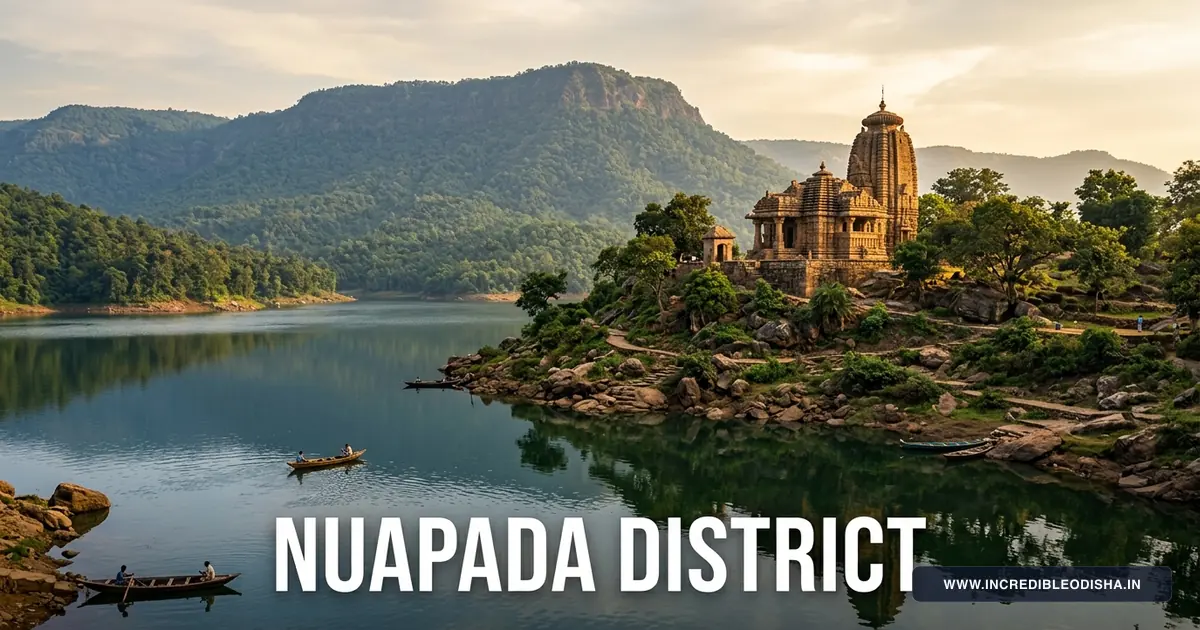
Constructed across the Jonk River near Nuapada town, Patora Dam forms an expansive freshwater reservoir ringed by forested hills. The dam was constructed under the Upper Jonk Irrigation Project, providing dependable irrigation waters to thousands of farm hectares while transforming the valley into an eco-tourism destination.
The reservoir features landscaped gardens, concrete walkways, and tourist pavilions along the embankment. Visitors enjoy paddle boating across the calm waters, while birdwatchers can observe cormorants, herons, and egrets feeding near the spillway. The reservoir becomes especially popular during winter months, drawing families and weekend excursion groups for lakeside picnics.
Yogeswar Shiva Temple at Patora
Perched on a high hill overlooking the Patora Dam reservoir, the Yogeswar Shiva Temple forms the spiritual center of the Upper Jonk valley. The temple enshrines a colossal natural stone Shiva linga that has drawn devotees for generations.
The temple complex includes spacious marble courtyards, ornamental stone gateways, and open terraces that offer panoramic views of the water reservoir and distant hills. Pilgrims climb stone stairs leading to the shrine to offer holy water and fresh flowers. During Maha Shivratri, tens of thousands of worshippers ascend the hill for day-long prayers, bhajans, and community feasts.
Maraguda Valley Archaeological Complex
Located fourteen kilometers from Nuapada town near the Jonk River, the Maraguda valley forms one of Odisha’s most important archaeological sites. Surrounded by steep hills, the valley preserves the ruins of an ancient fortified settlement believed by historians to be the capital of South Kosala under the Sarabhapuriya rulers.
Excavations have unearthed brick monasteries, paved streets, royal residential foundations, and stone sculptures dating from the fourth to twelfth centuries. Highlights include the ruins of a Buddhist vihara, a circular brick temple dedicated to the mother goddess, and ancient terracotta artifacts. History buffs and researchers visit the valley to study the early structural engineering and monastic urbanism of central India.
Budhikomna Pataleswar Brick Temple
Situated forty-two kilometers south of Nuapada in the village of Budhikomna, the Pataleswar Temple stands as an architectural wonder from the twelfth century. Dedicated to Lord Shiva, the entire temple was constructed from burnt red clay bricks fitted together without lime mortar.
The temple features a Triratha plan with a soaring pyramidal shikhara adorned with geometric brick carvings, pilasters, and decorative niches. Its architectural styling shows strong affinities with the famous Lakshmana brick temple at Sirpur in neighboring Chhattisgarh. Devotees and architectural historians marvel at the durability of the ancient bricks, which have withstood centuries of monsoon weathering.
Raj Khariar Palace and Maa Raktambari Temple
Located sixty-five kilometers south of Nuapada, Raj Khariar preserves the royal heritage of the Khariar principality. The town houses the historic palace of the Khariar royal family, with arched gateways, defensive ramparts, and ceremonial halls.
Within the town stands the revered temple of Maa Raktambari, the tutelary goddess of the Khariar royal lineage. Devotees assemble here to seek divine blessings, especially during Navaratri and Durga Puja, when traditional royal rituals and animal worship ceremonies are conducted according to ancient customs.
| Destination | Distance from HQ | Primary Heritage / Natural Feature | Best Visiting Months |
|---|---|---|---|
| Patora Dam | 18 km | Reservoir lake, Gardens, Boating | October to February |
| Yogeswar Shiva Temple | 18 km | Hilltop Shiva shrine, Reservoir panoramas | October to March |
| Maraguda Valley | 14 km | Ancient brick citadels, Buddhist vihara ruins | November to February |
| Budhikomna Brick Temple | 42 km | 12th-century mortarless Pataleswar shrine | October to March |
| Raj Khariar Palace | 65 km | Royal architecture, Maa Raktambari temple | October to February |
| Godhas Waterfall | 30 km | Hill cascade in Dharambandha forest | August to December |
| Sinapali Haat & Handlooms | 88 km | Weekly tribal fair, Traditional cotton weaving | October to March |
Wild Frontiers: Sunabeda Wildlife Sanctuary and Plateau Waterfalls
The crown jewel of Nuapada’s natural heritage is the Sunabeda Wildlife Sanctuary, an expansive wilderness notified in May 1988 over 591.75 square kilometers across the high Sunabeda plateau. Rising to elevations between 600 and 900 meters above sea level, the plateau forms an ecological continuum with the Udanti-Sitanadi Tiger Reserve in neighboring Chhattisgarh.
The sanctuary features flat tablelands broken by deep rock canyons, seasonal waterfalls, and dense woodlands. Vegetation consists of tropical dry deciduous sal, teak, asan, bija, and extensive open grasslands that provide grazing for herbivores.
Sunabeda provides a rare habitat for the endangered wild water buffalo (Bubalus arnee), known locally as the arna. The sanctuary also harbors viable populations of tigers, leopards, sloth bears, spotted deer, barking deer, sambar, wild boars, and the four-horned antelope (chausingha). Deep ravines shelter breeding populations of Indian giant squirrels and diverse reptiles.
Spectacular waterfalls drop from the edges of the plateau into rocky valleys below. The most famous among these are Kharaldhas Waterfall and Beniadhus Waterfall, where mountain streams drop hundreds of feet over vertical quartzite walls. Another scenic drop, Godhas Waterfall near Dharambandha, attracts trekkers and campers during post-monsoon months.
The forest department maintains nature trails and community forest camps that allow eco-tourists to observe wildlife in their natural environment. Local tribal guides lead walking tours, explaining traditional forest knowledge while earning sustainable livelihoods through eco-tourism.
Agriculture, River Basins and Forest Economy
The economy of Nuapada relies upon rainfed crop cultivation, river canal farming, and the collection of minor forest produce. More than seventy percent of working families depend directly upon agriculture and allied activities for their daily sustenance.
The Jonk, Sunder, and Indra river valleys contain fertile alluvial soils that permit double-cropping under canal irrigation. Upland red and lateritic soils support hardy pulses, millets, and oilseeds. The northern agricultural plains trade directly with the markets of Bargarh District agrarian trade corridor.
Paddy forms the primary food crop during the kharif season. Farmers cultivate high-yielding rice varieties alongside traditional drought-resistant landraces. Over the past decade, cotton farming has expanded rapidly across Komna, Boden, and Sinapali blocks, supplying raw lint to regional ginning mills and textile markets.
Maize and pulses, including black gram, pigeon pea, and green gram, provide dependable secondary income for upland farmers. Sugarcane cultivation along river channels supplies local jaggery processing units.
In tribal villages bordering Sunabeda, minor forest produce represents a vital economic lifeline. Rural families collect mahua flowers, char seeds, kendu leaves, sal seeds, and medicinal herbs, which are processed and traded through cooperative federations.
Handloom Weaving, Bell Metal and Rural Artisan Heritage
Nuapada preserves historic artisan traditions passed down through multigenerational rural craft families. Foremost among these cottage trades is the traditional cotton handloom weaving practiced in Khariar, Boden, and Sinapali.
Weavers from the Bhulia and Meher communities craft soft cotton sarees, dhotis, and dress materials using hand-dyed yarns. While adopting regional tie-and-dye techniques influenced by Subarnapur District handloom weaving centers, Nuapada weavers incorporate distinctive geometric borders, fish motifs, and earthy color palettes.
The district also sustains traditional blacksmiths and bell-metal workers who cast iron agricultural tools, household knives, brass bowls, and ceremonial bells. Village artisans work with open charcoal hearths to shape functional metal goods traded at weekly markets.
Tribal women craft functional utility baskets, storage boxes, and winnowing fans from wild split bamboo. In forested hamlets, women collect fallen sal leaves and stitch them into biodegradable dining plates that are sold across local markets.
| Craft Practice | Primary Production Center | Finished Products | Main Raw Materials |
|---|---|---|---|
| Cotton Handloom Weaving | Sinapali, Khariar | Cotton sarees, Fabrics, Gamuchhas | Cotton yarn, Mineral dyes |
| Traditional Blacksmithing | Komna, Nuapada | Sickles, Ploughs, Domestic knives | Iron, Scrap steel, Charcoal |
| Bell-Metal Casting | Rural artisan hamlets | Puja vessels, Bowls, Cattle bells | Bronze, Brass scrap |
| Bamboo Basketry | Tribal fringe settlements | Winnowing trays, Grain containers | Split bamboo reeds, Twine |
| Sal Leaf Utensils | Boden, Sunabeda hamlets | Biodegradable plates, Meal bowls | Dried sal leaves, Cotton thread |
| Terracotta Crafts | Khariar Road periphery | Water pitchers, Storage jars, Deepa | Alluvial clay, Natural pigments |
Folk Culture, Tribal Traditions and Regional Haats
The cultural life of Nuapada reflects a deep synthesis of tribal customs, royal festivals, and regional folk arts. Communities celebrate seasonal transitions with expressive drumming, folk songs, and lively rural fairs.
Tribal Dances and Danda Nata
Folk performances in Nuapada feature energetic tribal dances such as the Ghumura and Madal dances. Men play heavy circular ghumura drums strapped to their chests, executing synchronized acrobatic steps and singing traditional ballads that tell stories of heroism, seasonal harvests, and ancient village legends.
Danda Nata is celebrated enthusiastically during the summer month of Chaitra. Performers observe strict penance and perform the Dhuli Danda on scorching sand, the Pani Danda in water tanks, and the Agni Danda over glowing coals at midnight to the rhythm of dhol and mahuri instruments.
Nuakhai and Chaitra Parva
Nuakhai is celebrated as the foremost agrarian festival across every village in Nuapada. Families gather to offer the newly harvested rice to household deities, partake of the consecrated Nabanna meal, and greet elders with the traditional Nuakhai Juhar.
Tribal communities also celebrate Chaitra Parva with traditional hunting expeditions, archery contests, and nighttime dances around village bonfires. The festivals reinforce community unity and pass cultural oral traditions down to younger generations.
Weekly Rural Haats
Weekly village markets (haats) serve as the social and commercial heartbeat of Nuapada. Markets in Sinapali, Boden, Komna, and Khariar attract thousands of farmers, tribal gatherers, and itinerant traders.
Visitors to these markets experience a lively atmosphere where fresh seasonal produce, forest herbs, handloom cloth, and handmade earthenware pots are traded under open banyan trees. The haats also provide gathering spots where neighbors meet to discuss local affairs and enjoy hot evening snacks.
Local Cuisine and Western Border Flavors
The culinary culture of Nuapada unites the comforting traditions of western Odisha home cooking with subtle flavors from neighboring central Indian borderlands. Fresh seasonal produce, leafy greens, and slow-cooked pulses form the core of daily family meals.
Pakhala, fermented rice served cool in water with curd, green chilies, and roasted cumin seeds, is the everyday staple during the hot summer months. It is paired with Badi Chura (crushed sun-dried lentil cakes sauteed with mustard oil, garlic, and onions) and stir-fried wild greens known as Saga Bhaja.
During the winter harvest season, households prepare hearty curries from local country vegetables. Popular dishes include Besara, a mixed vegetable stew simmered in a sharp mustard and garlic gravy, and Dalma, yellow lentils slow-cooked with pumpkin, raw papaya, and roasted cumin powder.
In urban market centers like Khariar and Khariar Road, street vendors prepare delicious snacks such as Chaula Bara (crispy deep-fried rice and lentil fritters served with tangy tomato-coriander chutney) and hot Guguni. Confectioneries craft sweet milk delicacies including succulent Chhena Gaja, syrupy Gulab Jamun, and traditional harvest cakes such as Kakara Pitha and Arisa Pitha.
Transportation Logistics, Interstate Corridors and Rail Links
Nuapada benefits from well-established road and railway networks that connect western Odisha with Chhattisgarh and central Indian transit corridors. These transit links ensure dependable year-round mobility for travelers, commercial freight, and regional commuters.
Highway Corridors
National Highway 353 (NH-353) serves as the primary transportation artery through Nuapada district. The highway connects Gariaband and Raipur in Chhattisgarh directly with Nuapada, Komna, and Khariar before extending eastward toward Sambalpur District divisional headquarters and western Odisha trade centers. Private vehicles can complete the 120-kilometer drive from Raipur to Nuapada town in less than three hours.
State Highway 3 provides vital north-south connectivity, linking Nuapada with Bhawanipatna and Rayagada. Paved secondary roads connect rural block headquarters with interstate trading markets in Chhattisgarh, facilitating daily commerce and public bus travel.
Railway Connectivity
Nuapada is served directly by the Raipur to Vizianagaram railway line, a major electrified broad-gauge corridor operated by the East Coast Railway. Nuapada Road Railway Station (station code NPD) and Khariar Road Railway Station (station code KRAR) serve as important stops for express and passenger trains.
Daily express trains connect the district directly with major cities including Raipur, Visakhapatnam, Bhubaneswar, Puri, Kolkata, and New Delhi. Travelers can easily board daytime or overnight trains from Nuapada Road station to reach coastal Odisha or central Indian destinations.
Air and Local Transit
Swami Vivekananda Airport in Raipur, located 115 kilometers to the northwest, provides the closest major commercial airport. The airport offers frequent daily non-stop flights to New Delhi, Mumbai, Bengaluru, Hyderabad, and Kolkata.
Within the district, local transit is supported by auto-rickshaws, shared taxis, and regular bus services operated by the Odisha State Road Transport Corporation from the municipal bus terminal in Nuapada town.
Curated Travel Itineraries for Nuapada
Because Nuapada combines ancient brick architecture, high plateau wildlife reserves, and scenic reservoirs, organized itineraries help visitors experience the district effectively. Below are three curated travel plans designed for different lengths of stay.
1-Day Heritage and Engineering Circuit
- Morning (08:00 AM – 11:30 AM): Drive from Nuapada town to Patora Dam on the Jonk River. Tour the landscaped gardens along the reservoir embankment, take a boat ride, and ascend the stone stairs to Yogeswar Shiva Temple for panoramic valley views.
- Midday (12:00 PM – 02:00 PM): Return to Nuapada town or Khariar Road for a traditional Odia lunch featuring rice, dalma, seasonal vegetable bhaja, and fresh sweets.
- Afternoon (02:30 PM – 05:30 PM): Drive to the historic Maraguda valley. Explore the excavated ruins of the ancient Sarabhapuriya capital, inspect the foundations of the Buddhist vihara, and study ancient stone sculptures.
- Evening (06:00 PM onwards): Enjoy warm chaula bara and tea in the town bazaar before concluding your journey.
2-Day Complete Cultural and Architectural Expedition
- Day 1: Dam Views, Shrines and Ancient Ruins
- Morning: Visit Patora Dam and Yogeswar Shiva Temple for morning photography and lakeside strolls.
- Afternoon: Tour the archaeological excavations in Maraguda valley. Drive southward toward Komna.
- Evening: Check into your hotel in Khariar or Khariar Road. Explore the local evening market.
- Day 2: Brick Architecture and Royal Heritage
- Morning: Drive to Budhikomna to marvel at the twelfth-century Pataleswar brick temple built without mortar.
- Afternoon: Travel to Raj Khariar to view the historic royal palace and visit the revered Maa Raktambari temple.
- Evening: Tour handloom weaving workshops in Sinapali to watch artisans weave traditional cotton sarees before departing.
3-Day Eco-Wildlife and Frontier Adventure
- Day 1: Explore Patora Dam, Yogeswar Shiva Temple, and the Maraguda valley archaeological complex, staying overnight in Nuapada.
- Day 2: Journey with an authorized forest guide into the high plateau of Sunabeda Wildlife Sanctuary. Explore open grasslands, look for wild water buffaloes and deer, and photograph Kharaldhas Waterfall. Stay in forest eco-cottages or return to Khariar.
- Day 3: Visit the Budhikomna brick temple, tour Raj Khariar palace, and visit a weekly rural haat in Sinapali or Boden to experience authentic tribal village culture.
Accommodation, Forest Cottages and Visitor Advisory
Nuapada offers practical accommodation choices suited for heritage travelers, wildlife enthusiasts, and transit motorists. While luxury hotel chains are limited, the district provides clean budget hotels, government inspection bungalows, and rustic forest lodges.
In Nuapada town and Khariar Road, several private hotels provide air-conditioned rooms, attached bathrooms, television, and in-house dining serving vegetarian and non-vegetarian meals. Because Khariar Road sits along the main railway corridor, it offers the highest concentration of private lodging options.
Government inspection bungalows managed by the Works Department, Water Resources Department, and Forest Department provide well-maintained rooms in Nuapada, Patora, Khariar, and Komna. Official travelers and visiting researchers can reserve these rooms through the District Collectorate with advance written notice.
The forest department maintains eco-cottages and basic nature camps in peripheral zones of Sunabeda Wildlife Sanctuary. These nature camps provide simple rooms, meals prepared by community staff, and guided forest excursions led by local tribal guides.
| Accommodation Category | Recommended Options | Best Suited For | Booking Channel |
|---|---|---|---|
| Town Hotels | Hotel Sunabeda, Highway Stay, Railway Lodge | Transit Motorists, Business Travelers | Walk-in / Phone Reservation |
| Irrigation Resthouses | Patora Dam Inspection Bungalow | Families, Excursion Groups | Executive Engineer, Upper Jonk Division |
| Government Resthouses | Nuapada Circuit House, Khariar IB | Visiting Officials, Researchers | District Collectorate / SDO Office |
| Forest Eco-Camps | Sunabeda Peripheral Nature Cottages | Wildlife Enthusiasts, Trekkers | Divisional Forest Officer, Nuapada |
Seasonal Weather Guide and Travel Tips
The best period to travel through Nuapada runs from October through March, when dry weather and cool breezes prevail across both valleys and mountain plateaus. Daytime temperatures range from 20°C to 28°C, while winter evenings on the high Sunabeda plateau can drop to 10°C, requiring warm jackets.
Summers from April through mid-June bring intense heat, with daytime temperatures often climbing above 43°C in inland rocky valleys. If traveling in summer, plan sightseeing for early mornings or late afternoons, carry plenty of water, and use sun protection.
The southwest monsoon from mid-June to September brings substantial rainfall that fills rivers and causes waterfalls like Kharaldhas to thunder over cliffs. While the rain transforms the countryside into deep green, unpaved tracks on the Sunabeda plateau can become difficult to navigate, making high-clearance vehicles essential.
Healthcare, Educational Institutions and Civic Infrastructure
Civic infrastructure in Nuapada has expanded steadily in recent years, ensuring essential public services for resident communities and visiting travelers.
The District Headquarters Hospital in Nuapada town provides twenty-four-hour emergency medical care, maternity facilities, surgical suites, and diagnostic pathology services. Sub-Divisional and Community Health Centres operate in block headquarters including Khariar, Komna, Boden, and Sinapali, supported by state ambulance networks accessible via telephone hotlines 108 and 102.
Nuapada maintains growing educational institutions that support rural literacy and vocational skills. Established colleges include National College Nuapada and Khariar Autonomous College, alongside government polytechnics and industrial training institutes.
Electric power is distributed reliably through the state grid, while safe drinking water reaches urban wards and village centers through rural piped water initiatives. High-speed 4G and 5G cellular coverage from major national carriers covers all towns, highway corridors, and key tourist destinations across the district.
Eco-Tourism Prospects, Wildlife Conservation and Future Outlook
As Nuapada looks toward the future, planners and local communities are focusing on sustainable eco-tourism, archaeological preservation, and wildlife conservation. The district possesses immense potential to become a leading destination for offbeat heritage and nature tourism in eastern India.
The Archaeological Survey of India and the State Archaeology Department are working to protect and document the ancient ruins of the Maraguda valley. Conservation initiatives focus on fencing excavated monuments, setting up interpretive signs, and safeguarding the mortarless brick structure of the Budhikomna temple from structural damage.
In the wildlife sector, the forest department is implementing habitat management programs to protect the endangered wild water buffalo population in Sunabeda Wildlife Sanctuary. By establishing water harvesting structures, anti-poaching patrols, and community eco-development committees, the reserve aims to maintain contiguous wildlife corridors with Chhattisgarh’s protected forests.
Promoting traditional cotton handlooms from Sinapali and Khariar helps support rural artisans and encourages sustainable village livelihoods. By combining monument protection, wildlife conservation, and community eco-tourism, Nuapada demonstrates how ancient heritage and natural reserves can build a resilient future for its people.
Frequently Asked Questions About Nuapada District
What makes Sunabeda Wildlife Sanctuary ecologically significant?
Spanning 591.75 square kilometers across an elevated plateau, Sunabeda Wildlife Sanctuary protects rare wildlife species including wild water buffaloes, tigers, leopards, and four-horned antelopes. The sanctuary adjoins Chhattisgarh’s Udanti-Sitanadi corridor and features spectacular waterfalls such as Kharaldhas and Beniadhus.
Why is the Pataleswar Temple at Budhikomna historically unique?
The twelfth-century Pataleswar Temple at Budhikomna is constructed entirely of red bricks without mortar, exhibiting an architectural style reminiscent of the ancient temple at Sirpur. Dedicated to Lord Shiva, this Triratha brick shrine represents one of the rare surviving brick temples in western Odisha.
What is the historical importance of the Maraguda Valley?
Maraguda Valley preserves ancient archaeological ruins dating from the fourth to twelfth centuries, believed by historians to be the capital of the Sarabhapuriya dynasty. Excavations in the valley have revealed fortified brick citadels, Buddhist stupas, and ancient Shiva-Shakti temples along the Jonk River basin.
How can travelers travel to Nuapada by road and railway?
Nuapada is connected by National Highway 353 and State Highway 3, linking the district with Raipur, Balangir, and Bhawanipatna. Nuapada Road and Khariar Road railway stations along the Raipur–Vizianagaram main line provide direct daily express trains to major cities across central and eastern India.
What are the main attractions surrounding Patora Dam?
Patora Dam is a scenic irrigation reservoir built across the Jonk River, surrounded by forested hills that offer boating and picnic spots. Overlooking the reservoir stands the famous Yogeswar Shiva Temple, known for its massive Shiva linga, marble courtyards, and panoramic hill views.
Conclusion and Regional Travel Synthesis
Nuapada district stands as an extraordinary frontier of ancient heritage, wilderness plateaus, and artisan traditions. From the lakeside waters of Patora Dam to Sunabeda and Budhikomna, the region offers a rewarding travel journey. Travelers exploring its river valleys and historic ruins discover an enduring chapter of western Odisha.