Joranda Mahima Temple Dhenkanal: Timings, History & Guide
Explore Joranda Mahima Temple in Dhenkanal. Discover the 96-ft Sunya Mandir, eternal Dhuni fire, Alekh Brahma philosophy, Joranda Mela, and visitor guide.
Tucked amidst quiet agrarian groves in central Odisha, the historic joranda mahima temple dhenkanal serves as the global spiritual headquarters of Mahima Dharma. Situated roughly 24 kilometers northeast of Dhenkanal town in Gondia block, this expansive monastery represents one of India’s most extraordinary monotheistic reform movements.
What makes this sacred hermitage completely distinct from traditional temple sites across eastern India is its total absence of idols. Rather than venerating stone, brass, or wooden deities, the ashram is dedicated to Alekh Brahma, the unwritten, formless, and omnipresent Supreme Reality.
Together with landmark destinations detailed in our Dhenkanal district travel guide and places to visit in Dhenkanal, Joranda preserves an atmosphere of deep philosophical introspection and monastic austerity. Whether you arrive to observe ascetics praying before the eternal flame or witness the grand annual mela, this complete guide provides every detail for a meaningful journey.
Key Takeaways
- Joranda Gadi serves as the international administrative and spiritual nucleus of Mahima Dharma, an indigenous 19th-century monotheistic movement.
- The sanctuary encloses the Samadhi Pitha of the faith’s founder, Mahima Gosain, who attained final salvation here in 1876.
- The primary monument is the 96-foot Sunya Mandir (Temple of Emptiness), which contains no idols or physical depictions of the Divine.
- An unbroken sacred fire known as the Akhanda Dhuni has burned continuously in the Dhuni Mandir for more than a century and a half.
- The temple campus welcomes visitors daily from 6:00 AM to 8:00 PM with free public admission and peaceful ashram surroundings.
At-a-Glance: Temple Timings, Location & Sacred Summary
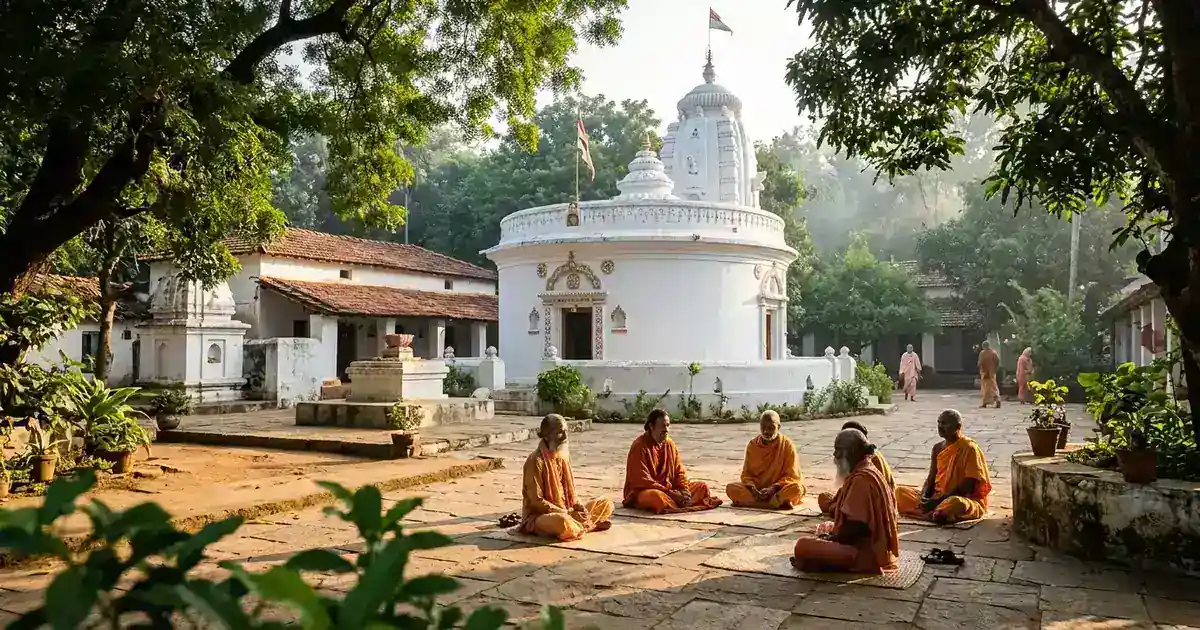
Visiting Joranda Gadi offers travelers a profound departure from typical busy pilgrim hubs. The atmosphere within the ashram walls is peaceful, characterized by wide open lawns, shaded dirt paths, and the faint, sweet scent of burning wood and pure cow ghee.
Because the hermitage operates under disciplined monastic rules, visitors are encouraged to maintain silence and respect the meditation hours of the resident monks. The complex remains accessible throughout the day without commercial entry barriers.
Daily Visiting Schedule and Prayer Hours
The main gates open at 6:00 AM each morning. Ascetic monks begin their daily spiritual duties long before sunrise, gathering in open courtyards to perform prostrations toward the eastern horizon.
Unlike conventional shrines with complex ticketing counters, access to all pavilions across Joranda is unrestricted. Evening prayers occur around sunset, when monks gather before the sacred Dhuni flame to chant devotional hymns until night closure at 8:00 PM.
| Visiting Window | Scheduled Hours | Monastic Practice & Devotional Significance |
|---|---|---|
| Morning Opening | 6:00 AM to 7:00 AM | Gates open, courtyard cleaning, and early morning meditation |
| Public Visiting Hours | 7:00 AM to 12:00 PM | Open exploration of Sunya Mandir and historic ashram grounds |
| Midday Monastic Period | 12:00 PM to 2:00 PM | Monks observe silent reading of philosophical texts |
| Afternoon Visiting Window | 2:00 PM to 5:30 PM | Peaceful walking hours along shaded monastery avenues |
| Evening Dhuni Prayer | 6:00 PM to 7:00 PM | Sacred fire ceremony, conch blowing, and collective chanting |
| Ashram Gate Closure | 7:30 PM to 8:00 PM | Final evening retirement and campus closure |
During the celebrated three-day Joranda Mela held on Magha Purnima, visiting hours extend around the clock. Lakhs of devotees arrive from across India to take part in mass evening prayers around the blazing Dhuni pavilions.
Essential Visitor Facts and Operational Details
The monastic campus covers several acres of land surrounded by tall whitewashed boundary walls. Simple information boards near the entrance explain the historical tenets of the faith and provide basic visitor guidelines.
Updated tourism advisories and cultural calendar details can be reviewed directly on the Official Odisha Tourism Portal and the Shree Jagannatha Temple Administration.
| Visitor Parameter | Practical Detail |
|---|---|
| Spiritual Doctrine | Mahima Dharma (Monotheism & Formless Alekh Brahma) |
| Location | Joranda, Gondia Tehsil, Dhenkanal District, Odisha 759014 |
| Entry Tariff | Completely free admission for all visitors |
| Photography Guidelines | Outer grounds permitted; strictly restricted inside prayer chambers |
| Recommended Dress Code | Modest traditional attire (dhoti, kurta, simple cotton clothing) |
| Ideal Visiting Months | October to March for cool weather; Jan/Feb for Joranda Mela |
| Nearest Railway Station | Dhenkanal Junction (24 km); Hindol Road (18 km) |
| Nearest Airport | Biju Patnaik International Airport, Bhubaneswar (85 km) |
Mahima Dharma: The Philosophy of Alekh Brahma & Anti-Caste Reform
The historical emergence of Mahima Dharma in 19th-century Odisha was a revolutionary cultural event. Founded by the wandering ascetic Mahima Gosain, the movement arose as a powerful reformist challenge against rigid caste divisions, social inequality, and elaborate priestly exploitation.
Mahima Gosain traveled extensively across western and central Odisha, living solely on alms and preaching a message of spiritual liberation accessible to every human being regardless of birth. He proclaimed that God was not confined to stone temples or exclusive ritual formulas.
The Radical Vision of Mahima Gosain and Bhima Bhoi
Mahima Gosain’s philosophy found its most eloquent poetic voice through his foremost disciple, the blind tribal poet-philosopher Santha Bhima Bhoi. Born in western Odisha, Bhima Bhoi composed thousands of moving devotional verses in simple Odia, making profound metaphysical ideas understandable to rural communities. His primary hermitage and memorial shrine are preserved today at the sacred Bhima Bhoi Samadhi Pitha in Subarnapur.
Bhima Bhoi’s legendary couplet, etched into the portals of the United Nations headquarters in New York, captures the core humanitarian compassion of the faith:
“Beholding the misery of boundless lives, who can remain unmoved? Let my soul be cast into eternal torment, if thereby the world may be redeemed.”
This profound empathy fueled the rapid growth of the movement across farming, tribal, and marginalized communities throughout Odisha, Chhattisgarh, Bengal, and Assam.
Rejection of Idol Worship and the Formless Absolute
Central to the faith is the complete rejection of polytheism and image worship. Followers believe that the supreme creator cannot be captured by human artistic representation, sculpted into stone, or bribed with material riches.
Instead, the Divine is reverently addressed as:
- Alekh: The Unwritten and Ineffable One.
- Nirakar: The Formless Reality.
- Sunya Brahma: The Divine Absolute manifested through the infinite cosmos.
Devotees practice simplicity, universal truthfulness, non-injury, and strict equality, refusing to observe caste dining restrictions or touch untouchability customs.
Architectural Monuments: Sunya Mandir, Dhuni Mandir & Gadi Mandir
The physical layout of Joranda Gadi reflects the architectural translation of its formless theology. Rather than following traditional Kalinga temple proportions designed to house an inner sanctum idol, the structures serve as memorial pavilions and communal prayer halls.
Built from whitewashed brick masonry and stone plinths, the monuments stand against an open skyline of tall coconut palms and mango orchards.
The 96-Foot Sunya Mandir: Architecture of Emptiness
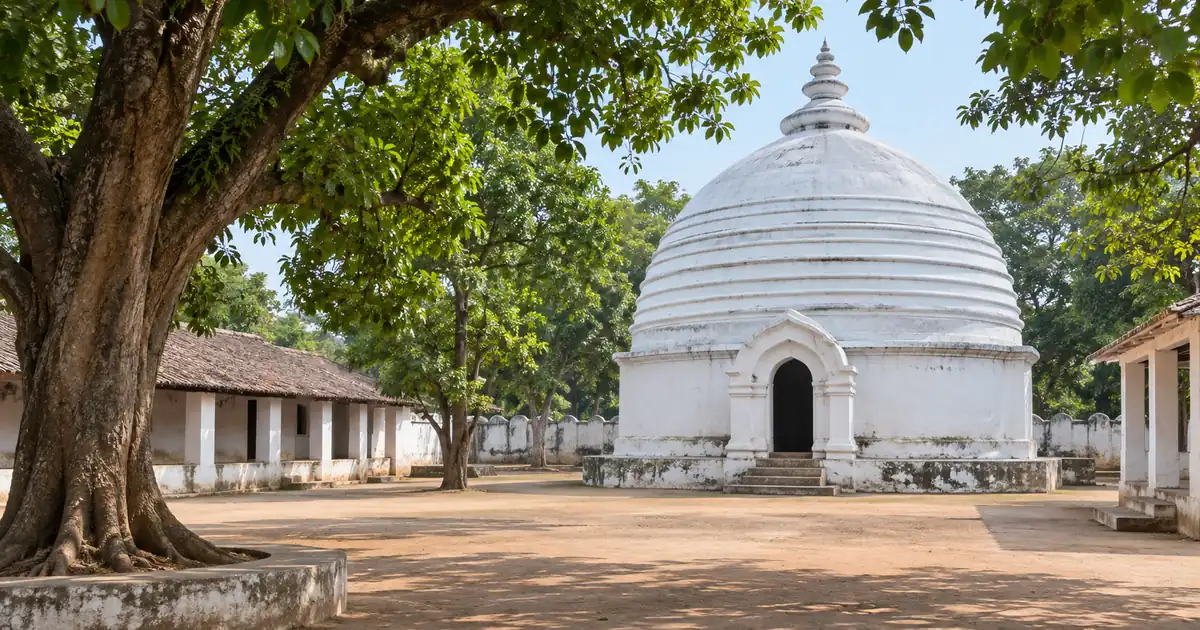
The crowning monument of the campus is the magnificent Sunya Mandir (Temple of the Void), rising to an impressive height of 96 feet. Resembling a towering whitewashed beehive, its conical form is instantly recognizable across the surrounding countryside.
Constructed directly over the sacred burial site (Samadhi) of Mahima Gosain following his passing in 1876, the tower stands as a monument of pure contemplation. Inside the massive central chamber, there are no statues, no altars, and no floral pedestals.
The chamber remains intentionally open and vacant, allowing devotees to meditate solely upon the void (Sunya) that encompasses the supreme creator. Sunlight and fresh air circulate freely through open arched doorways, reinforcing the concept of divine presence without physical boundaries.
The Eternal Flame: Akhanda Dhuni Mandir and Gadi Mandir
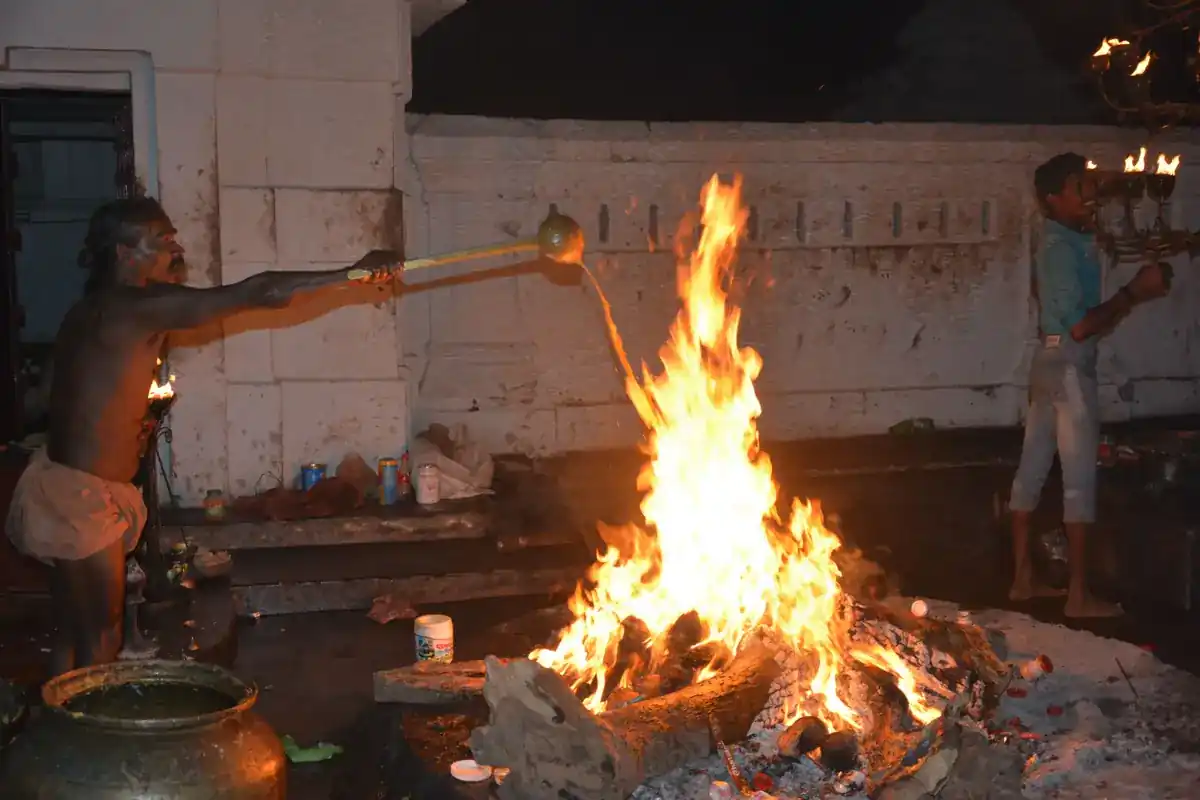
Adjacent to the Sunya Mandir stands the sacred Dhuni Mandir, an open-sided brick pavilion crowned by miniature spires. Inside rests the revered Akhanda Dhuni, a large sunken brick hearth where sacred hardwood logs burn continuously.
Kindled personally by Mahima Gosain in the 19th century, this holy fire has been carefully tended by generations of ascetic monks without ever being allowed to extinguish. Devotees offer pure cow ghee, camphor, and fragrant resin into the flames, viewing fire as a living, purifying manifestation of formless cosmic energy.
Nearby sits the Gadi Mandir, preserving the ceremonial seat and holy relics associated with the founder. Across the paved courtyard, the Niti Mandir and Akhanda Bati Mandir shelter ceremonial umbrellas and unbroken oil lamps used in communal monastic services.
Monastic Life: Kaupinadhari & Bakaldhari Sanyasi Disciplines
The resident community of monks at Joranda lives under rigorous ascetic vows that echo early Buddhist and Vedic monastic codes. The order is traditionally divided into two distinct ascetic brotherhoods:
- The Bakaldhari Order: Senior monks who wear garments crafted from the dried bark fibers of the indigenous Kumbhi tree, representing total detachment from textile commerce and manufactured goods.
- The Kaupinadhari Order: Monks who wear a simple, unstitched white cotton loincloth secured with a sacred cord around the waist.
Both orders observe absolute celibacy, non-violence, and complete renunciation of personal property. Monks possess only a brass water pot, a small palm-leaf umbrella, and a cloth shoulder bag.
[!NOTE] Under traditional monastic law, Mahima sanyasis are strictly forbidden from sleeping in any single village for more than two consecutive nights. This rule prevents monks from forming domestic attachments and ensures their lives remain dedicated to continuous travel and service.
Daily Routines, Sun Salutations, and Strict Monastic Vows
The day for a Mahima monk begins around 4:00 AM with cleansing ablutions and deep meditation. At daybreak, monks assemble in open courtyards to perform the ceremonial Sarana and Darsana prostrations toward the rising sun.
Monks prostrate seven times, touching their foreheads to the bare earth in reverence to Alekh Brahma. A similar prostration ritual is repeated at sunset facing the western sky.
Another strict rule governs dietary habits. Monks take only a single wholesome meal a day, strictly before sunset. Once darkness falls across the earth, no Mahima ascetic will consume food or milk until the sun rises the following morning.
The Grand Joranda Mela & Travel Logistics from Dhenkanal
While Joranda remains a quiet retreat throughout most of the year, it transforms into an awe-inspiring spiritual gathering during the annual Joranda Mela, celebrated over three days on Magha Purnima in January or February.
Lakhs of devotees, spiritual seekers, and wandering ascetics converge upon the village from across eastern India. The festival reaches its devotional climax on the full moon night, when monks gather around the Dhuni pavilions carrying massive brass vessels of clarified butter.
Amidst thunderous collective cries of “Alekh Brahma, Mahima Alekh,” tons of pure ghee are poured into the sacred hearths, sending towers of golden flames soaring into the winter night sky. Devotees believe the rising smoke purifies the regional atmosphere and blesses all humanity with peace.
How to Reach by Road, Train, and Bus from Dhenkanal and Cuttack
Joranda is well connected by paved district roads leading from Dhenkanal town and the National Highway 55 corridor.
| Starting Location | Recommended Transit Route | Distance | Travel Time | Estimated Fare (INR ₹) |
|---|---|---|---|---|
| Dhenkanal Railway Station | Direct Road through Gondia Block | 24 km | 35 to 40 minutes | ₹500 to ₹700 (cab) |
| Dhenkanal Town Bus Stand | Regular Auto-Rickshaw or Taxi | 23 km | 35 minutes | ₹300 to ₹400 (auto) |
| Cuttack Badambadi | Via Manguli Chhak and Dhenkanal | 68 km | 1 hour 40 minutes | ₹1,800 to ₹2,200 (cab) |
| Bhubaneswar Airport | Via NH-55 Expressway Corridor | 85 km | 2 hours 10 minutes | ₹2,400 to ₹3,000 (cab) |
| Local OSRTC Bus | Regular buses toward Gondia block | Direct stop | 50 minutes from town | ₹30 to ₹45 per seat |
Travelers arriving by express train at Dhenkanal Railway Station (DNKL) will find auto-rickshaws and app-based taxis readily available outside the main concourse. The drive to Joranda passes through scenic countryside lined with paddy fields and rolling forested hills.
Day Trip Circuit Pairing: Joranda, Kapilash & Sapua Dam
Because Joranda lies in the northern sector of Dhenkanal district, pairing it with neighboring cultural and scenic highlights creates a balanced full-day circuit:
- Morning at Kapilash Temple: Ascend the forested hill early in the morning to visit Kapilash Temple in Dhenkanal, exploring the medieval shrine of Lord Chandrasekhar and the deer park at the base.
- Midday in Town for Culinary Delights: Stop in Dhenkanal town to enjoy crispy Dhenkanal baras and sample the famous GI-tagged Dhenkanal Magji buffalo cheese sweetmeat.
- Afternoon Exploration at Joranda Gadi: Travel 24 kilometers to Joranda to tour the peaceful Sunya Mandir, observe the Akhanda Dhuni, and speak with resident monks.
- Sunset at Sapua Dam: Conclude your day 30 kilometers south at Sapua Dam, admiring its scenic serpentine spillway against the setting sun, or unwind at Saptasajya Nature Camp.
Frequently Asked Questions (FAQs)
What is the significance of Joranda Gadi in Dhenkanal?
Joranda Gadi is the global spiritual and administrative headquarters of Mahima Dharma, an indigenous monotheistic movement established during the nineteenth century. It houses the sacred Samadhi Pitha of the sect’s founder, Mahima Gosain, along with historical prayer halls dedicated to formless worship.
Why are there no idols inside the Sunya Mandir at Joranda?
The 96-foot Sunya Mandir contains no idols because Mahima Dharma completely rejects image worship and polytheism, teaching that the Supreme Creator, Alekh Brahma, is entirely formless and omnipresent. The vacant central chamber symbolizes the infinite void of divine existence that cannot be limited by sculpted stone.
What is the eternal flame (Akhanda Dhuni) at Joranda?
The Akhanda Dhuni is a sacred perpetual fire preserved inside the Dhuni Mandir that has burned without interruption for more than a hundred and fifty years since being kindled by Mahima Gosain. Devotees offer pure cow ghee into the sacred hearth, viewing the unbroken flame as a living symbol of divine truth and purification.
When is the famous Joranda Mela celebrated and what happens during the festival?
The Joranda Mela is celebrated annually on the full moon day of Magha (January or February), attracting lakhs of ascetics and pilgrims from across India. During the three-day festival, monks offer tons of pure cow ghee into the sacred flames amid collective prayers for world peace and universal brotherhood.
How far is Joranda Mahima Temple from Dhenkanal town and how can travelers reach it?
The temple is situated approximately 24 kilometers northeast of Dhenkanal town along well-paved district roads. Visitors can easily reach the ashram within forty minutes by hiring private taxis, auto-rickshaws, or boarding local public buses operating from Dhenkanal bus station.