Sundargarh District: Steel Capital, Hockey Cradle & Travel Guide
Discover Sundargarh district in Odisha. Explore Rourkela Steel Plant, Birsa Munda Hockey Stadium, Khandadhar Falls, Vedvyas, Mandira Dam, and travel logistics.
Sundargarh district occupies a unique position in eastern India as both a colossal industrial growth engine and the rural cradle of Indian field hockey. Located across the rugged Chota Nagpur plateau fringe in northwestern Odisha, the district unites heavy steel metallurgy with dense sal forests, sacred river confluences, and ancient tribal customs.
From the roaring blast furnaces of the Rourkela Steel Plant to the state-of-the-art Birsa Munda International Hockey Stadium, Sundargarh reflects modern Indian engineering alongside deep grassroots athletic traditions. At the same time, perennial mountain torrents like the 244-meter Khandadhar Waterfall and misty ridges at Tensa draw nature lovers into remote forested valleys.
Today, Sundargarh stands as an essential destination for travelers seeking to understand how industrial modernity, tribal heritage, and sporting passion converge in Western Odisha.
Key Takeaways
- Sundargarh covers 9,712 square kilometers, making it the second-largest district in Odisha by territorial landmass.
- The district recorded a population of 2,093,437 in Census 2011, with tribal communities comprising over 50 percent of the total populace.
- Rourkela functions as the commercial metropolis, home to India’s first public sector integrated steel plant built with German collaboration in the 1950s.
- The district is recognized worldwide as the nursery of Indian field hockey, contributing dozens of Olympians including Hockey India president Dilip Tirkey.
- Major tourist highlights include Khandadhar Waterfall, Vedvyas Temple, Mandira Dam, Tensa Hill Station, and Hanuman Vatika.
Introduction to Sundargarh: The Industrial Dynamo & Sporting Heartland of Odisha
Sundargarh district lies in the northwestern corner of Odisha, positioned between 21°36’ N to 22°32’ N latitude and 83°32’ E to 85°22’ E longitude. The district shares inter-state boundaries with Jharkhand to the north and Chhattisgarh to the west, while bordering Keonjhar to the east and Jharsuguda, Sambalpur, and Deogarh districts to the south.
Spanning 9,712 square kilometers, Sundargarh accounts for 6.23 percent of Odisha’s total geographical area. The district operates under two major urban centers, with administrative headquarters located at Sundargarh town along the Ib River and industrial economic operations centered in the steel city of Rourkela.
The regional administration functions through two Regional Transport Offices, designated as OD-16 for Sundargarh and OD-14 for Rourkela.
| Geographic Metric | Canonical Statistic | Regional Context |
|---|---|---|
| Total Geographical Area | 9,712 sq km | Second-largest district territory in Odisha |
| District Headquarters | Sundargarh Town | Historic administrative seat on the Ib River |
| Major Industrial Metropolis | Rourkela | Steel city and smart urban growth center |
| Geographic Coordinates | 21°36’ N – 22°32’ N, 83°32’ E – 85°22’ E | Chota Nagpur plateau fringe and Brahmani basin |
| Average Elevation | 240 meters (787 feet) above sea level | Undulating hills rising over 900 meters |
| Forest Cover | 4,032 sq km | Over 41.5% of total district territory |
| Motor Vehicle Registration (RTO) | OD-16 (Sundargarh) / OD-14 (Rourkela) | Divided between administrative and industrial hubs |
The climate is tropical dry sub-humid, marked by hot dry summers, torrential monsoon rains, and crisp winters. Summer temperatures from April to June regularly surpass 42°C in urban steel corridors, while winter lows drop to 8°C in hill pockets around Bonai and Tensa between November and February.
Official records, government notifications, and local services are documented on the Odisha Tourism Official Portal and district gazettes.
Geographical Landscape, Brahmani Basin & Natural Ecology
The terrain of Sundargarh presents an undulating plateau landscape fragmented by rugged quartzite hills and dense river drainages. Geologically, the region forms part of the Iron Ore Supergroup and Bonai Pluton, containing some of the oldest Archaean rock formations and richest iron deposits in Asia.
The district’s hydrology is dominated by the sacred confluence of two swift mountain rivers: the Sankh flowing from Jharkhand and the South Koel descending from the Ranchi plateau. These two rivers meet at Vedvyas near Panposh to give birth to the Brahmani River, the second-longest river system in Odisha.
The western sectors of Sundargarh are drained by the Ib River, a prominent tributary of the Mahanadi that feeds downstream into the Hirakud reservoir.
Key river networks and geographical water corridors include:
- Brahmani River: Formed by the union of the Sankh and South Koel at Vedvyas, supplying municipal and industrial water to the Rourkela urban belt.
- Sankh River: Perennial river originating in Jharkhand, dammed at Mandira to supply cooling water for industrial steel plants.
- South Koel River: Fast-flowing river emerging from the northern plateau, joining the Sankh amid rocky granite boulders.
- Ib River: Western drainage corridor that waters the agrarian plains around Sundargarh town and Hemgir coalfields.
- Korapani Nala: Mountain stream feeding the precipitous plunge of Khandadhar Waterfall before joining the Brahmani drainage.
Over 41 percent of Sundargarh remains under dense forest cover, categorized into Northern Tropical Dry Deciduous and Moist Peninsular Sal forests. The forests of Bonai and Lefripada provide natural corridors for wild Asian elephants, leopards, sloth bears, sambar deer, and barking deer.
Valuable forest timber includes Sal (Shorea robusta), Teak, Asan, and Mahua, alongside rich non-timber forest resources like Kendu leaves, Harida, and wild mushrooms.
Historical Evolution: Princely States of Gangpur & Bonai to Modern Era
The territory comprising modern Sundargarh possesses an ancient lineage that traces through prehistoric stone tool sites, medieval tribal chieftaincies, and British colonial treaties. The district was formally constituted on January 1, 1948, following the merger of two historic feudatory princely states: Gangpur and Bonai.
Before the merger, the princely state of Gangpur was governed by the Sekhar Deo dynasty, while Bonai was ruled by rulers of the Kadamba Rajput lineage. Both kingdoms maintained autonomy under the Eastern States Agency of British India until signing the Instrument of Accession to join independent India.
The name “Sundargarh” translates directly to “Beautiful Fort”, referencing the fortified royal residence established along the banks of the Ib River.
| Historical Period | Defining Milestone | Long-Term Regional Significance |
|---|---|---|
| Prehistoric Era | Rock shelters discovered at Manikmunda and Ushakothi | Early human settlement and rock art along river valleys |
| Medieval Centuries | Rule of Gangpur Rajas and Bonai Kadamba chiefs | Tribal consolidation and protection of mountain trade routes |
| Colonial Era (1803–1947) | Eastern States Agency administrative treaties | Integration of local chiefs under British colonial administration |
| January 1, 1948 | Merger of Gangpur and Bonai princely states | Formal formation of modern Sundargarh district |
| 1950s Decade | Establishment of Rourkela Steel Plant with German aid | Foundation of post-independence Indian heavy manufacturing |
| 1990s to Present | Rise of field hockey dominance and smart city growth | Transformation into national athletic cradle and industrial giant |
During the early twentieth century, Sundargarh witnessed significant agrarian resistance movements led by indigenous leaders against oppressive revenue assessments. Tribal hero Nirmal Munda organized the historic Munda agitation in Gangpur state, demanding land rights and forest protections.
Detailed chronological records are preserved within the historical archives of the Sundargarh District Administration Profile.
Following India’s independence, national planners recognized the region’s immense mineral wealth and selected Rourkela as the site for the country’s first public sector steel facility. This historic decision permanently reshaped the demographic, economic, and physical profile of Western Odisha.
Administrative Framework: Subdivisions, Blocks, Tehsils & Constituencies
Sundargarh is organized into a comprehensive administrative hierarchy designed to deliver civic governance across its extensive geographical territory. The district is managed by the District Collector and District Magistrate headquartered in Sundargarh town, while Rourkela maintains a dedicated Additional District Magistrate office and municipal leadership.
Administratively, the district is partitioned into three revenue subdivisions: Sundargarh, Panposh, and Bonai. These subdivisions oversee seventeen community development blocks and eighteen tehsils.
Urban administration is directed by the Rourkela Municipal Corporation (RMC), alongside three municipalities located at Sundargarh, Rajgangpur, and Biramitrapur.
| Administrative Tier | Structural Division Count | Designated Administrative Units |
|---|---|---|
| Revenue Subdivisions | 3 Subdivisions | Sundargarh, Panposh, Bonai |
| Community Development Blocks | 17 Blocks | Balisankara, Bargaon, Bisra, Bonaigarh, Gurundia, Hemgir, Koida, Kuarmunda, Kutra, Lahunipara, Lathikata, Lefripada, Nuagaon, Rajgangpur, Subdega, Sundargarh, Tangarpali |
| Revenue Tehsils | 18 Tehsils | Sundargarh, Hemgir, Lephripara, Bargaon, Subdega, Balisankara, Tangarpali, Rajgangpur, Kutra, Panposh, Rourkela, Bisra, Kuanrmunda, Lathikata, Bonaigarh, Lahunipara, Gurundia, Koira |
| Urban Local Bodies (ULBs) | 4 ULBs | Rourkela Municipal Corporation, Sundargarh Municipality, Rajgangpur Municipality, Biramitrapur Municipality |
| Gram Panchayats | 279 Panchayats | Grassroots rural village governance councils |
| Assembly Constituencies (MLAs) | 7 Vidhan Sabha Seats | Talsara (ST), Sundargarh (ST), Biramitrapur (ST), Raghunathpali (SC), Rourkela (GEN), Rajgangpur (ST), Bonai (ST) |
| Parliamentary Constituency | 1 Lok Sabha Seat | Sundargarh (ST) Parliamentary Constituency |
In democratic governance, Sundargarh encompasses seven legislative assembly constituencies. Six of these assembly seats are reserved for Scheduled Tribes and Scheduled Castes, reflecting the district’s indigenous demographic composition.
The entire district unites under the Sundargarh Lok Sabha seat, which remains a key tribal constituency in national parliamentary affairs.
Demographic Profile & Tribal Heritage: Census 2011 Analysis
According to the official 2011 Census of India, Sundargarh recorded a total population of 2,093,437 individuals, representing an 8.43 percent increase over the 2001 count. The district comprises 1,061,147 males and 1,032,290 females, resulting in a balanced sex ratio of 973 females per 1,000 males.
The average population density stands at 216 persons per square kilometer, which remains well below the state average of 270 due to rugged hill ranges and vast forest reserves. The overall literacy rate reached 73.34 percent in 2011, with male literacy recorded at 81.01 percent and female literacy standing at 65.48 percent.
Over 35 percent of the population resides in urban agglomerations, driven by the cosmopolitan workforce of Rourkela, Rajgangpur, and Biramitrapur.
| Demographic Metric | Census 2011 Figure | State & Regional Context |
|---|---|---|
| Total Population | 2,093,437 | 4.99% of Odisha’s total population |
| Male Population | 1,061,147 | 50.7% of total district population |
| Female Population | 1,032,290 | 49.3% of total district population |
| Sex Ratio | 973 females per 1,000 males | Close to Odisha state average (979) |
| Population Density | 216 persons per sq km | Low density due to 41.5% forest terrain |
| Overall Literacy Rate | 73.34% | Above state average (72.87%) |
| Male Literacy Rate | 81.01% | High industrial technical literacy |
| Female Literacy Rate | 65.48% | Steady rural school enrollment gains |
| Scheduled Tribe (ST) Share | 50.75% (1,062,338 persons) | Majority indigenous demographic presence |
| Scheduled Caste (SC) Share | 9.17% (191,908 persons) | Significant artisanal and labor communities |
Sundargarh is characterized by its demographic tribal majority, with Scheduled Tribes accounting for 50.75 percent of the district population. Major tribal groups include the Oraon (Kurukh), Munda, Kisan, Kharia, Gond, and the primitive Pauri Bhuiyan community residing in the Bonai highlands.
Each indigenous community maintains distinct oral dialects, Clan totems, and traditional councils headed by village elders known as Gauntias or Padhans.
Industrial Vanguard: Rourkela Steel Plant & Mineral Corridors
Sundargarh is widely recognized as the industrial capital of northern Odisha, driven by abundant deposits of iron ore, dolomite, limestone, and coal. The centerpiece of this industrial empire is the Rourkela Steel Plant (RSP), managed by the public sector giant Steel Authority of India Limited (SAIL).
Commissioned in 1959 under the visionary leadership of Prime Minister Jawaharlal Nehru, RSP was India’s first integrated steel plant in the public sector. The facility was established with West German technological collaboration involving engineering firms Krupp and Demag, introducing modern LD oxygen steelmaking technology to Asia.
Today, RSP produces high-grade hot rolled coils, plates, silicon steel sheets, and pipes used in defense submarines, national pipelines, and aerospace structures.
| Industrial Facility / Company | Core Sector | Operational Scale & Product Output |
|---|---|---|
| Rourkela Steel Plant (SAIL) | Integrated Iron & Steel | Over 4.5 million tonnes crude steel capacity; heavy plates and coils |
| Dalmia Cement Bharat Ltd | Cement & Refractory | Massive manufacturing hub at Rajgangpur producing specialized cement |
| Biramitrapur Limestone Mines (BSLC) | Flux Minerals & Mining | One of India’s largest quarries for industrial limestone and dolomite |
| Odisha Mining Corporation (OMC) | Iron Ore Extraction | Extensive mechanized open-cast mines across the Koira and Barsuan belts |
| NTPC Darlipali Super Thermal | Electric Power Generation | 1,600 MW mega thermal plant supplying grid power across eastern states |
| Mahanadi Coalfields Ltd (MCL) | Fossil Energy Extraction | Open-cast coal mines in the Hemgir and Basundhara mining corridors |
Beyond basic steel production, Sundargarh supports an extensive ancillary manufacturing corridor supplying foundry castings, machine tools, and refractory bricks. In Rajgangpur, Dalmia Cement operates one of the oldest and largest cement factories in eastern India.
Mining activities across Koira, Barsuan, and Kalta extract millions of tonnes of hematite iron ore each year to feed domestic blast furnaces and export shipping docks.
Visitors can explore the deep technical legacy of the plant by reviewing the Rourkela Steel Plant Historical Monograph.
Cradle of Indian Hockey: Birsa Munda Stadium & Sporting Legends
Field hockey is not merely a sport in Sundargarh; it functions as an authentic way of life and an emotional cultural pulse. The forested blocks of Balisankara, Saunamura, Bargaon, and Subdega are revered across India as the nursery of international hockey talent.
Young tribal boys and girls learn stickhandling barefoot on red dirt fields, crafting hockey sticks from curved bamboo roots known as Kendu branches. Rural communities organize traditional village competitions called Khasi Cups, where teams compete with intense passion for a celebratory community feast.
Over the past four decades, Sundargarh has contributed more than sixty international players to Indian senior national squads.
Sundargarh legends have captained national teams and secured Olympic glory across multiple generations:
- Dilip Tirkey: Former captain of Team India, three-time Olympian, legendary defender with over 400 international caps, and current President of Hockey India.
- Lazarus Barla: Stalwart international defender who represented India at the Sydney Olympics and secured gold at the 1998 Asian Games.
- Ignace Tirkey & Prabodh Tirkey: Esteemed brothers who captained Indian national squads through major international trophy campaigns.
- Amit Rohidas: Double Olympic bronze medalist renowned as one of the world’s finest defensive first rushers against penalty corners.
- Deep Grace Ekka: Influential defensive stalwart who anchored the Indian Women’s National Hockey Team at the Tokyo Olympics.
The district’s sporting prestige reached a global zenith with the construction of the Birsa Munda International Hockey Stadium in Rourkela. Built in an incredible fifteen months inside the BPUT campus, the stadium holds the official Guinness World Record as the world’s largest fully-seated hockey stadium with 20,011 individual spectator seats.
The arena co-hosted the historic Men’s FIH Hockey World Cup tournament alongside Kalinga Stadium in Bhubaneswar, welcoming top international squads.
Structural dimensions and tournament records are cataloged in the Birsa Munda International Hockey Stadium Survey.
Today, every one of Sundargarh’s seventeen blocks features modern synthetic astroturfs installed by state authorities, ensuring the next generation trains on Olympic-standard surfaces.
Sacred Confluences & Shrines: Vedvyas Temple & Hanuman Vatika
Sundargarh preserves ancient spiritual monuments that blend mythological literature with placid river landscapes. The most revered pilgrimage site in the district is the sacred Vedvyas Temple, located twelve kilometers west of Rourkela at the meeting point of the Sankh and South Koel rivers.
According to enduring Vedic tradition, Sage Krishna Dvaipayana Ved Vyasa established his forest hermitage here on an elevated rocky outcropping. Within an underground cave sanctuary overlooking the water, he is believed to have compiled the monumental epic Mahabharata and transcribed the four Vedas.
The river confluence, known as the Triveni Sangam due to a mythical underground Saraswati current, attracts thousands of pilgrims during Maha Shivratri for holy ablutions.
Within the urban heart of Rourkela stands Hanuman Vatika, a masterfully landscaped temple garden spanning thirteen acres. The central attraction of this spiritual complex is a majestic 75-foot-tall statue of Lord Hanuman, inaugurated in 1994 as one of the tallest religious statues in eastern India.
Surrounding the central monument are replica shrines dedicated to Lord Jagannath, Maa Sarala, Bimaleswar Shiva, and Vaishno Devi, offering a tranquil retreat from industrial activity.
Prominent sacred shrines and spiritual centers across the district include:
- Vedvyas Cave & Shiva Sanctum: Sacred rock-cut cavern where Sage Vyasa composed scripture, featuring a natural underground spring.
- Hanuman Vatika Complex: Thirteen-acre spiritual sanctuary housing the iconic 75-foot Hanuman monument and multi-deity temples.
- Vaishnodevi Temple Rourkela: Hilltop shrine constructed atop Durgapur hill, replicating the famous cave passage of Jammu.
- Ghisida Shiva Temple: Historic Shaivite shrine in Hemgir block, known for ancient stone lingams and annual Shravan gatherings.
- Maa Tarini Temple at Panposh: Riverside shrine dedicated to the benevolent goddess, visited daily by traveling drivers and pilgrims.
Cascading Natural Wonders: The Magnificent Khandadhar Waterfall
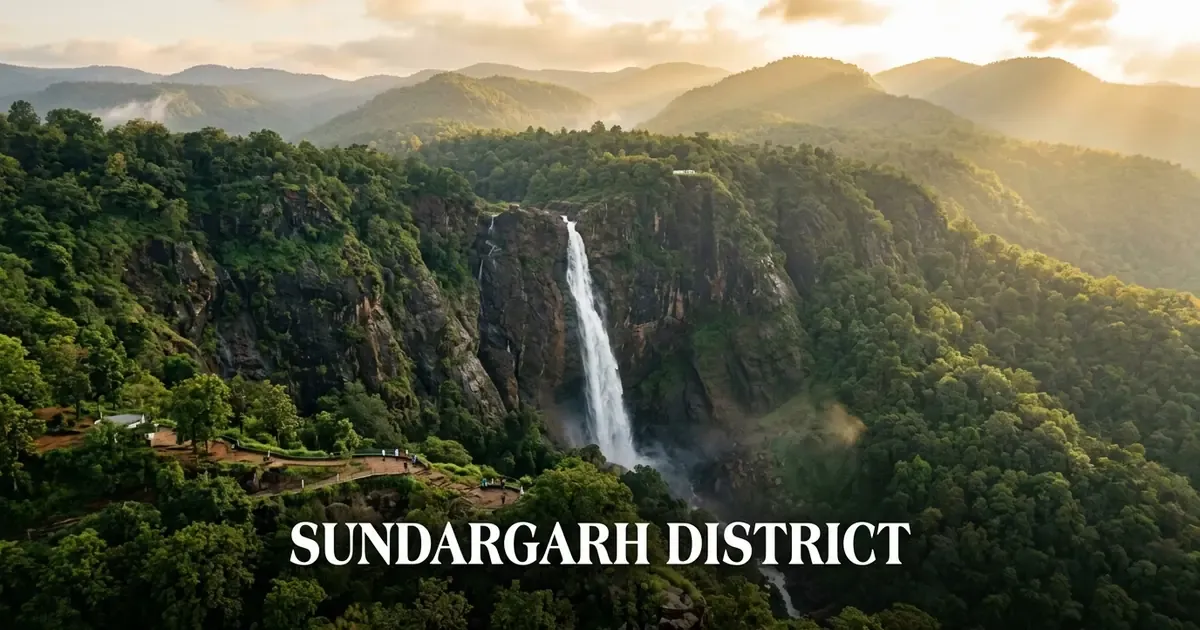
In the deep forested wilderness of Bonai subdivision plunges the magnificent Khandadhar Waterfall, one of the most dramatic natural wonders in eastern India. Plunging from an unbroken vertical drop of 244 meters (801 feet), Khandadhar ranks as the second-tallest waterfall in Odisha after Barehipani in Similipal.
The perennial Korapani Nala stream descends over an inclined volcanic cliff like an unsheathed silver sword, creating a perennial cloud of cool mist across the valley floor. The name derives from the Odia words Khanda meaning sword and Dhara signifying streaming cascade.
Geological surveys indicate the surrounding rock beds belong to the ancient Bonai Pluton, where iron-rich basalt creates dark cliff faces that contrast sharply with foaming white mountain water.
Visitors can explore detailed geological records via the Khandadhar Waterfall Geographical Profile.
The falls are situated approximately 104 kilometers south of Rourkela and nineteen kilometers from Bonaigarh. Visitors can ascend a well-maintained 900-step stone stairway flanking the gorge to reach panoramic viewing platforms overlooking the upper plunge pool.
Travelers looking for overnight wilderness stays can reserve eco-cottages at the Khandadhar Waterfalls eco-tourism nature camp, managed by local forest protection committees.
The surrounding Rantha plateau is also the ancestral home of the vulnerable Pauri Bhuiyan tribal community, who honor the waterfall deity Kankala Devi through annual agricultural rituals.
Dams, Lakes & Mountain Escapes: Mandira Dam & Tensa Hill Valley
Sundargarh offers striking water bodies and elevated mountain valleys that provide refreshing retreats from steel foundries and urban roads. Located twenty-four kilometers west of Rourkela on the Sankh River, Mandira Dam is an expansive artificial reservoir constructed in 1957 to fulfill the heavy water demands of the Rourkela Steel Plant.
Framed by green hill ranges, Mandira has evolved into a popular weekend boating and picnic destination. Visitors can hire paddle boats, view peaceful aquatic scenery, or explore quiet lakeside gardens maintained by SAIL authorities.
Access permits are easily obtained at the entry security gate, making it a favorite excursion for families and photography enthusiasts.
High up in the Bonai hill range, perched at an elevation of 3,700 feet above sea level, lies the misty mountain retreat of Tensa. Often described as the hill station of Sundargarh, Tensa is enveloped in cool alpine breezes, rolling iron ore hills, and dense sal canopies that stay pleasantly cool even during summer months.
The region serves as an active mining settlement for the Steel Authority of India, where terraced open-cast iron quarries contrast dramatically with undisturbed primary jungle.
Key scenic dams, reservoirs, and mountain escapes across Sundargarh include:
- Mandira Dam Reservoir: Vast artificial lake on the Sankh River offering scenic boat tours and lakeside picnic spots.
- Tensa Hill Valley: Elevated hill station located 1,100 meters above sea level, famous for morning mist, cool weather, and iron ore lookouts.
- Sarafgarh Dam & Nature Camp: Tranquil reservoir in Lephripara block near Sundargarh town, featuring an eco-retreat and boating facilities.
- Darjeeng Picnic Point: Scenic riverbank recreation zone along the Brahmani River, ideal for quiet day outings.
- Pitamahal Dam: Compact irrigation dam situated sixteen kilometers from Rourkela, surrounded by dense low-lying hillocks.
Nature travelers seeking peaceful forest stays can book eco-cottages at the scenic Tensa Nature Camp retreat to experience morning mist and sweeping valley vistas.
Academic Excellence & Urban Landscape: NIT Rourkela & BPUT Hub
In addition to its industrial prominence, Sundargarh serves as a prestigious center for higher technical education and scientific research in eastern India. The intellectual flagship of the district is the National Institute of Technology (NIT) Rourkela, recognized as an Institution of National Importance by the Government of India.
Founded in 1961 as the Regional Engineering College (REC) Rourkela, the institute spans an expansive 647-acre campus equipped with modern laboratories, supercomputing centers, and innovation incubation hubs. NIT Rourkela consistently ranks among the top engineering universities nationwide in NIRF rankings, attracting exceptional faculty and students across disciplines.
The city also hosts the headquarters of the Biju Patnaik University of Technology (BPUT), the state coordinating university that governs over one hundred engineering, management, and pharmacy colleges across Odisha.
Prominent academic and research institutions across Sundargarh include:
- National Institute of Technology (NIT) Rourkela: Leading engineering university renowned for metallurgical research, computer sciences, and material engineering.
- Biju Patnaik University of Technology (BPUT): State coordinating headquarters for technical and professional university education.
- Government Autonomous College Rourkela: Historic undergraduate and postgraduate college delivering quality arts, science, and commerce degrees.
- Rourkela Institute of Management Studies (RIMS): Established regional center for postgraduate business administration and computing studies.
- Hi-Tech Medical College & Hospital Rourkela: Modern medical teaching hospital providing advanced healthcare services to northern Odisha.
The urban landscape of Rourkela is thoughtfully planned, divided into the tranquil SAIL Township and the energetic Civil Township. Wide tree-lined avenues, planned sector layouts, abundant neighborhood parks, and modern civic infrastructure give Rourkela a unique standard of living among industrial cities.
The ongoing Smart Cities Mission has modernized street lighting, automated public services, and renovated urban open spaces across the city.
Tribal Art, Weekly Haats & Indigenous Culture
The cultural identity of Sundargarh is deeply anchored in the artistic expressions, community dances, and village markets of its tribal communities. The Oraon, Munda, and Kharia peoples celebrate seasonal rhythms through community dance ceremonies accompanied by the deep rhythmic beat of the Madal (earthen drum), Dhol, and Flute.
One of the most joyous tribal celebrations is the Karma Festival, observed in the month of Bhadrabada (August-September). Villagers gather to plant sacred branches of the Karam tree in the village center, dancing through the night to invoke prosperity and agricultural abundance.
Other vital festivals include Sarhul, which celebrates the spring flowering of sacred sal trees, and Sohrai, an agrarian cattle blessing festival featuring geometric wall murals.
| Cultural Tradition / Craft | Practicing Communities | Description & Artistic Characteristics |
|---|---|---|
| Karma Dance & Music | Oraon, Munda, Kharia, Kisan | Lively community circle dances set to the rhythmic pulse of the Madal and flute |
| Karam Wall Murals (Jhoti/Chita) | Rural tribal households | Geometric tribal murals painted with natural rice paste and red ochre clays |
| Bamboo & Cane Weaving | Mahali and local artisans | Intricately woven grain baskets, fishing traps, and household mats |
| Weekly Village Haats | Multi-tribal rural gatherings | Traditional barter and open-air markets held in Nuagaon, Bonaigarh, and Lahunipara |
| Sarhul Spring Festival | Munda and Oraon communities | Sacred worship of Sal blossoms celebrating nature’s rebirth in early spring |
| Pauri Bhuiyan Woodcraft | Bonai hill artisans | Hand-carved wooden tobacco containers, wooden masks, and agricultural tools |
A defining aspect of rural economic life in Sundargarh is the weekly village market, locally known as the Haat. Held on designated weekdays in central villages like Bonaigarh, Lahunipara, and Hemgir, these markets serve as energetic social and commercial gathering points.
Tribal villagers walk miles to sell forest-collected Mahua blossoms, fragrant wild honey, seasonal wild mushrooms, and hand-woven bamboo baskets. Visitors exploring these markets can witness authentic rural exchange and purchase genuine handicrafts directly from village artisans.
Culinary Identity: Forest Produce, Rice Delicacies & Steel City Street Food
The culinary culture of Sundargarh presents a delectable contrast between traditional tribal forest cuisine and the diverse cosmopolitan palate of a steel boomtown. In rural tribal homes, cooking revolves around seasonal forest produce gathered from surrounding hillsides.
A cherished monsoon specialty is Rugda, a small subterranean puffball mushroom that grows beneath sal trees after early rains. When cooked with mustard paste, garlic, and wild spices, Rugda delivers a firm, earthy texture celebrated by food lovers across Western Odisha.
Another forest staple is Kardi and Hendua, made from tender bamboo shoots that are cooked fresh or sun-dried into tangy, fermented seasoning flakes.
Traditional culinary specialties and beloved local preparations include:
- Rugda Curry: Rich, earthy curry made from wild subterranean sal mushrooms harvested during the early monsoon season.
- Kardi & Hendua Preparations: Tender bamboo shoot dishes cooked fresh with mustard gravy or preserved as tangy dried seasoning flakes.
- Chaula Bara: Crispy golden fritters prepared from soaked rice paste and black gram, served hot with tangy tomato and tamarind chutneys.
- Handia: Traditional mild rice beverage naturally fermented using indigenous herbal cakes (Ranu), consumed during rural festivals.
- Steel City Street Food: Cosmopolitan chaat varieties, spicy mutton rolls, Mughlai parathas, and vegetable cutlets popular around Rourkela’s Ambagan market.
In the urban sectors of Rourkela, industrial migration has fostered an exceptionally diverse street food scene. Markets like Ambagan, VIP Market, and Sector-5 Market come alive every evening with food stalls serving regional Odia delicacies alongside North Indian, Bengali, and Chinese street fare.
Visitors can enjoy piping-hot Chaula Bara, spiced mutton cutlets, Kolkata-style kathi rolls, and traditional chenna sweets in lively evening markets.
Transportation & Transit Logistics: Reaching and Navigating Sundargarh
Sundargarh is strategically positioned along key transportation arteries connecting Odisha with Jharkhand, Chhattisgarh, and West Bengal. Travelers can easily reach the district via modern aviation facilities, trunk rail corridors, and four-lane expressways.
The city of Rourkela is served by the commercial Rourkela Airport (RRK), operating scheduled flights under the UDAN regional connectivity scheme to Bhubaneswar and Kolkata.
For comprehensive flight networks, Veer Surendra Sai Airport in nearby Jharsuguda sits just ninety kilometers to the southwest, offering regular flights to New Delhi, Bengaluru, Hyderabad, and Mumbai.
Sundargarh’s rail and highway connections provide exceptional transit access across eastern India:
- Rail Connections: Rourkela Railway Junction (ROU) is a major A-category junction on the Howrah-Mumbai main trunk line, serviced by daily Superfast, Vande Bharat, and Rajdhani express trains.
- Road Infrastructure: The district is traversed by National Highway 143 (NH-143) connecting Ranchi to Barkote, alongside State Highway 10 and the four-lane Biju Expressway.
- Bus Networks: The interstate bus terminals in Rourkela and Sundargarh town run round-the-clock air-conditioned luxury coaches and OSRTC services to Bhubaneswar, Cuttack, Sambalpur, and Raipur.
- Air Connectivity: Scheduled flights operate from Rourkela Airport, complemented by high-frequency domestic flights through Jharsuguda Airport ninety minutes away.
The table below outlines travel distances, transit modes, and typical travel times to Rourkela from prominent regional hubs.
| Origin City | Travel Mode | Primary Highway / Rail Route | Distance | Typical Travel Time |
|---|---|---|---|---|
| Bhubaneswar | Rail | Direct Vande Bharat / Intercity Express | 415 km | 5 hours 15 minutes |
| Bhubaneswar | Road / Bus | NH-55 and Biju Expressway / NH-143 | 330 km | 7 hours 30 minutes |
| Jharsuguda (Airport) | Road / Rail | State Highway 10 / Biju Expressway | 90 km | 1 hour 30 minutes |
| Kolkata (Howrah) | Rail | Direct Howrah-Mumbai Trunk Route | 415 km | 6 hours 00 minutes |
| Ranchi (Jharkhand) | Road / Rail | Direct NH-143 Highway Corridor | 165 km | 3 hours 45 minutes |
| Sambalpur | Road / Rail | Four-lane Biju Expressway | 140 km | 2 hours 15 minutes |
Local commuting across Rourkela, Panposh, and Sundargarh town is managed by city buses, auto-rickshaws, and app-based taxi aggregators. Travelers can easily combine trips to explore the neighboring cultural center of Sambalpur district via the four-lane Biju Expressway.
Private rental taxis are readily available at Rourkela Railway Station for day excursions to Khandadhar Waterfall, Mandira Dam, and Tensa.
Seasonal Weather & Optimal Travel Timings
Planning a journey to Sundargarh requires careful consideration of the district’s distinct inland seasons. Because northern Odisha experiences sharp temperature swings between summer and winter, selecting the right travel window ensures a safe and rewarding exploration.
The seasonal overview below details weather conditions, average temperatures, and sightseeing recommendations across the calendar year.
| Season | Calendar Months | Temperature Range | Weather Characteristics | Travel Feasibility & Advice |
|---|---|---|---|---|
| Winter | October to February | 8°C – 28°C | Cool crisp mornings; mild golden sunshine | Peak Travel Season: Perfect for visiting Khandadhar Waterfall, Mandira Dam, and Tensa |
| Summer | March to June | 26°C – 44°C | Intense dry heat; high afternoon temperatures | Restrict outings to early morning and late evening; carry hydration and sun hats |
| Monsoon | July to September | 24°C – 32°C | Heavy tropical rainfall; lush green hills | Best for viewing roaring waterfalls; mountain roads may require cautious driving |
The optimal period to explore Sundargarh district is from October to February. During these winter months, daytime temperatures stay pleasantly mild between 18°C and 25°C, making hiking up the 900 steps of Khandadhar Waterfall or attending matches at the Birsa Munda Stadium enjoyable.
Nights turn brisk, with temperatures in elevated valleys like Tensa occasionally dipping below 8°C, calling for warm woolen clothing.
The monsoon season from July to September brings impressive visual grandeur as mountain torrents swell to maximum capacity and the sal forests turn emerald green. However, travelers should check local weather advisories before driving on winding ghat roads in Bonai and Koira during heavy rainstorms.
Summer months from April to June are characterized by fierce heat waves, with urban temperatures in Rourkela regularly exceeding 42°C, making outdoor midday travel uncomfortable.
Accommodation, Local Etiquette & Practical Travel Advice
Sundargarh offers diverse hospitality facilities suited for corporate travelers, tourists, sports fans, and nature enthusiasts. In Rourkela, modern luxury and business hotels cluster around Main Road, Bisra Road, and Civil Township, offering air-conditioned rooms, business amenities, and multi-cuisine dining.
For university and stadium visitors, the World Cup Village guest suites near BPUT provide contemporary accommodations.
Nature lovers can reserve government eco-tourism retreats, including the scenic cottages at Khandadhar Nature Camp and Tensa Nature Camp, which offer guided treks and organic meals prepared by local community self-help groups.
To ensure a smooth, respectful, and safe journey through Sundargarh, travelers should observe several practical guidelines:
- Sacred Shrine Etiquette: Remove leather items and footwear before entering temple premises at Vedvyas and Hanuman Vatika. Dress modestly in clothing that covers shoulders and knees.
- Khandadhar Trekking Preparation: Climbing the 900 stone steps at Khandadhar Waterfall requires moderate physical endurance. Wear sturdy sports shoes, carry water bottles, and avoid venturing onto slippery wet boulders near the plunge pool.
- Industrial and Plant Security: Rourkela Steel Plant is a high-security industrial installation. Public entry into manufacturing areas requires prior administrative clearance from SAIL authorities, and photography is prohibited inside factory gates.
- Ghat Road Driving Caution: The hilly roads winding through Bonai, Koira, and Tensa experience heavy mining truck traffic. Exercise extra caution when driving around sharp mountain bends, particularly during monsoon rainfall or winter morning fog.
- Tribal Village Etiquette: When visiting rural haats or indigenous hamlets, always ask for permission before taking photographs of village residents or tribal elders.
Frequently Asked Questions (FAQ) About Sundargarh District
What is Sundargarh district famous for?
Sundargarh district is famous worldwide as the cradle of Indian field hockey and the home of the monumental Rourkela Steel Plant. The district also attracts travelers with natural landmarks such as the 244-meter Khandadhar Waterfall, sacred shrines like Vedvyas Temple, and the Guinness World Record-holding Birsa Munda International Hockey Stadium.
Why is Sundargarh called the cradle of Indian field hockey?
Sundargarh has earned this reputation by nurturing more than sixty international players for Indian national teams, including legends Dilip Tirkey, Lazarus Barla, and Amit Rohidas. Field hockey is deeply ingrained in tribal village traditions, supported by modern synthetic astroturfs installed across every block in the district.
How high is Khandadhar Waterfall in Sundargarh?
Khandadhar Waterfall plunges from a magnificent uninterrupted vertical height of 244 meters (801 feet), making it the second-tallest waterfall in Odisha after Barehipani. The cascade forms an iconic horse-tail pattern over iron-rich volcanic cliffs in the Bonai subdivision.
What is the historical significance of Vedvyas Temple in Rourkela?
Vedvyas Temple marks the sacred confluence of the Sankh and South Koel rivers where they unite to form the Brahmani River. According to Vedic tradition, Sage Ved Vyasa lived here in an underground cave and compiled the revered epic Mahabharata.
What is the best time of year to visit Sundargarh district?
The ideal time to visit Sundargarh district is between October and February, when pleasant winter weather brings temperatures ranging from 8°C to 28°C. These cool, dry months provide comfortable conditions for hiking to Khandadhar Waterfall, exploring Tensa hill station, and sightseeing in Rourkela.