Ratnagiri Buddhist Monastery Jajpur: History & Travel Guide
Discover Ratnagiri Buddhist Monastery in Jajpur, Odisha. Explore Monastery 1 chlorite doorway, colossal Buddha, Mahastupa, ASI museum, timings, and routes.
Ratnagiri Buddhist Monastery in Jajpur district represents the crowning jewel of ancient Buddhist monastic architecture in eastern India. Known historically as the “Hill of Jewels,” this sprawling archaeological complex was established during the fifth century and flourished through the thirteenth century as an international university of Mahayana and Vajrayana philosophy. Together with nearby Lalitgiri and Udayagiri, it anchors Odisha’s famed Diamond Triangle Buddhist circuit.
The institution rivaled Nalanda in academic prestige and played a seminal role in developing the esoteric Kalachakra Tantra tradition. Today, the monument is protected and maintained by the Archaeological Survey of India alongside tourism resources provided by the Odisha Tourism Development Corporation.
Key Takeaways
- Location & Geography: Situated on an isolated hillock in Bari Block of Jajpur district, 100 km northeast of Bhubaneswar and 21 km from Jajpur town.
- Primary Architectural Highlight: Monastery 1 houses an exquisite green chlorite entrance portal hailed by archaeologists as the finest in India, leading to a 12-foot colossal Buddha sanctum.
- Visiting Hours: Monastic ruins are open daily from 9:00 AM to 5:00 PM; the adjacent ASI Archaeological Museum is open 9:00 AM to 5:00 PM and closed on Fridays.
- Admission Tariffs: Ruins entry costs ₹25 for Indian, BIMSTEC, and SAARC visitors, and ₹300 for foreigners; museum admission is ₹5.
- Circuit Travel: Easily paired with Udayagiri and Lalitgiri as a complete full-day excursion from Bhubaneswar or Cuttack.
Ratnagiri at a Glance: Timings, Entry Fees & Quick Visitor Facts
Ratnagiri welcomes cultural historians, travelers, and spiritual seekers six days a week for the combined museum and monument experience, and seven days a week for the open-air archaeological ruins. Because the excavation site sits across an elevated hillock bordered by the Birupa and Brahmani rivers, exploring the courtyards offers sweeping views across rural farmland.
The table below summarizes all primary logistical details, operating hours, ticket prices, and transit markers to help you organize a hassle-free visit:
| Metric / Parameter | Visitor Information |
|---|---|
| Site Name | Sri Ratnagiri Mahavihara Archaeological Complex |
| District & Administrative Block | Jajpur District (Bari Block), Odisha |
| Ruins Visiting Hours | 9:00 AM – 5:00 PM (Open all 7 days) |
| ASI Site Museum Hours | 9:00 AM – 5:00 PM (Strictly closed on Fridays) |
| Ruins Entry Fee | ₹25 (Indians, SAARC, BIMSTEC); ₹300 (Foreign nationals) |
| Museum Entry Fee | ₹5 per person (Children under 15 enter free) |
| Nearest Railway Junction | Jajpur Keonjhar Road (JJKR, 35 km) |
| Recommended Visit Time | 2.5 to 3.5 hours for ruins and museum |
Visiting Hours, Gate Rules and Museum Schedule
The open-air monastic excavations remain open daily from 9:00 AM until 5:00 PM without midday closures. Visitors should allocate at least two hours to examine Monastery 1, Monastery 2, the Mahastupa, and the votive stupa fields.
Travelers must pay careful attention to the calendar when planning a journey. The four-gallery ASI Site Museum located at the base of the hill closes every Friday for conservation maintenance. Scheduling your tour between Saturday and Thursday ensures full access to both the open-air stone ruins and the priceless excavated bronze galleries.
Ticket Counters, Cashless Entry and Free Admission Categories
Visitors can purchase admission tickets directly at the entry gate using digital UPI payments or debit cards, as well as cash. In accordance with central government heritage policies, children under fifteen years of age enter both the excavated ruins and the archaeological museum free of charge.
Still photography with handheld digital cameras and personal smartphones is permitted throughout the outdoor complex without extra fees. Visitors asking about ratnagiri photography charges will find that personal non-commercial shooting is completely free, while professional tripod usage, commercial filming, and drone videography require formal written clearance from the ASI circle office in Bhubaneswar.
Monastery 1: The Celebrated Chlorite Doorway and Colossal Buddha Sanctum
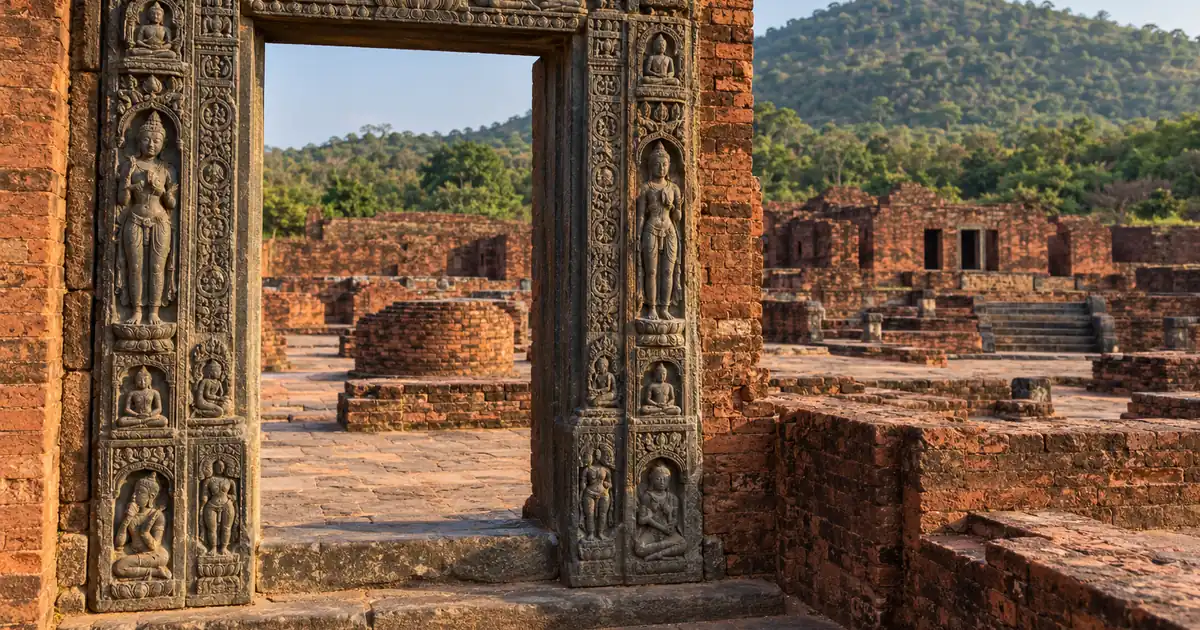
Monastery 1 constitutes the grandest structural complex at Ratnagiri, built in a quadrangular layout with a central paved courtyard surrounded by residential monastic cells. The entrance facade is constructed from fine-grained, greenish-blue chlorite stone, contrasting brilliantly against the surrounding burnt-clay brickwork.
When eminent archaeologist Debala Mitra directed the systematic excavations between 1958 and 1961, she documented this portal as one of the supreme achievements of Indian stone masonry. She famously described the doorway as the loveliest entrance to a structural monastery in the whole of India.
[!NOTE] Monastery 1 Architectural Composition
- Entrance Portal: Multi-banded chlorite frame featuring flowing foliated scrolls, playful celestial lovers, and guardian figures of Yamuna.
- Central Courtyard: Vast stone-flagged quadrangle flanked by twenty-four residential monk cells across two original stories.
- Main Sanctum: Large vaulted chamber sheltering a 12-foot seated Buddha touching the earth in Bhumisparsha mudra, flanked by Padmapani and Vajrapani.
Debala Mitra’s Excavation and The Green Chlorite Portal
The chlorite doorway displays multiple concentric decorative bands carved in deep relief. The innermost bands feature intricate foliage arabesques, followed by rows of flying celestial beings (vidyadharas) and classical floral garlands.
At the base of the door jambs stand graceful guardian statues, accompanied by a beautifully preserved representation of the river goddess Yamuna standing upon her tortoise mount. The precision of the chisel work demonstrates that eastern Indian stone sculptors achieved the same delicate virtuosity in hard chlorite stone as ivory carvers did in miniature panels.
The Central Courtyard, Monastic Cells and the Colossal Buddha
Passing through the chlorite entrance reveals an expansive open courtyard surfaced with smooth stone paving slabs. Surrounding this central quadrangle are twenty-four residential cells where monk scholars lived, meditated, and transcribed sacred palm-leaf manuscripts.
At the far end of the courtyard lies the main sanctum sanctorum. The chamber enshrines a colossal twelve-foot stone statue of Gautama Buddha seated in the meditative padmasana posture, extending his right hand toward the ground in the earth-touching Bhumisparsha mudra. Flanking the Buddha stand tall, beautifully carved relief sculptures of the Bodhisattvas Padmapani holding a lotus and Vajrapani wielding a thunderbolt.
The Great Stupa (Mahastupa) & The Votive Stupa Fields
On the highest crest of the hillock stands the Great Stupa, known architecturally as the Mahastupa. Constructed primarily from fine red bricks during the eighth century, the circular drum originally rose above a stepped square platform measuring over forty-seven feet on each side.
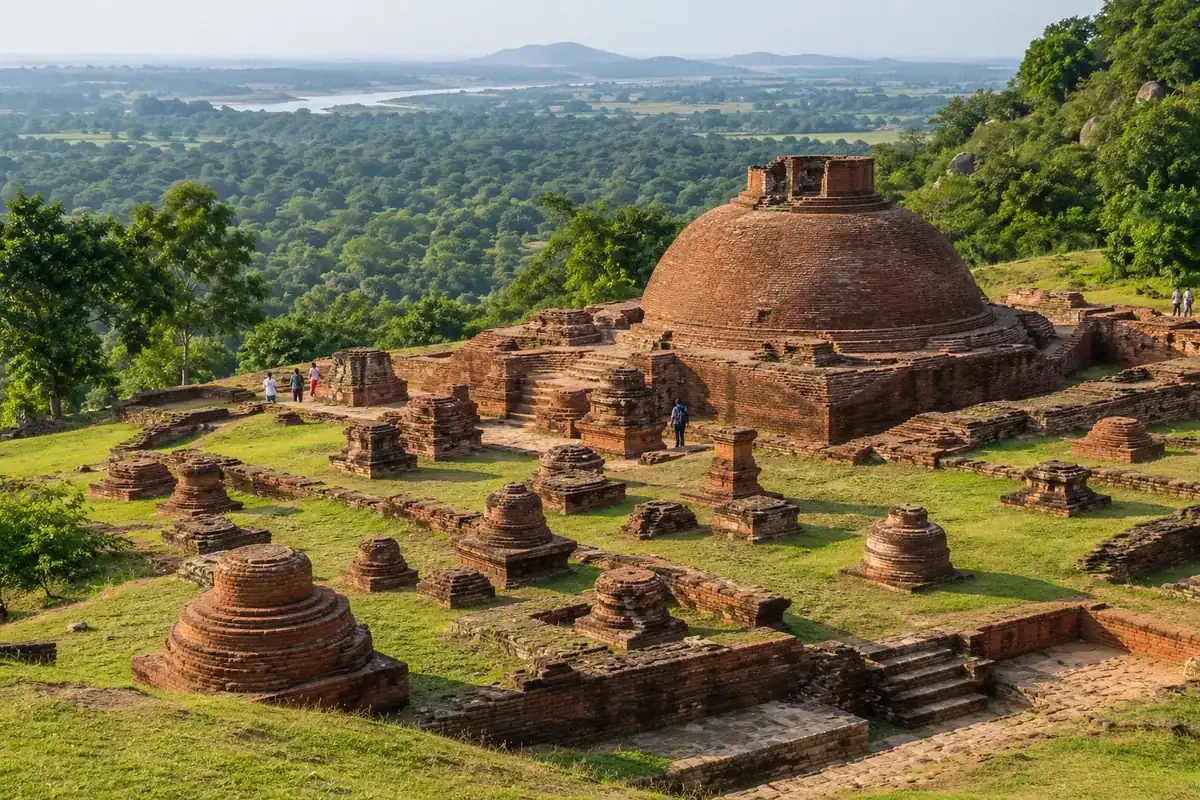
Excavations around the Mahastupa uncovered multiple concentric renovation layers, revealing that successive Buddhist dynasties, particularly the Bhauma-Karas and Somavamshis, continually enlarged and embellished the primary shrine. This evolutionary sequence stands as a landmark study in Bhaumakara dynasty Buddhist architecture for archaeology researchers of ancient India.
| Structural Feature | Archaeological Specification |
|---|---|
| Base Plan | Stepped square platform with sharp corner projections |
| Original Plinth Width | Approximately 47 feet (14.3 meters) square |
| Core Material | High-density fired brick masonry with lime plastering |
| Votive Stupa Count | Over 700 miniature stone and brick stupas |
| Prominent Iconography | Tara, Lokeshvara, Manjushri, Vajrasattva, and Aparajita |
| Historical Period | Active expansion from 8th to 12th century CE |
The Monumental Brick Mahastupa and Relic Chambers
The core of the Mahastupa contained sacred relic chambers where monks deposited consecrated terracotta votive plaques, silver ornaments, and inscribed copper plates. Surrounding the drum ran a wide circumambulatory passage (pradakshina patha) where pilgrims walked clockwise while chanting sutras.
The brick masonry was originally coated with smooth white lime plaster, gleaming in the tropical sunshine to guide travelers navigating the waterways of the coastal plain. Today, the exposed red brick terraces provide an evocative backdrop overlooking the green fields of Jajpur district.
Over 700 Votive Stupas and Tantric Vajrayana Imagery
Spread across the terraces surrounding the Mahastupa lies a field of more than seven hundred votive stupas. When wealthy patrons, visiting pilgrims, or departing student monks wished to gain spiritual merit, they commissioned craftsmen to carve miniature stone stupas inscribed with Buddhist dharnis.
Many of these votive stupas feature small recessed niches sheltering exquisite miniature reliefs of tantric Buddhist deities. Carvings of Avalokiteshvara, Tara, Marichi, and Heruka document the historical transition of the monastery from early Mahayana scholasticism into advanced Vajrayana esoteric mysticism.
Ratnagiri Archaeological Museum: Antiquities, Bronzes & Friday Closure Warning
Located near the entrance gate at the foot of the hillock, the Ratnagiri Archaeological Site Museum provides essential historical context for understanding the excavated ruins. The museum houses more than 3,400 registered antiquities recovered during ASI digs across the hillock.
Four spacious galleries exhibit stone sculptures, bronze cast figurines, terracotta sealings, inscribed copper plates, and everyday monastic utensils dating from the sixth to twelfth centuries.
[!WARNING] Friday Museum Closure Notice: The ASI Archaeological Museum at Ratnagiri is strictly closed every Friday and on national public holidays. The outdoor monastery ruins remain open seven days a week, but plan your trip between Saturday and Thursday to tour both facilities.
Four Galleries of Buddhist Sculpture and Inscribed Seals
Gallery 1 and Gallery 2 display monumental stone masterworks, including colossal heads of the Buddha, seated images of Bodhisattva Manjushri, and elaborate statues of the fierce protective deity Heruka dancing upon a corpse.
Gallery 3 and Gallery 4 present fragile metal cast bronzes and terracotta seals. The most significant historical objects are dozens of round clay sealings bearing the clear Sanskrit inscription: Sri Ratnagiri Mahavihariyarya Bhikshu Sanghasya (Of the community of noble monks of the illustrious Ratnagiri monastery). These seals proved conclusively to modern historians that the ruins represented the legendary Ratnagiri university celebrated in medieval records.
Planning Around the Friday Museum Weekly Closure
Because visiting the museum costs only ₹5 and contains some of the finest bronze castings in eastern India, skipping it diminishes the educational value of your journey. If you must travel on a Friday, spend extra time examining the outdoor masonry of Monastery 1 and Monastery 2.
On any other day of the week, begin your tour at the open-air hilltop ruins in the morning when ambient temperatures are cooler, then descend to the museum galleries around midday to examine sculptures in air-cooled comfort.
The Diamond Triangle Circuit: Ratnagiri, Udayagiri and Lalitgiri Compared
Ratnagiri forms the central pillar of Odisha’s Buddhist Diamond Triangle, accompanied by Udayagiri and Lalitgiri. Located within a forty-kilometer driving radius of one another, each site preserves a distinct facet of eastern Indian Buddhist heritage.
Understanding the unique character of each center helps travelers appreciate the vast scale of monastic university life during the classical era:
| Comparison Attribute | Ratnagiri | Udayagiri | Lalitgiri |
|---|---|---|---|
| District | Jajpur District | Jajpur District | Cuttack District |
| Primary Claim to Fame | Ornate chlorite doorway and colossal Buddha | Rock-cut stepwell, stupas, and scenic valley | Oldest site (3rd century BCE) and bone relics |
| Monastic Ruins | 2 large monasteries, Mahastupa, 700+ stupas | 2 large monasteries and colossal rock carvings | Multi-tiered monastery, apsidal chaitya, stupa |
| Museum Highlights | 3,400+ stone sculptures, seals, and bronzes | On-site outdoor sculptural exhibits | Sacred casket preserving Buddha bone relics |
| Best Travel Role | Architectural and artistic centerpiece | Scenic landscape and rock-cut monuments | Spiritual relic pilgrimage and antiquity |
Key Differences Between the Three Buddhist Universities
Lalitgiri is the earliest established of the three, with origins dating back to the Mauryan era of Emperor Ashoka in the third century BCE. Archaeologists at Lalitgiri discovered three concentric stone relic caskets containing genuine bone fragments believed to belong to Gautama Buddha or his foremost disciples.
Udayagiri, situated thirteen kilometers west of Ratnagiri, is known for its monumental stone stepwell and colossal rock-cut sculptures carved directly into the hillside cliff faces. Ratnagiri, the youngest and most artistically developed, reached its zenith during the eighth to tenth centuries with unmatched stone carving sophistication.
Why Ratnagiri Anchors the Diamond Triangle Experience
While Lalitgiri provides spiritual antiquity and Udayagiri offers geological grandeur, Ratnagiri delivers the most complete visual picture of a functioning Buddhist university. The intact chlorite portal, the colossal central Buddha, and the dense field of votive stupas make it the indispensable core of any regional itinerary.
Travelers exploring classical history can link this destination with other celebrated sites featured in our overview of ancient historical sites in Odisha and the world-famous Buddhist stupa at Dhauli Giri Hills Shanti Stupa near Bhubaneswar.
How to Reach Ratnagiri, Diamond Triangle Itinerary & Transit Logistics
Ratnagiri is well connected by smooth four-lane and two-lane paved roads branching off National Highway 16, the primary transportation artery running between Kolkata, Cuttack, and Bhubaneswar.
The table below outlines practical travel routes, transit distances, and driving estimates from key regional urban centers:
| Origin City / Transit Point | Recommended Travel Route | Distance | Driving Duration |
|---|---|---|---|
| Bhubaneswar (BPIA Airport) | NH-16 via Cuttack & Chandikhol to Bari | 100 km | 2 hours 15 minutes |
| Cuttack Railway Station | NH-16 via Tangi & Chandikhol to Ratnagiri | 70 km | 1 hour 40 minutes |
| Jajpur Town (Biraja Temple) | State Road via Kuakhia and Bari | 21 km | 35 minutes |
| Jajpur Keonjhar Road (JJKR) | NH-16 southbound via Kuakhia | 35 km | 50 minutes |
| Udayagiri Buddhist Complex | Direct connecting rural highway | 13 km | 20 minutes |
| Lalitgiri Buddhist Site | Via Chandikhol connecting road | 22 km | 35 minutes |
Driving Routes via NH-16 and Chandikhol Junction
Travelers driving from Bhubaneswar or Cuttack should follow National Highway 16 northbound until reaching Chandikhol Junction. At Chandikhol, diverge eastward onto the well-signposted state road toward Bari and Ratnagiri. The route passes peaceful countryside, crossing irrigation canals and rural markets.
For visitors arriving by long-distance express trains, Jajpur Keonjhar Road (station code JJKR) serves as the closest major railhead, with regular express connections to Howrah, Puri, and New Delhi. Pre-paid private taxis can be hired outside the station for full-day circuit tours covering Ratnagiri, Udayagiri, and Lalitgiri.
Recommended One-Day Diamond Triangle Tour Itinerary
A well-paced full-day tour from Bhubaneswar or Cuttack allows you to explore all three monastic complexes without feeling rushed:
- 7:30 AM – 9:30 AM: Depart early from Bhubaneswar or Cuttack along NH-16; reach Ratnagiri by 9:30 AM.
- 9:30 AM – 11:30 AM: Explore Monastery 1, photograph the chlorite portal, view the colossal Buddha sanctum, and inspect the Mahastupa.
- 11:30 AM – 12:30 PM: Tour the four galleries of the ASI Archaeological Museum (ensure visit is not on a Friday).
- 12:30 PM – 1:30 PM: Enjoy lunch at the government-run OTDC Panthanivas or a highway dhaba near Chandikhol. Regarding food and stay near Ratnagiri, OTDC Panthanivas operates comfortable air-conditioned rooms, while Chandikhol and Jajpur town offer private budget hotels.
- 1:30 PM – 3:00 PM: Drive thirteen kilometers to Udayagiri to examine the ancient stepwell and open-air stupa complexes.
- 3:30 PM – 5:00 PM: Conclude your day at Lalitgiri, visiting the modern relic museum and the hilltop stupa overlooking the Birupa river valley.
- 5:00 PM onwards: Return smoothly along NH-16 toward Cuttack or Bhubaneswar.
For travelers looking to explore wider pilgrimage destinations across the district, combining this circuit with a visit to the sacred Maa Biraja Temple in Jajpur provides an unforgettable balance of Buddhist and Shakta heritage.
Travelers seeking to trace Buddhist architectural continuity across Odisha can contrast Ratnagiri with the living Tibetan center at Jiranga Buddhist Monastery and the rock-cut heritage at Udayagiri and Khandagiri Caves in Bhubaneswar. You can also explore surrounding regional attractions in our guide to the best places to visit in Jajpur district.
Frequently Asked Questions About Ratnagiri Buddhist Monastery
What is the historical significance of Ratnagiri Buddhist Monastery?
Ratnagiri flourished from the fifth to thirteenth centuries as an international Buddhist university and the foremost center of Vajrayana and Kalachakra Tantra studies in eastern India. Excavations revealed two large quadrangular monasteries, a monumental brick stupa, and over 1,300 clay seals confirming its identity as Sri Ratnagiri Mahavihara.
What are the visiting hours and entry fees for Ratnagiri in Odisha?
The outdoor monastic ruins are open daily from 9:00 AM to 5:00 PM, with admission fees of ₹25 for Indian, BIMSTEC, and SAARC visitors, and ₹300 for foreigners. The adjacent ASI Archaeological Museum costs ₹5 per person and remains strictly closed on Fridays.
Is the Ratnagiri Archaeological Museum open on Fridays?
No, the ASI Archaeological Site Museum at Ratnagiri is closed every Friday for maintenance and conservation. However, the outdoor monastic ruins, courtyards, and stupas remain open to visitors every day of the week.
Why is the chlorite doorway of Monastery 1 famous?
The green chlorite doorway of Monastery 1 is celebrated for its exquisite multi-banded carvings of floral arabesques, celestial lovers, and guardian figures of Yamuna. Archaeologist Debala Mitra famously called it the loveliest entrance to a structural monastery in India.
How to reach Ratnagiri from Bhubaneswar and Cuttack?
Ratnagiri is located 100 km from Bhubaneswar and 70 km from Cuttack along National Highway 16 via Chandikhol Junction. Jajpur Keonjhar Road railway station, located thirty-five kilometers away, serves as the nearest major rail hub with regular taxi services.
What are the three sites of the Diamond Triangle in Odisha?
The Diamond Triangle comprises the three excavated Buddhist monastic centers of Ratnagiri, Udayagiri, and Lalitgiri, located within a forty-kilometer radius across Jajpur and Cuttack districts. Together they represent the apex of ancient Mahayana and Vajrayana architectural achievement in eastern India.