Ranipur Jharial Balangir: 64 Yogini Temple & Visitor Guide
Plan your trip to Ranipur Jharial in Balangir, Odisha. Explore the circular 64 Yogini temple, Indralath brick shrine, Someswar temple, timings, and routes.
Ranipur Jharial in Balangir district stands as one of the most enigmatic archaeological landscapes in eastern India. Spread across an expansive granite plateau between the twin villages of Ranipur and Jharial, this open-air sanctuary preserves around fifty medieval shrines dating from the eighth to eleventh centuries.
The centerpiece of this sacred enclave is a rare hypaethral Chausathi Yogini temple, accompanied by the towering sixty-five-foot Indralath brick temple and the epigraphically rich Someswar complex. For travelers exploring Western Odisha, Ranipur Jharial offers an uncrowded encounter with royal Somavamshi architecture, tantric heritage, and early medieval Shaivism.
The entire complex remains fully accessible throughout the year without ticket barriers, making it an essential cultural detour from Balangir and Titilagarh. Official monument records and visitor guidelines are cataloged by the Archaeological Survey of India alongside the Odisha Tourism Development Corporation Portal.
Key Takeaways
- Location & Geography: Situated in Bangomunda Block of Balangir district, 104 km southwest of Balangir town and 32 km from Titilagarh Junction.
- Core Monuments: Features an open-roof circular 64 Yogini temple, the 65-foot Indralath brick temple, and the Someswar Shiva temple beside Someswar Sagar.
- Visiting Hours & Tariffs: Open daily from 6:00 AM to 6:00 PM with free entry for all visitors.
- Tantric Significance: Represents one of only four surviving circular hypaethral 64 Yogini temples in India, and one of two located in Odisha alongside Hirapur.
- Best Season: October to March provides comfortable temperatures for walking across the exposed granite bedrock.
Ranipur Jharial at a Glance: Quick Timings & Visitor Facts
Ranipur Jharial is an open-air archaeological complex that welcomes historians, pilgrims, and day travelers from dawn until dusk. Because the monuments sit across a natural granite outcrop rather than within an enclosed modern museum compound, visitors enjoy freedom to examine outer facades, stone carvings, and elevated platforms. The site is protected jointly by the Archaeological Survey of India and the State Archaeology Department of Odisha.
The table below summarizes primary operational facts, access details, and key architectural highlights for planning a smooth visit:
| Metric / Parameter | Visitor Information |
|---|---|
| Site Name | Ranipur Jharial Archaeological Complex |
| District & State | Balangir District, Western Odisha |
| Nearest Town / Junction | Titilagarh (32 km) / Kantabanji (35 km) |
| Daily Visiting Hours | 6:00 AM – 6:00 PM (Monday through Sunday) |
| Entry Fee | Free (₹0 for domestic and international tourists) |
| Primary Architectural Style | Early Kalinga, Somavamshi Brick Rekha Deula & Tantric Hypaethral |
| Best Travel Months | October to March (Cool winter months) |
| Estimated Exploration Time | 2.5 to 4 hours across the plateau |
Visiting Hours, Gate Rules and Entry Tariffs
Visiting Ranipur Jharial incurs no admission fees or camera charges. The rocky knoll remains open from 6:00 AM to 6:00 PM every day of the week. Arriving early in the morning allows you to photograph the stone textures before harsh midday glare washes out shallow stone carvings.
While mobile photography and personal handheld cameras are freely permitted, commercial drone operations require advance permits from district administrative offices. Because active worship continues at the Someswar and Indralath shrines, visitors must remove footwear before entering sanctum interiors.
Top Archaeological Highlights Across the Rocky Plateau
The complex occupies a vast geological rock bed dotted with natural water reservoirs, stone pillared mandapas, and freestanding shrines. Scholars often describe the expanse as an architectural laboratory because multiple religious streams converged here between the eighth and eleventh centuries.
Beyond the major hypaethral Yogini temple, visitors should inspect the cluster of miniature sandstone shrines surrounding Someswar Sagar, the weathered monolithic rock sculptures, and the surviving terracotta work of the brick temples.
The Hypaethral 64 Yogini Temple: Architecture & Tantric Pantheon
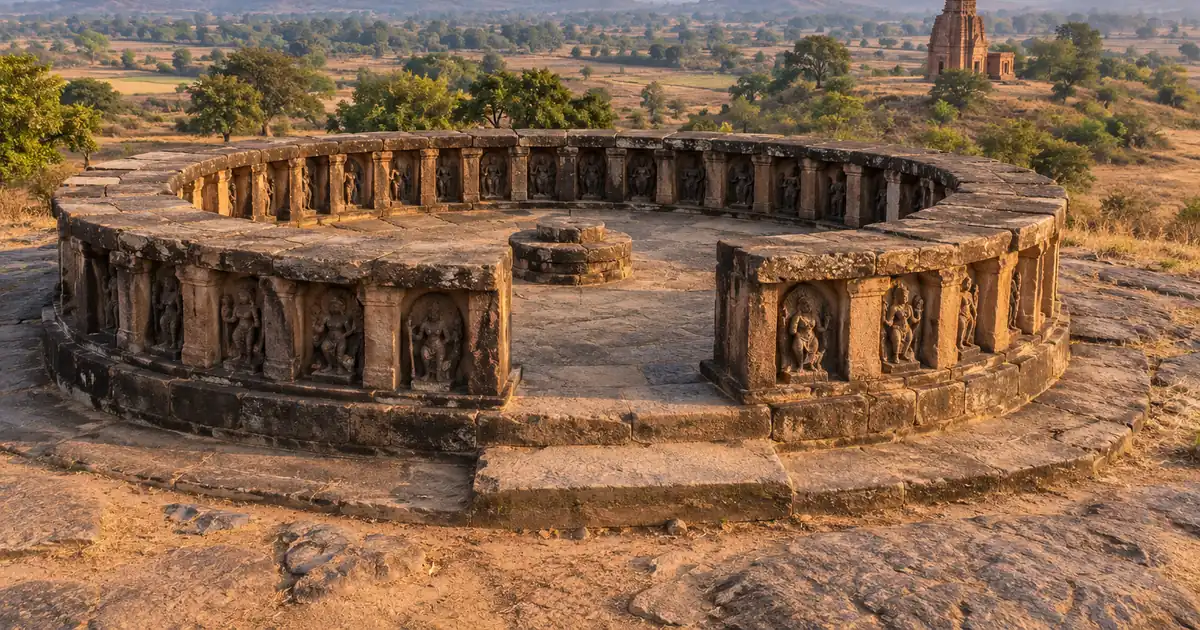
The Chausathi Yogini temple at Ranipur Jharial is an architectural wonder that draws historians and spiritual seekers from across the world. Unlike conventional Hindu temples that conceal the primary deity within a dark, cave-like sanctum, this shrine was intentionally constructed without a roof. The circular sandstone enclosure opens directly to the sky, celebrating cosmic feminine energies under open celestial vaulting.
This structure ranks as one of only four recognized circular hypaethral Yogini temples across India, alongside the famous shrine at Hirapur near Bhubaneswar, and the central Indian temples at Khajuraho and Bhedaghat in Madhya Pradesh.
[!NOTE] Chausathi Yogini Ground Plan Layout
- Outer Enclosure: Approximately 56-foot diameter constructed from regional coarse sandstone blocks.
- Perimeter Niches: 64 recessed arches designed to shelter individual sandstone Yogini goddess sculptures.
- Central Mandapa: Four-pillared open stone pavilion enshrining a three-headed dancing Shiva (Nataraja).
Open-Sky Circular Plan and Sandstone Niches
The circular perimeter wall has an internal diameter of approximately 56 feet, constructed with dry-masonry blocks of coarse regional sandstone. Along the interior face of the wall runs a continuous series of sixty-four arched niches, each originally designed to shelter a distinct Yogini sculpture.
An entrance passage punctures the southern wall, admitting worshippers into the central open arena. The circular geometry allowed tantric practitioners to move in a ritual clockwise pradakshina, facing each goddess sequentially while remaining directly under the sky and stars.
The Central Nataraja Mandapa and Surviving Yogini Carvings
At the physical center of the circular courtyard stands a small four-pillared stone mandapa sheltering a multi-armed depiction of Lord Shiva. The deity is sculpted in the vigorous dancing posture of Nataraja, possessing three heads and holding sacred attributes. In tantric philosophy, Shiva represents static pure consciousness around whom the dynamic feminine Yoginis enact the drama of universal creation and destruction.
Although centuries of weathering have damaged some perimeter sculptures, several dozen sandstone Yoginis remain visible in their original niches. The goddesses exhibit diverse poses, animal mounts, multi-armed weapons, and expressive hairstyles, demonstrating high artistic freedom among medieval Western Odisha guilds.
Indralath Brick Temple: The Tallest Ancient Brick Monument of Odisha
Rising dramatically against the skyline of the rocky ridge stands the Indralath Temple, recognized by historians as the tallest surviving ancient brick temple in Odisha. Towering to a height of approximately sixty-five feet, the monument demonstrates the exceptional terracotta engineering achieved during the Somavamshi period.
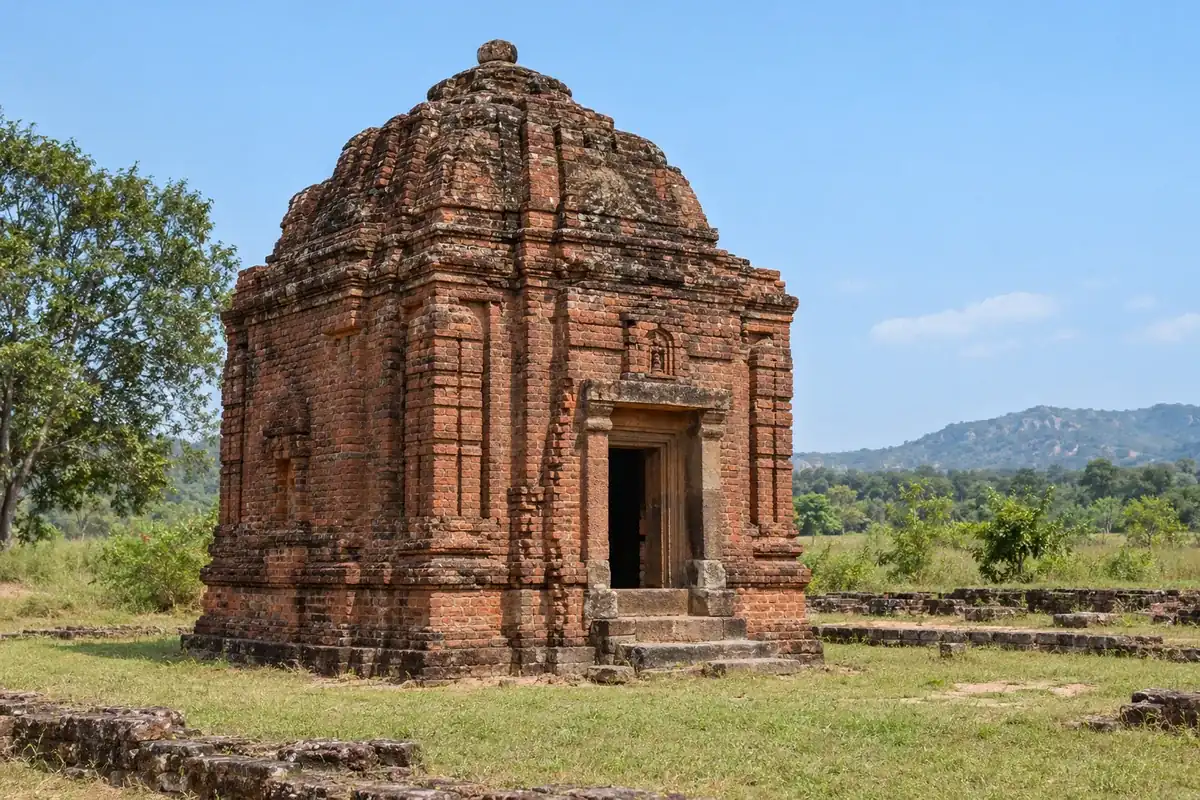
While most surviving medieval shrines in coastal Odisha were carved from khondalite or sandstone blocks, Indralath relied on well-fired red bricks bonded with fine lime-clay mortar. The spire retains its classic Rekha Deula curvilinear silhouette, visible from miles across the surrounding paddy fields.
| Structural Feature | Specification & Architectural Detail |
|---|---|
| Structure Type | Rekha Deula (Curvilinear Sanctum Spire) |
| Total Height | Approximately 65 feet (19.8 meters) |
| Base Material | Molded terracotta red bricks on elevated sandstone plinth |
| Estimated Chronology | 10th to 11th century CE (Somavamshi dynasty) |
| Original Cult Dedication | Syncretic Harihara (Vishnu & Shiva combined) |
| Surviving Components | Sanctum Vimana intact; Jagamohana hall ruined |
65-Foot Rekha Deula Engineering and Terracotta Reliefs
The builders erected Indralath upon a broad, elevated stone platform to provide structural stability over the uneven granite surface. The sanctum walls rise with sharp horizontal projections, stepped corner pagas, and recessed niches that mirror stone temple geometry.
Close inspection of the exterior reveals delicate terracotta scrollwork, miniature decorative towers, and molded ornamental brick reliefs. The durability of these bricks after nearly a millennium of harsh tropical monsoons and summer heat testifies to the advanced firing techniques practiced by ancient regional kilns.
Harihara Iconography: Merging Shaivism and Vaishnavism
Although modern local worshippers revere the shrine as a Shiva temple due to a later-installed Shivalinga inside the sanctum, sculptural panels on the exterior walls reflect a syncretic Harihara dedication. Detailed reliefs carved into stone inserts depict Lord Vishnu, the boar avatar Varaha, Nrisimha, Kartikeya, and Ganesha.
This harmonious blending of Vaishnava and Shaiva themes reveals how royal patrons sought spiritual synthesis during the medieval era, fostering unity across diverse religious communities throughout the Balangir district heartland.
Someswar Temple, Somatirtha & The Gagana Siva Inscription
Beside a large rock-cut reservoir named Someswar Sagar, also known locally as Jogibandh, stands the sturdy stone Someswar Temple. Dedicated to Lord Shiva, this sanctuary serves as a living place of worship where priests conduct daily morning and evening rituals for villagers and visiting pilgrims.
The temple occupies an honored place in regional epigraphy. A preserved Sanskrit inscription carved upon the entrance lintel explicitly identifies this locality as Somatirtha, celebrating it as one of the preeminent sacred pilgrimage centers of early medieval India.
Epigraphical Insight: Acharya Gagana Siva
The lintel inscription records that the temple was constructed under the guidance of Acharya Gagana Siva, an ascetic belonging to the famous Mattamayura branch of the Siddhanta Shaiva order. Gagana Siva migrated from northern India to Western Odisha under royal patronage, transforming Ranipur Jharial into an influential monastic university and spiritual refuge.
Gagana Siva Inscription and Early Medieval Monasticism
The epigraph of Gagana Siva provides concrete historical anchor points that connect Western Odisha with widespread monastic networks spanning central and northern India. Under the guidance of these Mattamayura scholars, monasteries flourished where ascetics studied philosophy, logic, tantra, and temple architecture.
The inscription mentions grants, temple foundations, and sacred water tanks, demonstrating that Ranipur Jharial functioned not merely as a cluster of shrines, but as a residential academic center similar to the Buddhist monasteries of Nalanda and Ratnagiri.
Someswar Sagar and the Granite Outcrop Shrines
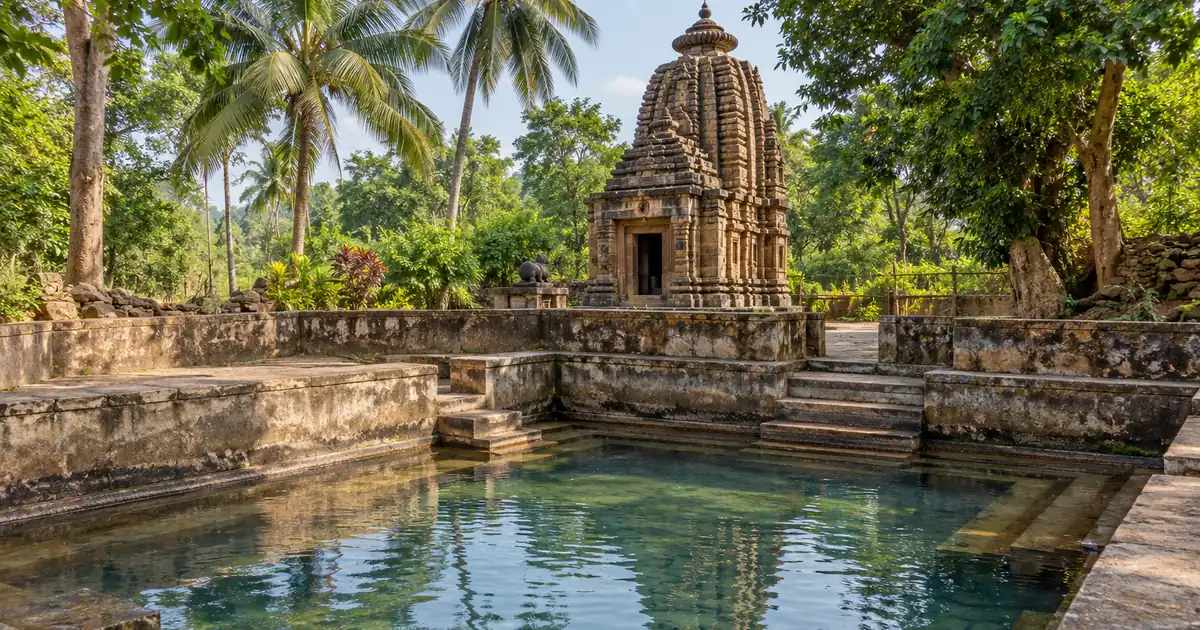
The water body adjacent to Someswar Temple was carved directly into the living granite bedrock. Sacred tanks formed an indispensable part of ancient temple complexes, providing water for ritual ablutions, pilgrim bathing, and temple gardens.
Around the margins of Someswar Sagar stand dozens of smaller stone shrines, votive stupa-like miniature deulas, and sheltered rock-cut carvings. Exploring these smaller shrines reveals ancient engineering methods used to channel seasonal rainwater into the central tank.
Ranipur Jharial vs Hirapur: Comparing Odisha’s Twin Yogini Pithas
Odisha holds a unique position in Indian art history by housing two of the country’s four surviving circular hypaethral Yogini temples: Ranipur Jharial in Balangir district and Hirapur near Bhubaneswar. While both share an open-air circular layout dedicated to sixty-four esoteric goddesses, their scale, materials, and surrounding atmospheres differ markedly.
Travelers planning an in-depth cultural journey will find that each monument offers distinct perspectives on medieval tantric worship:
| Architectural Metric | Ranipur Jharial (Balangir) | Hirapur (Bhubaneswar) |
|---|---|---|
| Geographic Setting | Rugged granite knoll, rural Western Odisha | Fertile alluvial plain, coastal Khordha district |
| Enclosure Diameter | Large (~56 feet interior diameter) | Compact (~25 feet interior diameter) |
| Construction Material | Coarse yellow/brown sandstone | Fine black chlorite and sandstone plinth |
| Sculptural State | Weathered sandstone, several missing figures | Intact, finely polished chlorite Yogini figures |
| Central Sanctum | 4-pillared stone mandapa with dancing Shiva | Rectangular stone pavilion with Chandi figures |
| Visitor Footfall | Low, quiet, solitary exploration | Moderate to high, popular day trip from capital |
| Associated Shrines | Surrounded by 50+ brick and stone temples | Standalone single shrine near village pond |
Structural Dimensions, Stone Material and Sculptural State
Hirapur is intimate and compact, measuring only twenty-five feet across. Its interior is lined with delicately carved chlorite images that have retained remarkable detail, polish, and expressive grace over the centuries.
In contrast, Ranipur Jharial is more than twice as large, featuring an enclosure diameter of fifty-six feet. Because the artists used coarse sandstone exposed to high winds and open weather on a hillock, the carvings display a rugged, weathered patina that reflects the wild terrain of western forests.
Atmosphere and Spiritual Setting: Coastal Plain vs Granite Rock
The atmosphere at Ranipur Jharial feels timeless and untamed. The wide expanse of granite rock, panoramic views of distant hills, and complete absence of commercial crowds allow visitors to experience the solitude sought by ancient tantric practitioners.
Pairing an expedition here with visits to other sacred shrines documented in our comprehensive guide to temples across Odisha provides a balanced understanding of classical coastal monuments versus inland Western Odisha architecture.
How to Reach Ranipur Jharial, Travel Routes & Day Trip Itinerary
Ranipur Jharial is located in the southwestern corner of Balangir district, close to the borders of Nuapada and Kalahandi districts. The site is easily accessible by road from major regional rail junctions, particularly Titilagarh and Kantabanji.
The road network connecting Balangir, Patnagarh, Bangomunda, and Titilagarh consists of well-maintained state highways and two-lane rural roads that pass through scenic agricultural country:
| Starting Location | Travel Route & Highway | Road Distance | Approximate Drive Time |
|---|---|---|---|
| Balangir Town | SH-42 via Patnagarh & Bangomunda | 104 km | 2.5 hours |
| Titilagarh Junction | Via Muribahal & Sindhekela | 32 km | 45 minutes |
| Kantabanji Station | Via Bangomunda rural road | 35 km | 50 minutes |
| Harishankar Temple | Via Khaprakhol & Patnagarh | 78 km | 1.8 hours |
| Bhubaneswar (Capital) | NH-57 via Boudh, Balangir & Titilagarh | 420 km | 9 hours |
Road Directions from Balangir, Titilagarh and Kantabanji
The most convenient base for visiting Ranipur Jharial by train is Titilagarh Junction, a major railway hub on the Raipur-Vizianagaram and Howrah-Mumbai lines. From Titilagarh station, travelers can hire a private taxi or auto-rickshaw for the 32-kilometer drive to the site via Muribahal.
If traveling by personal vehicle from Balangir city, follow the state highway toward Patnagarh, proceed southward toward Bangomunda, and watch for rural signboards directing you toward the twin villages of Ranipur and Jharial. The final three kilometers follow a quiet paved village road terminating at a gravel parking area beside the foot of the rocky knoll.
Recommended One-Day Western Odisha Heritage Itinerary
To make the most of your journey to Balangir district, consider combining Ranipur Jharial with nearby spiritual and natural attractions:
- 8:00 AM – 10:30 AM: Depart early from Titilagarh or Balangir; arrive at Ranipur Jharial and explore the circular 64 Yogini temple under soft morning sunlight.
- 10:30 AM – 12:30 PM: Inspect the sixty-five-foot Indralath brick temple, photograph the Someswar lintel inscription, and walk around Someswar Sagar.
- 12:30 PM – 2:00 PM: Enjoy lunch at a traditional dhaba in Bangomunda or Titilagarh.
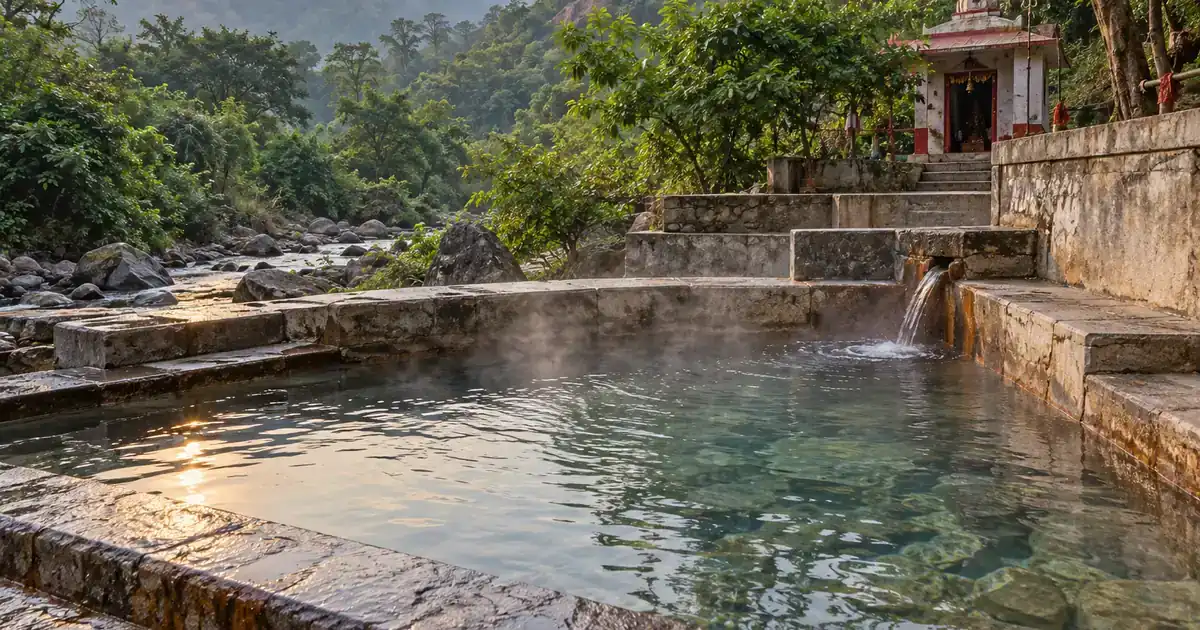
- 2:00 PM – 4:30 PM: Drive to the forested foothills of the Gandhamardan hills to visit the sacred Harishankar Temple in Patnagarh, famous for its perennial mountain stream and natural rock slide.
- 5:00 PM onwards: Return to Balangir town for an evening stay, or board connecting trains at Titilagarh Junction.
Visitor Guidelines, Seasonality & Practical Travel Tips
Because Ranipur Jharial is situated in an open rural landscape, thoughtful preparation ensures an enjoyable and safe excursion across the exposed rocky terrain.
Visitors should plan their travel according to seasonal temperatures, hydration needs, and local facilities:
[!TIP] Footwear & Sun Protection: The dark granite rocks absorb heat rapidly from late morning onward. Wear easily removable walking shoes with good grip for climbing stone terraces, and carry wide-brim hats, sunglasses, and high-SPF sunscreen.
Weather Seasons and Granite Heat Factors
The ideal window for exploring Ranipur Jharial runs from October through March. During these winter months, daytime temperatures hover between 20°C and 28°C, accompanied by clear blue skies and pleasant morning breezes.
Conversely, Western Odisha experiences intense summer conditions from April to mid-June, with midday mercury levels frequently exceeding 42°C. Walking across the granite outcrop during summer afternoons becomes uncomfortable and is strongly discouraged. If visiting during monsoon months (July to September), exercise caution near mossy rock ledges and rain-slicked stone steps.
Facilities, Snacks and Accommodation Logistics
Ranipur Jharial is a peaceful rural site without commercial tourist complexes. Clean public restrooms and basic shade shelters are maintained near the base entry path by local caretakers, but there are no formal restaurants at the monument.
Visitors should carry sufficient bottled drinking water and light packed snacks from Titilagarh or Bangomunda. For overnight accommodation, travelers should reserve rooms at government guest houses or comfortable private hotels in Titilagarh or Balangir town, both of which offer regular dining, pharmacy, and banking facilities.
For travelers curious about how regional kingdoms shaped Odisha’s monumental history, our detailed overview of the history of Odisha and list of scenic picnic spots in Odisha offer rich context for broader travel planning.
Frequently Asked Questions About Ranipur Jharial
What is the historical importance of Ranipur Jharial in Balangir?
Ranipur Jharial is an eighth-to-eleventh-century archaeological complex in Balangir district featuring around fifty medieval shrines representing Shaiva, Vaishnava, and tantric traditions. It preserves one of India’s four circular 64 Yogini temples alongside Odisha’s tallest surviving ancient brick monument.
Which is the tallest brick temple in Odisha?
The Indralath Temple at Ranipur Jharial is the tallest surviving ancient brick temple in Odisha, measuring approximately sixty-five feet in height. Built during the Somavamshi period, it features sophisticated molded brick masonry and syncretic Harihara sculptures.
What are the entry fees and opening hours for Ranipur Jharial?
Ranipur Jharial is open daily from 6:00 AM to 6:00 PM with free entry for all domestic and international visitors. Handheld still cameras and mobile phones can be used across the site without payment of any permits.
How is Ranipur Jharial different from the Hirapur 64 Yogini Temple?
Ranipur Jharial is a large fifty-six-foot sandstone circular enclosure situated on a rocky granite knoll in rural Western Odisha. By comparison, Hirapur near Bhubaneswar is a smaller twenty-five-foot enclosure crafted from fine chlorite stone located in a coastal plain.
Which railway station is nearest to Ranipur Jharial?
Titilagarh Junction is the nearest major railway station, situated approximately thirty-two kilometers from Ranipur Jharial with frequent trains to Raipur, Sambalpur, and Visakhapatnam. Kantabanji railway station is also nearby at a distance of thirty-five kilometers.
Are there hotels or restaurants near Ranipur Jharial?
The immediate village area has only small roadside kiosks selling bottled water and tea, with no full-service hotels or restaurants. Visitors should stay in Titilagarh or Balangir town, which offer comfortable air-conditioned lodges, private hotels, and multi-cuisine dining options.