Kedar Gouri Temple Bhubaneswar: Timings & Kundas Guide
Plan your visit to Kedar Gouri Temple Bhubaneswar with verified 2026 timings, sacred Marichi & Gouri Kundas, legend, architecture, and transit tips.
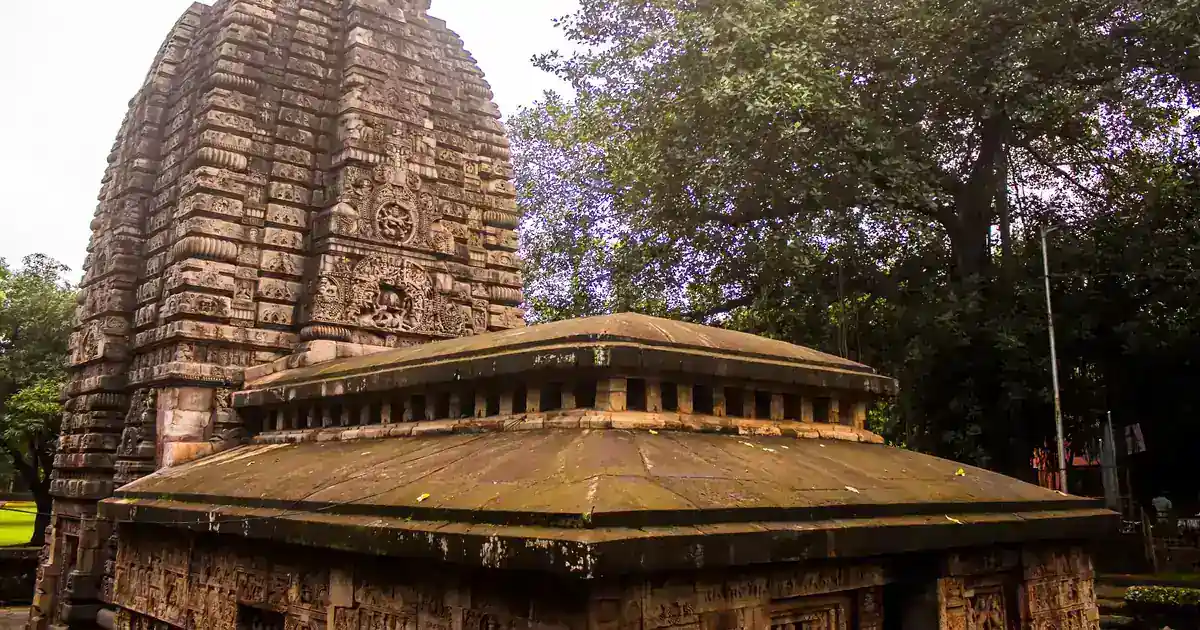
Situated within a peaceful garden courtyard along Kedar Gouri Temple Road, Kedar Gouri Kedareswar Temple Bhubaneswar represents one of the most beloved sacred complexes in Old Town. Dating to the tenth and eleventh centuries CE under the Somavamshi rulers, this twin-shrine sanctuary offers an essential stop for travelers exploring places to visit in bhubaneswar.
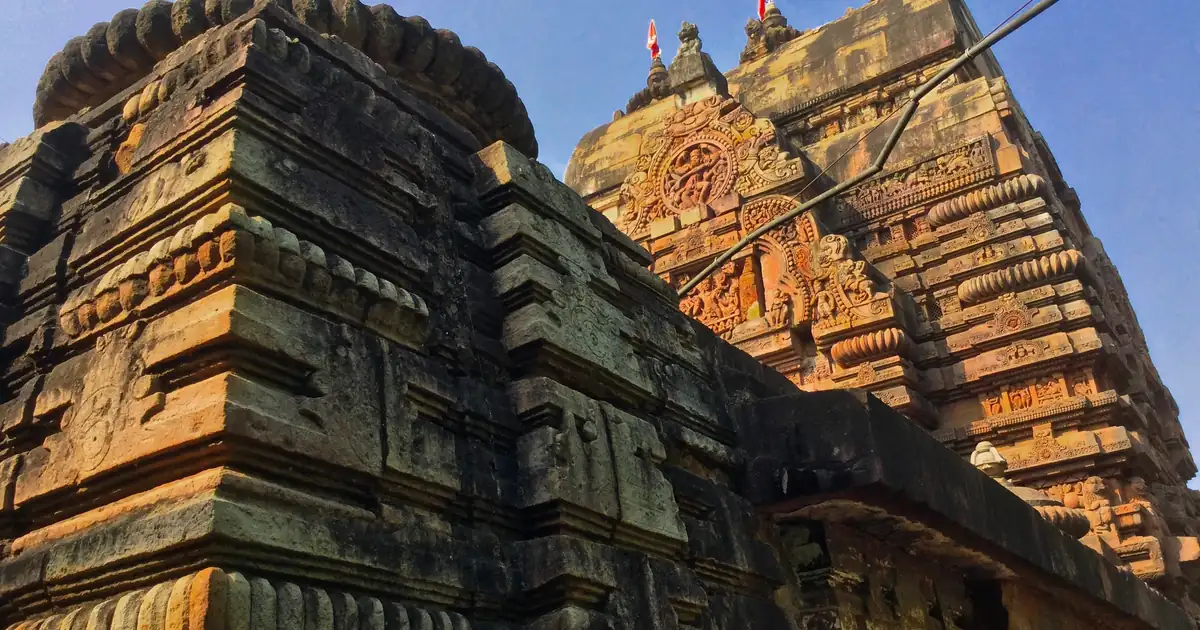
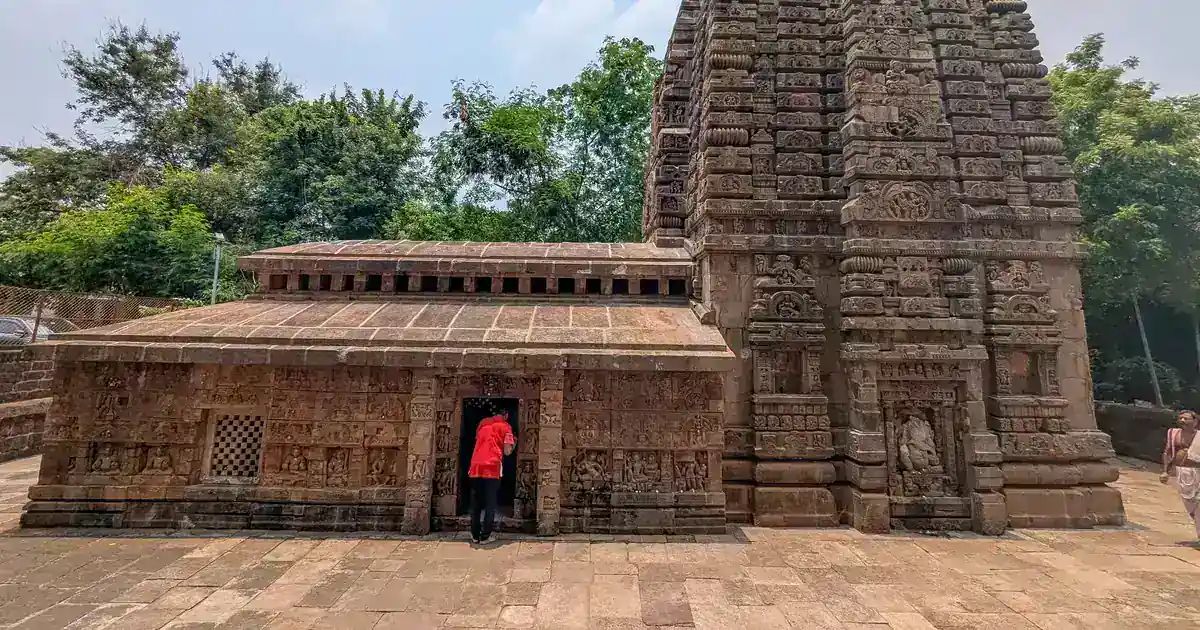
The complex uniquely pairs two distinct shrines: the soaring Kedareswar Temple dedicated to Lord Shiva and the exquisite Gouri Temple dedicated to Goddess Parvati. Bordering these ancient sandstone sanctums are two perennial natural spring pools, Gouri Kunda and Kedar Kunda, whose mineral-rich waters never dry up.
Devotees revere the grounds as the celebrated site of the annual Sitalasasthi divine marriage festival. A morning walk through the courtyard reveals living spiritual customs, classical Kalinga masonry, and timeless romantic folklore.
Key Takeaways
- Location & Setting: Situated along Kedar Gouri Temple Road in Old Town, just one hundred meters south of the Mukteswara-Parsurameswara heritage precinct.
- Daily Timings: Open from 6:00 AM to 12:30 PM and 4:00 PM to 8:30 PM daily with free admission.
- Twin Shrines: Houses the 45-foot Kedareswar Rekha Deula and the 30-foot Gouri Khakhara temple inside a single sacred compound.
- Sacred Springs: Renowned for two natural subterranean perennial spring pools whose clear water is traditionally revered for curative properties.
Kedar Gouri Temple Bhubaneswar at a Glance: Quick Timings, Fees & Key Facts
Kedar Gouri Temple Complex is an active place of Shaivite and Shakta worship administered by hereditary priests and the state endowments department. It welcomes devotees, pilgrims, and heritage visitors daily without requiring any entrance fees or tickets.
The temple sits in the southern sector of Bhubaneswar within Khordha district. It occupies a shaded compound shaded by leafy champak trees and stone ghat steps descending into crystal-clear spring tanks.
| Parameter | Verified Detail | Practical Notes |
|---|---|---|
| Temple Complex | Kedar Gouri Temple (Kedareswar & Gouri) | Twin shrines sharing a sacred courtyard |
| Construction Period | 10th to 11th Century CE (Somavamshi) | Contemporary with nearby Mukteswara Temple |
| Architectural Forms | Rekha Deula (Kedar) & Khakhara Deula (Gouri) | Classical masculine spire paired with vaulted roof |
| Presiding Deities | Lord Shiva (Kedareswar) & Goddess Gauri | Joint Shaivite and Shakta pilgrimage center |
| Morning Darshan | 6:00 AM to 12:30 PM | Best window for morning rituals and prayers |
| Evening Darshan | 4:00 PM to 8:30 PM | Warm courtyard lamps and evening arati |
| Entry Fee | Free admission for all visitors | No online booking or token counter |
| Photography | Permitted in outer garden courtyards | Restricted inside the sanctum chambers |
| Nearest Airport | Biju Patnaik International Airport (BPI) | 4.4 km via Old Town arterial road |
| Nearest Railway | Bhubaneswar Railway Station (BBS) | 4.9 km via Rajmahal and Master Canteen |
The Moving Legend of Kedar and Gouri
Beyond formal scriptural accounts, the temple is celebrated throughout Odia folklore for a poignant romantic legend. Local tradition recounts the story of two young lovers, Kedar and Gouri, who lived in ancient Ekamra Kshetra during King Lalatendu Kesari’s reign.
Facing bitter societal opposition to their marriage, the lovers fled into the forested hills bordering Old Town. While searching for drinking water for his exhausted companion, Kedar was attacked and killed by a wild tiger near a forest spring.
When Gouri discovered her lover’s tragic fate, she threw herself into the deep spring pool to join him in the afterlife. Grief-stricken upon hearing of their pure devotion, the king consecrated twin temples beside the spring pools, ensuring their names would be remembered forever.
Spiritual Significance in Ekamra Kshetra
In orthodox Shaivite theology, the shrine holds deep sacred significance as one of the eight foundational Shaivite pithas (Astasmbhu) of Bhubaneswar. The lingam enshrined inside Kedareswar Temple is regarded as an authentic counterpart to the Himalayan Kedarnath shrine.
Devotees believe that offering water to Lord Kedareswar bestows the spiritual merit of an arduous pilgrimage to the high Himalayas. The divine pairing with Goddess Gouri symbolizes cosmic balance between masculine consciousness and creative feminine power.
The sacred spring pools add an elemental dimension to the pilgrimage. Taking holy water (achamana) from the springs before entering the sanctum is believed to purify the mind and body.
Darshan Timings, Daily Rituals & Sacred Bathing Schedule
The temple gates open before dawn at 6:00 AM as hereditary servitors initiate the morning ritual ablutions. Public darshan continues without interruption until 12:30 PM, when the deities are offered midday bhoga.
The sanctum doors close during early afternoon hours for the traditional rest period. The shrine reopens at 4:00 PM and remains active until the final evening arati and closure at 8:30 PM.
| Visiting Window | Courtyard Atmosphere | Natural Light & Temperature | Recommended Activity |
|---|---|---|---|
| 6:00 AM – 8:00 AM | Quiet prayers, temple bells | Soft morning light across green spring water | Devotional darshan and morning walk |
| 8:00 AM – 11:00 AM | Moderate footfall, daily pujas | Direct sunlight illuminating wall carvings | Architectural study and photography |
| 11:00 AM – 12:30 PM | Midday ritual food offerings | Warmer daylight, quiet courtyard | Witnessing noon bhoga ceremonies |
| 4:00 PM – 6:00 PM | Pleasant afternoon breeze | Golden hour reflections in Gouri Kunda | Family visits, relaxing by the water |
| 6:00 PM – 8:30 PM | Evening lamps, chanting priests | Dramatic oil lamp illumination | Evening arati and peaceful contemplation |
Daily Rituals and Devotional Offerings
Travelers visiting during the early morning hours can witness the traditional Snana (sacred bath) performed using fresh water drawn directly from Gouri Kunda. Priests adorn the lingam with sandalwood paste, marigold garlands, and bilva leaves while chanting Vedic suktas.
In the evening around 7:00 PM, the atmosphere turns deeply contemplative during the Sandhya Alati. Devotees gather near the temple threshold as the rhythmic ringing of brass gongs and conch blasts reverberates across the stone halls.
Devotees can obtain simple puja baskets containing flowers, incense, and sweets from local vendors seated along the temple street. Priests accept offerings graciously and return consecrated sandalwood paste (chandan) as prasada.
The Divine Marriage Festival of Sitalasasthi
The temple complex reaches the peak of its annual religious calendar during the festival of Sitalasasthi, celebrated in May or June. This festive five-day celebration commemorates the celestial marriage of Lord Shiva and Goddess Parvati.
During the festival, a prominent citizen of Old Town assumes the ceremonial role of Parvati’s father to conduct the traditional bridal negotiations. Decorated processions carrying the divine marriage party move between Kedar Gouri and Lingaraj Temple amidst traditional percussion orchestras.
Witnessing Sitalasasthi provides travelers a captivating window into the warmth of Odia domestic religion. Even during intense summer heat, thousands of devotees assemble in festive high spirits to celebrate the divine wedding.
The Twin Temples: Kedareswar Rekha Deula and Gouri Khakhara Shrine
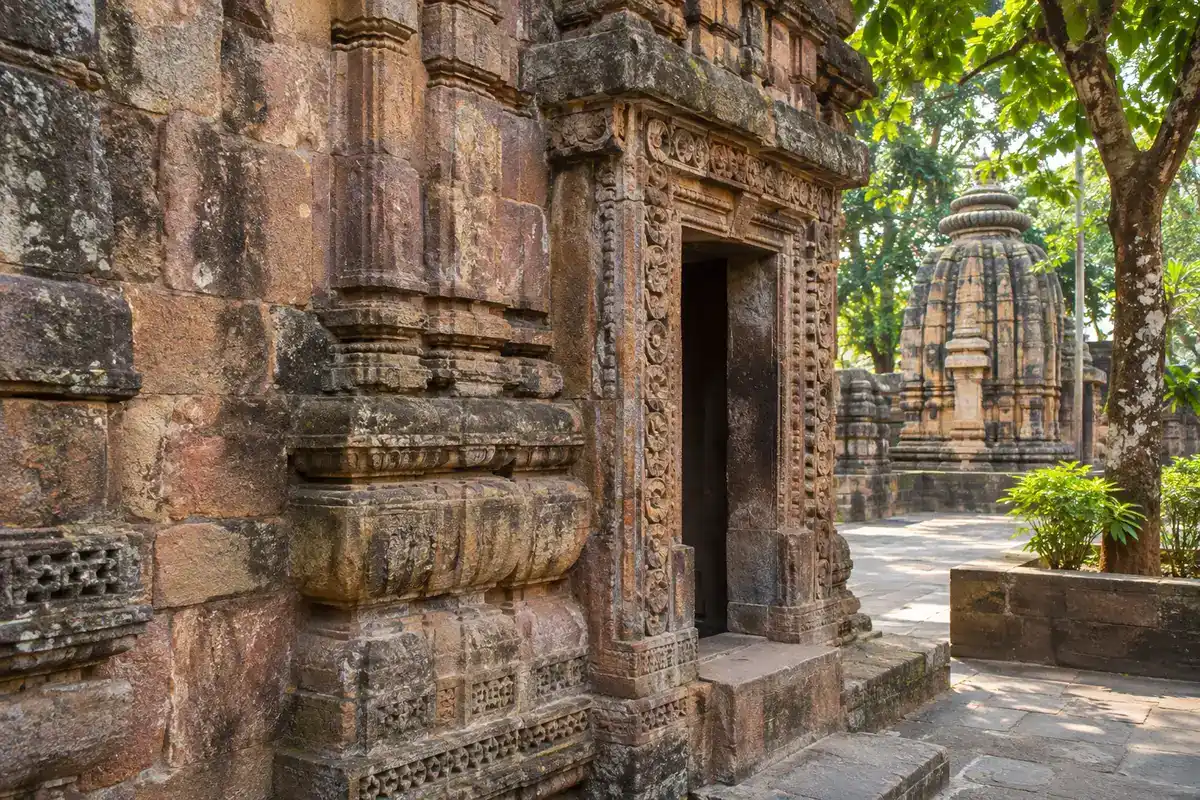
The unique architectural hallmark of the Kedar Gouri complex is the co-existence of two stylistically divergent temples standing side-by-side within a shared courtyard. Both monuments were constructed during the Somavamshi period when stone sculpting reached sophisticated heights across famous temples in Odisha.
The northern shrine, dedicated to Lord Shiva, follows the towering Rekha Deula order. The southern shrine, dedicated to Goddess Gouri, adopts the rare wagon-vaulted Khakhara order.
| Architectural Dimension | Kedareswar Temple (Shiva) | Gouri Temple (Parvati) |
|---|---|---|
| Deula Classification | Pancharatha Rekha Deula | Khakhara Deula (Wagon-Vault) |
| Spire Height | 45 feet (13.7 meters) | 30 feet (9.1 meters) |
| Plan Projection | Five vertical facets (Pancharatha) | Oblong rectangular sanctum |
| Crowning Elements | Fluted stone Amalaka & Kalasa | Barrel-vaulted ridge with Kalashas |
| Presiding Icon | Monolithic Shivalinga | Stone image of Goddess Gauri on lotus |
The Kedareswar Rekha Deula
The main Kedareswar Temple rises gracefully to a height of forty-five feet above a low laterite plinth. The tower follows a mature Pancharatha plan, dividing each exterior wall into five distinct vertical projections.
The curvilinear spire is adorned with miniature chaitya motifs, decorative floral scrolls, and playful ganas. Deep wall niches on the exterior display finely chiseled Parsvadevata images including Ganesha, Kartikeya, and Parvati.
Inside the square sanctum sits the ancient Shivalinga, submerged in a shallow stone basin fed by an underground natural water channel. This continuous trickle of spring water keeps the sacred lingam perpetually bathed.
The Gouri Khakhara Temple
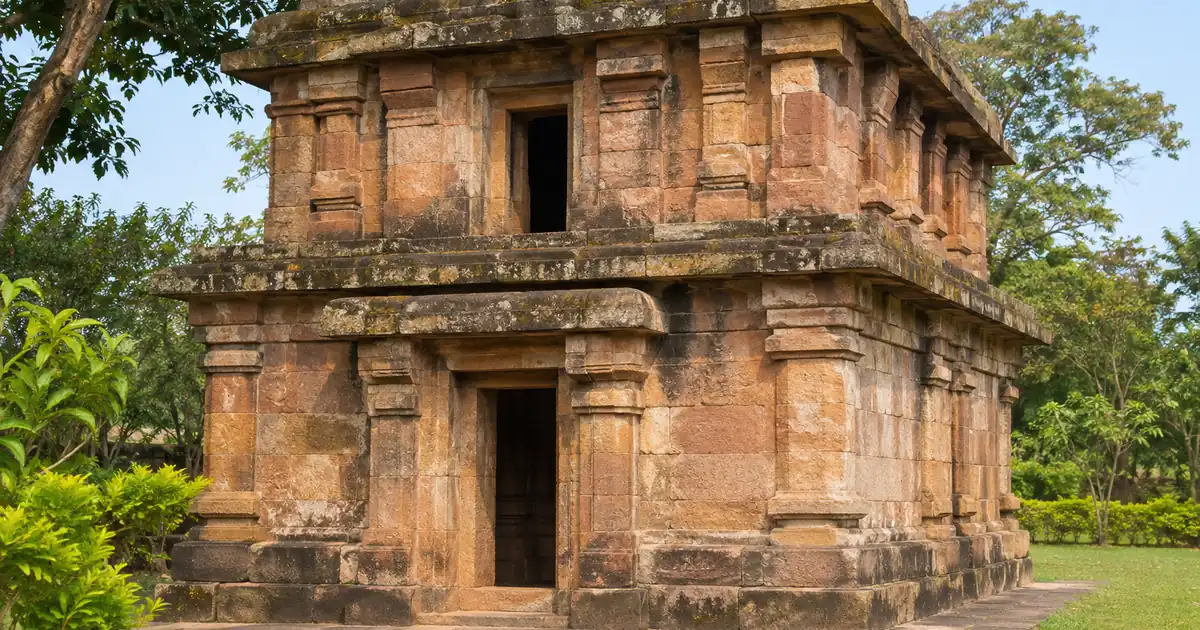
Standing just twenty paces south is the jewel-like Gouri Temple. The sanctum features a rectangular ground plan crowned with an elegant barrel-vaulted roof reminiscent of an overturned boat.
This wagon-vaulted roof profile classifies it as an authentic Khakhara deula, designed specifically for female divine manifestations. The exterior walls are decorated with delicate scrollwork, entwined creepers, and charming celestial maidens (Alasa Kanyas).
The crowning ridge of the roof supports three miniature stone kalashas. Inside the sanctum, the presiding image of Goddess Gauri stands gracefully atop a carved lotus pedestal, holding lotuses and displaying the protective abhaya mudra.
The Sacred Kundas: Perennial Healing Springs of Gouri & Kedar
The most remarkable natural feature of Kedar Gouri is its system of natural subterranean springs feeding two expansive stone-revetted pools: Gouri Kunda and Kedar Kunda. While many urban reservoirs fluctuate with erratic seasonal rainfalls, these springs maintain steady, crystal-clear water year-round.
Geologists attribute this unvarying flow to underground natural aquifers percolating through porous laterite and fractured sandstone bedrock. The water emerges remarkably transparent and cool even when surface temperatures surpass 40 degrees Celsius.
| Sacred Kunda | Dimensions & Setting | Traditional Beliefs & Uses |
|---|---|---|
| Gouri Kunda | 50 ft by 40 ft stone-paved tank | Mineral spring water believed to aid digestion and skin health |
| Kedar Kunda | Smaller circular stone stepwell | Reserved primarily for temple worship and priestly ablutions |
| Marichi Kunda (Nearby) | Stepwell at Mukteswara Temple | Renowned for holy water distributed during Ashokashtami eve |
Healing Traditions and Mineral Water
For centuries, local Odia residents have revered the water of Gouri Kunda for its digestive and therapeutic qualities. Traditional Ayurvedic practitioners often recommended drinking a small cup of this spring water daily to relieve gastric ailments.
The spring water contains trace dissolved minerals filtered naturally through subterranean laterite stone beds. The stone steps leading down to the water allow pilgrims to sprinkle the holy water over their heads in reverent purification.
Visitors can sit on the broad stone parapet walls bordering the tank to watch schools of sacred fish swimming in the green depths. Bathing directly in the tank is regulated to ensure water clarity and cleanliness.
Ecological and Hydraulic Significance
The ancient engineers who selected this site demonstrated profound hydrological understanding. By excavating tanks at the natural discharge points of subterranean aquifers, they created dependable water reserves that have sustained communities for over a thousand years.
The water level remains steady during heavy monsoon downpours due to stone drainage outlets leading toward Bindu Sagar. This sophisticated medieval hydraulic engineering protected the neighboring temple foundations from soil erosion.
The presence of continuous fresh spring water creates a cool microclimate inside the courtyard. Even during hot summer afternoons, the air near the tank edge remains noticeably cooler than the surrounding city streets.
Visitor Guidelines, Etiquette & Practical Ground Realities
Visiting Kedar Gouri Temple allows travelers to witness authentic Odia temple culture in an unhurried, welcoming setting. Following simple etiquette guidelines ensures respect for local worshippers and temple customs.
The compound is kept clean and quiet by local sevayats. Paved stone pathways connect the main entrance to both sanctums and the surrounding spring tanks.
[!TIP] Footwear & Steps Safety: Footwear must be removed at the shoe stand near the main entrance arch. The stone steps surrounding Gouri Kunda can be slick from splashed spring water, so step carefully, especially when wearing socks.
Dress Code and Temple Etiquette
Modest attire is expected when visiting active temples across Odisha. Wear garments that cover your shoulders and extend past your knees comfortably.
Traditional Indian dress like kurtas, sarees, and salwar suits is widely worn, while modest casual attire such as long pants and shirts is completely acceptable. Avoid wearing shorts, sleeveless vests, or transparent clothing inside the sacred enclosure.
Please keep mobile devices on silent mode while walking through the sanctum courtyard. Maintaining a quiet demeanor respects devotees engaged in private prayers.
Photography and Filming Guidelines
Still photography using personal smartphones or mirrorless cameras is permitted across the outer garden courtyards and along the perimeter of Gouri Kunda. Capturing the twin temples reflected in the sacred pool makes for timeless photographs.
Photography inside the dark sanctum chambers of both Kedareswar and Gouri shrines is not permitted. The Archaeological Survey of India and local trusts prohibit commercial camera tripods, lighting stands, and drones without written permits.
Always ask for polite consent before photographing temple priests or local pilgrims near the water. Respecting personal privacy ensures warm interactions with the community.
Amenities and Practical Facilities
Clean drinking water taps and stone seating benches are available in the shade of the garden trees. Small tea stalls, flower shops, and tender coconut vendors operate right outside the entrance gate along the street.
Public restrooms are located approximately 150 meters away near the Mukteswara tourism plaza. The approach road is flat and easily accessible, though ascending the sanctum plinth involves a few stone steps.
Parking for two-wheelers is convenient right in front of the gate. Cars can be parked in the spacious municipal parking lot near Mukteswara Temple, followed by a short two-minute walk.
How to Reach Kedar Gouri Temple & Old Town Heritage Walk
Kedar Gouri Temple is situated along Kedar Gouri Temple Road in the heart of Old Town Bhubaneswar. The monument enjoys straightforward road connections to all major transportation terminals in the capital.
Its close proximity to other foundational monuments makes it an indispensable component of any walking itinerary through the temple city.
| Transit Terminal | Distance | Travel Time | Recommended Transit Mode |
|---|---|---|---|
| Bhubaneswar Airport (BPI) | 4.4 km | 15 minutes | Pre-paid airport taxi or auto-rickshaw |
| Bhubaneswar Station (BBS) | 4.9 km | 18 to 20 minutes | CRUT Mo Bus Route 20 or auto from Master Canteen |
| Lingaraj Temple Complex | 1.2 km | 4 minutes | Short auto-rickshaw ride or 12-minute walk |
| Mukteswara Temple | 100 m | 2 minutes | Direct walking stroll across the lane |
| Baramunda Bus Stand (ISBT) | 9.0 km | 25 to 30 minutes | City transit bus or app-based cab |
Transit Directions: Air, Rail and Road
Travelers arriving at Biju Patnaik International Airport can easily hire an app-based taxi or pre-paid cab directly to Old Town. The drive follows the historic Aerodrome Gate road and takes roughly fifteen minutes outside peak hours.
From Bhubaneswar Railway Station, board CRUT Mo Bus Route 20 or Route 33 departing from Master Canteen terminal. Ask the conductor for the Kedar Gouri or Old Town bus stop.
From the bus shelter, a short two-minute walk down a paved stone street brings you directly to the temple gate. Auto-rickshaws are readily available throughout the day at railway and bus stations.
Designing an Old Town Heritage Walking Tour
Because Old Town concentrates exceptional stone shrines within a short walking perimeter, exploring on foot provides the most rewarding cultural experience:
- First Stop (6:30 AM to 7:30 AM): Start at the 7th-century Parsurameswara Temple to admire the oldest surviving stone friezes in Bhubaneswar.
- Second Stop (7:30 AM to 8:30 AM): Cross the street to explore the 10th-century Mukteswara Temple and its world-famous arched torana.
- Third Stop (8:30 AM to 9:30 AM): Stroll down the lane to Kedar Gouri Temple to admire the twin shrines and reflect beside the peaceful waters of Gouri Kunda.
- Fourth Stop (9:45 AM to 11:00 AM): Walk westward along temple alleyways to visit the monumental 11th-century Lingaraj Temple for morning darshan.
- Fifth Stop (11:15 AM to 12:15 PM): Take a quick auto ride to the richly sculpted Rajarani Temple set amidst rolling gardens.
- Afternoon Extension: In the cooler late afternoon, travel south to visit the historic peace pagoda at Dhauli Shanti Stupa along the banks of the sacred Daya River.
For official tourism circulars, festival schedules, and heritage archives, consult the Odisha Tourism Portal and monument listings on the Archaeological Survey of India portal.
Frequently Asked Questions About Kedar Gouri Temple Bhubaneswar
What is the history behind Kedar Gouri Temple in Bhubaneswar?
Kedar Gouri Temple was constructed during the 10th to 11th century CE under the patronage of the Somavamshi dynasty. It features twin temples dedicated to Lord Shiva and Goddess Gauri, accompanied by ancient perennial spring tanks.
Why is the water of Gouri Kunda considered sacred?
The water of Gouri Kunda is fed by a natural underground perennial spring that maintains clean, unvarying flow year-round. Traditional beliefs attribute digestive and healing properties to the mineral-rich water, which is also used for daily temple rituals.
What are the visiting hours for Kedar Gouri Temple?
The temple complex is open daily from 6:00 AM to 12:30 PM in the morning and from 4:00 PM to 8:30 PM in the evening. There are no closed days, and visitors can explore the grounds freely.
Which deities are worshipped in Kedar Gouri Temple?
The complex houses two principal sanctums: the Kedareswar Temple enshrining Lord Shiva in the form of a perennial Shivalinga, and the Gouri Temple enshrining an image of Goddess Parvati standing upon a carved lotus pedestal.
Is admission free at Kedar Gouri Temple in Bhubaneswar?
Yes. Admission to the Kedar Gouri Temple complex is completely free for all visitors and pilgrims. No entry tickets, online passes, or registration tokens are required.