Cuttack Durga Puja 2026: Chandi Medha Pandals & Bhasani
Cuttack Durga Puja guide: famous Chandi Medha silver filigree pandals, Suna Besha gold crowns, 500-year history and Devigada Bhasani.
Key Takeaways
- 500-Year Heritage: Durga Puja in Cuttack traces its sacred origin to the 16th century when Sri Chaitanya Mahaprabhu organized the first community celebration at Binod Bihari in Balu Bazar.
- Chandi Medha Artistry: Over 30 elite pandals present backdrops sculpted from more than 5,000 kilograms of pure silver filigree crafted by hereditary Tarakasi artisans.
- Suna Besha Grandeur: Prominent mandaps including Choudhury Bazar, Mangalabag, and Sheikh Bazar adorn the deities with solid gold crowns and intricate jewelry.
- Devigada Bhasani Carnival: The festival culminates on Vijaya Dashami and Ekadashi with a day-and-night immersion procession at Devigada along the banks of the Kathajodi River.
- Visitor Logistics and Dining: Pandal hopping peaks between 7:00 PM and 4:00 AM, complemented by traditional Cuttack delicacies including Dahi Bara Aloo Dum and Chaat.
Every autumn during the Hindu month of Ashwin, the Millennium City of Cuttack transforms into an open-air pavilion of devotion, heritage, and metallurgy. Known historically as the Silver City, Cuttack celebrates Durga Puja with an architectural grandeur unmatched across eastern India. While neighboring states construct temporary cloth and fiberglass installations, Cuttack adorns its deities with intricate backdrops sculpted from hundreds of kilograms of pure silver filigree.
This centuries-old decorative tradition is known locally as Chandi Medha. Across more than 160 community pandals, hereditary silversmiths, clay sculptors, and neighborhood committees unite to create a sparkling cultural carnival. This comprehensive visitor guide explores the 500-year history of Cuttack Durga Puja, the most famous Chandi Medha pandals, essential viewing routes, festive street food traditions, and the legendary Devigada immersion spectacle.
What Makes Cuttack Durga Puja Unique in India?
Cuttack Durga Puja is distinctive because it integrates indigenous silver filigree metalcraft directly into the devotional tableau of Goddess Durga. Rather than relying on transient paper mache or canvas structures, neighborhood committees invest in permanent, hand-carved silver and gold heirlooms that grow in opulence year after year.
The festival also stands apart through its community ethos, locally celebrated as Bhaichara or universal brotherhood. Residents from diverse religious backgrounds actively participate in organizing pandals, managing crowd logistics, and celebrating the grand carnival. Civic coordination and historic municipal guidelines are documented in the Cuttack urban heritage archives. To explore the wider administrative geography and block circuits of the region, read our definitive Cuttack district guide.
Furthermore, the idols of Goddess Durga in Cuttack feature a peaceful facial expression known as Shanta Murti. Traditional sculptors deliberately avoid fierce or terrifying depictions, presenting the Mother Goddess with a gentle, benevolent smile that greets millions of devotees.
The 500-Year History of Durga Puja in Cuttack
The historic roots of Durga Puja in Cuttack reach back to the early 16th century, bridging royal dynasties, wandering saints, and maritime merchant guilds. Understanding this evolution reveals how a quiet monastic ceremony developed into one of the largest public cultural festivals of Odisha.
Sri Chaitanya Mahaprabhu and the Balu Bazar Origin
Community Durga Puja in Cuttack began around 1510 CE when the Vaishnavite saint Sri Chaitanya Mahaprabhu visited the city while traveling to Puri. During his stay near the Mahanadi riverbank, Sri Chaitanya organized autumn Durga worship at the Binod Bihari temple complex in Balu Bazar.
This landmark gathering established Balu Bazar as the oldest recorded Durga Puja mandap in Cuttack. Unlike modern commercial setups, the Balu Bazar committee preserves this devotional foundation by strictly following ancient Shakta rituals recorded in sacred palm-leaf manuscripts. The ritual history and devotional significance are chronicled in the classical encyclopedia of Durga Puja.
The Evolution from Aristocratic Mandaps to Public Festivities
During the Maratha governance and the British colonial period of the 18th and 19th centuries, Bengali administrators, Odia landlords, and Gujarati merchant families sponsored private household pujas. Over time, these private ceremonies expanded into neighborhood-wide collectives known as Sahi Pujas.
Local residential quarters pooled community funds to finance clay idols, oil lamps, brass instruments, and communal feasts. This grassroots evolution transformed the festival from an exclusive domestic observance into an inclusive civic celebration that now defines urban Cuttack.
What Is Chandi Medha? The Silver Filigree Revolution
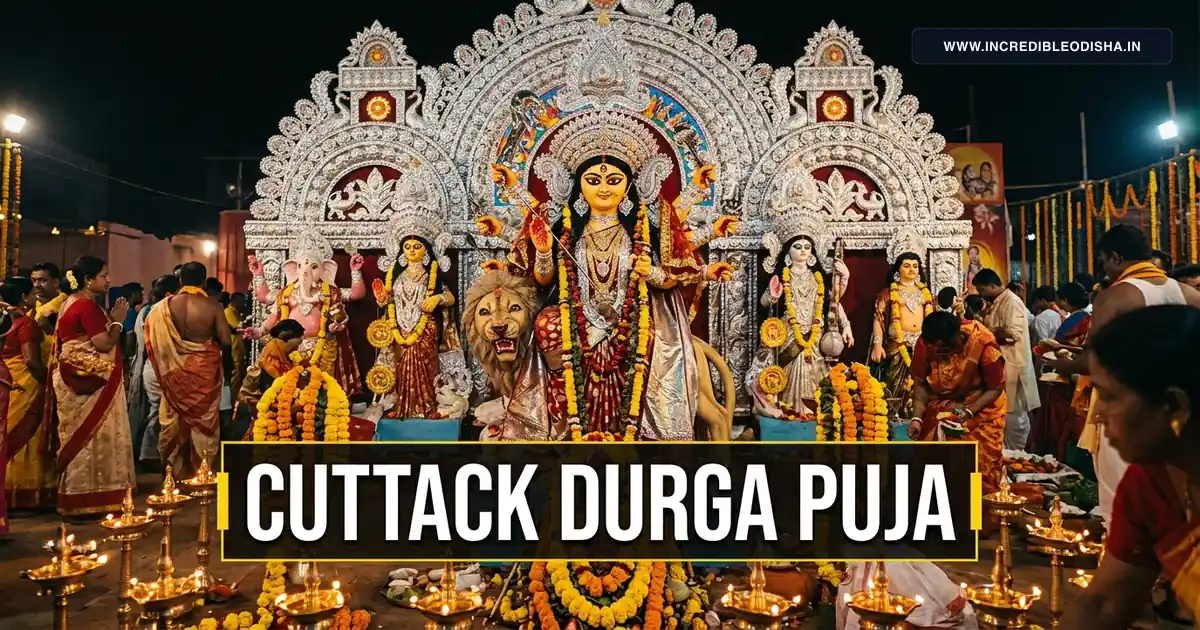
Chandi Medha refers to the monumental archway tableau constructed entirely from pure silver wire using traditional Odia Tarakasi filigree techniques. Standing behind the clay idols of Goddess Durga, Mahishasura, Lakshmi, Saraswati, Ganesha, and Kartikeya, this silver framework depicts intricate floral vines, sacred peacocks, and mythical deities.
The craft requires months of painstaking hand fabrication by master silversmiths who draw pure silver into hair-thin strands, twist them into delicate patterns, and solder them onto sturdy brass support frames. Travelers interested in regional artistic traditions often pair their festival visit with shopping for authentic Odisha handloom sarees woven in neighboring textile clusters.
Choudhury Bazar: The 1956 Pioneer of Silver Tableaux
The modern Chandi Medha movement was ignited in 1956 by the visionary Choudhury Bazar Puja Committee. Seeking a lasting alternative to perishable floral and paper decorations, the committee commissioned local artisans to fabricate a complete silver filigree backdrop using 250 kilograms of pure silver.
For 35 consecutive years, Choudhury Bazar stood as the sole committee in Cuttack with a Chandi Medha, attracting visitors from across the country. The breakthrough proved that traditional Odia metallurgy could transform festive devotion into timeless public art.
Suna Besha: The Introduction of Pure Gold Crowns
In 2002, the Choudhury Bazar committee raised the artistic benchmark once again by introducing Suna Besha, or golden adornment, for the deities. Artisans crafted solid gold crowns, delicate necklaces, earrings, and ornamental weapons using more than 30 kilograms of pure gold.
This opulent milestone inspired neighboring committees including Mangalabag, Sheikh Bazar, and Ranihat to incorporate gold crowns and floral borders. Today, the convergence of shimmering gold ornaments against polished silver backdrops creates an extraordinary visual spectacle during evening darshan.
Cuttack Tarakasi and Its Official Geographical Indication (GI) Tag
The exquisite metalwork displayed across Cuttack pandals is the direct heritage of Tarakasi, an indigenous silver filigree craft practiced in the city for centuries. Centered around artisan lanes in Alisha Bazar and Mansinghpatna, Tarakasi involves heating, drawing, flattening, and crimping silver wires into mesmerizing motifs without heavy die-casting.
Since earning its official Geographical Indication (GI) tag in 2024, the heritage of Tarakasi silver filigree enjoys national recognition and legal protection. This milestone honors the hereditary silversmiths whose masterworks illuminate the festival every October.
Top Chandi Medha Pandals in Cuttack You Must Visit
While Cuttack hosts over 160 Durga Puja mandaps, around 30 committees form the elite circle of Chandi Medha installations. Each pandal displays distinct artistic nuances, historical traditions, and decorative themes.
1. Choudhury Bazar Puja Committee
As the undisputed pioneer of both Chandi Medha and Suna Besha, Choudhury Bazar remains the crown jewel of Cuttack Durga Puja. The mandap features an imposing silver tableau weighing nearly 500 kilograms, complemented by crowns, trident weapons, and jewelry crafted from pure gold.
Choudhury Bazar is also famous for its unique artistic inclusion: the committee places images of Lord Jagannath, Balabhadra, and Subhadra directly on the silver backdrop above Goddess Durga. This harmonious synthesis reflects the deep Jagannath culture that permeates all spiritual traditions in Odisha.
2. Sheikh Bazar Puja Committee
Situated adjacent to the historic Chandi Temple, Sheikh Bazar entered the Chandi Medha fraternity in 1991. The committee unveiled a magnificent filigree backdrop utilizing approximately 350 kilograms of silver, designed with sweeping peacock plumes and swirling lotuses.
Sheikh Bazar later added a pure gold crown for Goddess Durga weighing over 3.5 kilograms. The mandap is celebrated for its wide open courtyard, spectacular overhead illumination gates, and close proximity to famous temples in Odisha honoring Maa Cuttack Chandi.
3. Balu Bazar Puja Committee (Binod Bihari)
Balu Bazar stands as the living museum of Cuttack Durga Puja traditions. While the committee introduced an ornate silver backdrop in modern decades, it remains deeply committed to heritage preservation.
Artisans at Balu Bazar sculpt the idol using the exact same clay mold design that has been preserved for over a century. The committee strictly utilizes natural vegetable and mineral dyes rather than synthetic paints, creating a warm, earthy icon that commands deep spiritual reverence.
4. Ranihat Puja Committee
Located near the central commercial hub, Ranihat is widely renowned for its majestic idol styling and luxurious silver filigree architecture. Installed in the late 1990s, Ranihat’s Chandi Medha incorporates more than 400 kilograms of silver filigree, crowned with radiant gold ornaments.
The Durga idol at Ranihat is famous for its intricate zardozi embroidered garments and lifelike, expressive eyes. Visitors often spend extended time admiring the lifelike lion vahana and the exquisite filigree peacocks perched atop the archway.
5. Mangalabag Puja Committee
Mangalabag presents one of the heaviest and most visually intricate silver backdrops in the city, fabricated using over 500 kilograms of silver and more than 5 kilograms of gold. The committee is famous for its magnificent welcome arches that span hundreds of meters across the approach roads.
The backdrop at Mangalabag features miniature filigree shrines housing celestial dancers, apsaras, and guardian lions. The lighting design here is exceptionally sophisticated, utilizing computerized LED arrangements that highlight every delicate silver filament.
6. Chandni Chowk and College Square Pandals
Chandni Chowk, located in the historic western quarter, features a Chandi Medha that emphasizes classic geometric symmetry and floral arabesques. Its central location near High Court road makes it an essential anchor along the inner heritage walking circuit.
College Square, positioned right opposite Cuttack Railway Station, serves as the grand reception gate for incoming railway passengers. The committee combines a lavish silver filigree backdrop with monumental illuminated welcome gates that replicate famous global monuments.
Elite Chandi Medha and Suna Besha Pandals Comparison
The following table summarizes the signature artistic features, metal usage, and unique highlights of the top Durga Puja mandaps in Cuttack:
| Puja Committee | Introduction Year | Approx. Silver Weight | Gold Ornaments (Suna Besha) | Signature Architectural & Ritual Feature |
|---|---|---|---|---|
| Choudhury Bazar | 1956 (Pioneer) | ~500 kg | Yes (Crowns & Weapons) | First Chandi Medha in Odisha; features Jagannath Trinity on backdrop |
| Sheikh Bazar | 1991 | ~350 kg | Yes (Gold Crown) | Elegant peacock filigree motifs; located near Maa Cuttack Chandi Temple |
| Balu Bazar | 1510 CE (Oldest) | ~300 kg | Traditional Ornaments | Historic 500-year Chaitanya lineage; organic vegetable dyes and clay molds |
| Mangalabag | 1998 | ~500 kg | Yes (Solid Gold Crowns) | Intricate filigree miniature shrines; massive synchronized LED light arches |
| Ranihat | 1999 | ~400 kg | Yes (Gold Jewelry) | Exquisite zardozi designer garments; striking lifelike facial aesthetics |
| Chandni Chowk | 1995 | ~300 kg | Yes (Gold Accents) | Geometric symmetry; historic location along the western old-city corridor |
| Chauliaganj | 2005 | ~350 kg | Yes (Gold Crown) | Expansive tableau design; prominent community cultural performances |
| College Square | 2008 | ~350 kg | Yes (Gold Accents) | Monumental thematic gates; grand welcome hub near Cuttack Railway Station |
The Idols of Cuttack: Shanta Murti Artistry and Organic Clay Traditions
The clay idols of Goddess Durga in Cuttack possess a visual identity that distinguishes them from representations anywhere else in India. Sculpted primarily in the traditional potters’ quarter of Kumbhar Sahi, each idol reflects deep spiritual grace and artistic restraint.
Master sculptors gather sacred alluvial clay from the beds of the Mahanadi and Kathajodi rivers. This sacred soil is blended with organic binders, rice husk, and jute fiber to create a smooth, durable sculpting medium that adheres to bamboo and straw armatures.
Unlike dramatic depictions featuring fierce scowls, Cuttack’s idols are rendered in the Shanta Murti style. The Mother Goddess displays large, almond-shaped eyes filled with motherly affection, gently curved lips with a peaceful smile, and compassionate posture. Even while vanquishing the demon Mahishasura, her expression remains gentle, symbolizing the effortless triumph of divine righteousness over earthly ignorance.
Bhasani Jatra: The Grand Devigada Immersion Procession
The conclusion of Durga Puja in Cuttack is celebrated through Bhasani Jatra, an exhilarating street carnival that begins on Vijaya Dashami and continues through the following night. Unlike quiet immersions, Cuttack’s Bhasani transforms the city into an ocean of rhythm, traditional percussion, and illuminated tableaux.
Traditional Instruments and Procession Routes
During Bhasani Jatra, each neighborhood mandap disassembles its portable structures and mounts the clay deities onto lavishly decorated open trucks and hydraulic trolleys. The idols are accompanied by hundreds of folk musicians playing indigenous instruments including the Ghanta (brass bell-metal cymbals), Ghanta-Badya, Dulduli drums, and conch shells.
Processions from across the city converge along two major arterial corridors: the Buxibazar-Choudhury Bazar stretch and the Mangalabag-Ring Road route. Youth groups perform traditional martial arts, Sambalpuri folk dances, and acrobatics before massive crowds that pack the balconies and terraces until daybreak.
Eco-Friendly Immersion at Devigada Ghat
All immersion processions ultimately arrive at Devigada along the sandy banks of the Kathajodi River. In earlier decades, idols were immersed directly into the flowing river waters.
To protect the aquatic ecosystem and water quality, municipal authorities construct large artificial immersion ponds along the riverbed. Idols are respectfully immersed inside these lined reservoirs, allowing swift collection of organic clay, wooden armatures, and biodegradable ornaments. Official event promotions and visitor advisories are published each season on the Odisha Tourism portal.
Best Pandal Hopping Route and Festive Night Itinerary
Navigating Cuttack during Durga Puja requires strategic planning, as police authorities restrict motorized traffic inside the inner market streets during peak evening hours. The following walking and rickshaw itinerary helps visitors experience the leading mandaps smoothly:
- 06:00 PM to 07:30 PM: Begin at College Square to view the spectacular illuminated entrance archways right outside the railway station before pedestrian crowds peak.
- 07:30 PM to 09:00 PM: Walk west toward Ranihat and Mangalabag to admire the heavy silver filigree backdrops and enjoy evening arati ceremonies.
- 09:30 PM to 11:30 PM: Head into the historic core of Choudhury Bazar to witness the iconic gold and silver tableau, followed by a visit to nearby Balu Bazar at Binod Bihari.
- 11:30 PM to 01:00 AM: Continue along Naya Sarak toward Sheikh Bazar and Chandni Chowk to appreciate the tranquil night lighting and peacock filigree work.
- 01:30 AM to 03:30 AM: Conclude your nighttime circuit around Bidanasi and Barabati Fort to explore local community pandals and savor late-night street food.
Visitors seeking broader sightseeing during daylight hours can explore medieval ramparts, island temples, and museums outlined in our guide to best places to visit in Cuttack district.
What to Eat During Cuttack Durga Puja: Street Food Delights
Pandal hopping in Cuttack is inseparable from the city’s legendary culinary culture. As night falls, street vendors and sweetshops line the festive streets, serving piping-hot snacks to hungry revellers until the early morning hours.
Cuttack Dahi Bara Aloo Dum
The undisputed king of Cuttack street gastronomy is Dahi Bara Aloo Dum. Tender, light urad dal dumplings are soaked in lightly spiced, tempered buttermilk, then smothered with fiery potato curry (Aloo Dum) and yellow pea curry (Ghuguni).
The dish is garnished with freshly chopped onions, grated ginger, sev, and chopped coriander leaves. Every serving concludes with a refreshing cup of spicy, mustard-infused Dahi Pani. Iconic spots near Bidanasi, Biju Patnaik Chowk, and Choudhury Bazar serve thousands of plates every festive night.
Chaat, Guguni, and Festive Sweets
Alongside Dahi Bara, food stalls across Mangalabag and College Square serve sizzling Cuttack Chaat, prepared on massive iron tawas with crushed samosas, yellow peas, sweet tamarind chutney, and black salt.
To balance the spices, visitors indulge in traditional Odia dairy confections including fresh Chenna Gaja, Chenna Poda, and warm Rasagolas. Travelers can discover more culinary gems in our curated guide to 10 famous Odisha foods you must try.
Essential Visitor Tips and Travel Logistics
Planning a smooth festive trip to Cuttack requires attention to transportation, seasonal weather, and local crowd management rules.
How to Reach Cuttack by Train, Flight, and Road
Cuttack is one of the most accessible travel hubs in eastern India, directly integrated into national rail and highway networks:
- By Train: Cuttack Junction (CTC) is a major station on the Howrah-Chennai main line, served by daily superfast express trains and Vande Bharat services from Kolkata, New Delhi, and Hyderabad.
- By Air: The nearest airport is Biju Patnaik International Airport (BBI) in Bhubaneswar, located roughly 32 kilometers south of Cuttack. Pre-paid taxis and app-based cabs connect the airport to central Cuttack in 45 minutes via National Highway 16.
- By Road: Frequent intercity Mo Bus electric services and express coaches run between Bhubaneswar and Cuttack every few minutes, stopping near major transit points like Badambadi Bus Stand.
Best Time to Visit and Traffic Regulations
The optimal window to experience the festivities is between Maha Saptami and Vijaya Dashami, usually falling in October. Daytime temperatures remain pleasant around 28°C, while evenings cool to a comfortable 20°C.
During the peak four days of the festival, city traffic police enforce one-way pedestrian zones across the old bazaar lanes between 6:00 PM and 4:00 AM. Visitors are advised to park personal vehicles at designated perimeter grounds along the Kathajodi and Mahanadi ring roads and explore the inner mandaps on foot or via cycle rickshaws.
Those planning extended seasonal travel can coordinate their itinerary with the historic Bali Jatra festival guide that follows in November along the Mahanadi riverbank.
Frequently Asked Questions About Cuttack Durga Puja
Why is Cuttack Durga Puja famous across India?
Cuttack Durga Puja is celebrated for its opulent Chandi Medha backdrops crafted from thousands of kilograms of pure silver filigree and gold ornaments. The festival blends 500 years of Vaishnavite heritage with the city’s internationally acclaimed Tarakasi metal artistry.
What is Chandi Medha in Cuttack Durga Puja?
Chandi Medha refers to the massive, intricately sculpted tableau made entirely from pure silver filigree wires that frames the deities. First introduced by Choudhury Bazar in 1956, this unique tradition now graces more than 30 major community pandals across Cuttack.
Which is the oldest Durga Puja pandal in Cuttack?
Balu Bazar Durga Puja at Binod Bihari is the oldest recorded celebration in Cuttack, tracing its roots to the visit of Sri Chaitanya Mahaprabhu in 1510 CE. The committee continues to observe ancient Shakta rituals, organic vegetable dye coloring, and historic clay molding techniques.
Which pandals have gold ornaments or Suna Besha in Cuttack?
Choudhury Bazar introduced solid gold crowns and jewelry in 2002, inspiring mandaps such as Mangalabag, Sheikh Bazar, and Ranihat to follow. These prominent pandals display elaborate crowns, weapons, and floral motifs crafted from pure gold.
Where does the Cuttack Durga Puja immersion procession take place?
The grand immersion procession, known as Bhasani Jatra, takes place along the banks of the Kathajodi River at Devigada Ghat. The deities are carried in festive day-and-night processions with traditional percussion before eco-friendly immersion in artificial ponds.
What is the best time for pandal hopping in Cuttack?
Nighttime between 8:00 PM and 3:00 AM from Maha Saptami to Vijaya Dashami offers the best atmosphere with cool breezes and dazzling street illuminations. Traffic police enforce pedestrian-only zones in the inner markets during these hours, making walking comfortable for families.