Langudi Hills Jajpur: Pushpagiri Buddhist Stupas & Guide
Explore Langudi Hills in Jajpur, the ancient Pushpagiri Buddhist site. Complete guide with rock-cut stupas, history, timings, entry fee, and travel routes.
Rising above the fertile alluvial plains of the Kelua and Brahmani river basins in coastal Odisha, an ancient hill formation preserves one of India’s most extraordinary archaeological revelations. For centuries, historians and world scholars searched for the location of Pushpagiri, a celebrated Buddhist university recorded by seventh-century Chinese pilgrim Xuanzang (Hiuen Tsang). Today, excavations confirm that Langudi Hills in Jajpur district represents the authentic grounds of this lost monastic center.
Unlike later structural brick monasteries, this site features dozens of monolithic stupas carved directly into laterite bedrock. Spanning from the Mauryan era of Emperor Ashoka to the eleventh century CE, Langudi offers a window into early Buddhist art, epigraphy, and monastic life. This detailed visitor guide covers historical discoveries, rock-cut stupas, satellite sites, transit routes, and field advice.
Key Takeaways
- Historical Identity: Langudi Hills is an ancient Buddhist archaeological site in Jajpur district, confirmed by excavated Brahmi inscriptions as the ancient Pushpagiri Mahavihara recorded by Chinese pilgrim Xuanzang.
- Rock-Cut Monuments: The hill preserves a central brick Mahastupa and 34 rock-cut monolithic stupas carved directly into the living rock face, dating between the 3rd century BCE and the 11th century CE.
- Free Public Access: Admission to the open-air archaeological complex is completely free, with the hillside pathways welcoming visitors daily from 6:00 AM to 6:00 PM.
- Convenient Transit: Located just 18 kilometers northeast of Chandikhol Junction and 75 kilometers from Bhubaneswar along National Highway 16, easily reached by road.
Langudi Hills at a Glance: Ancient Pushpagiri, Stupas & Key Visitor Facts
Langudi Hills extends across a low-lying laterite ridge near the village of Mirzapur in the Dharmasala administrative block of Jajpur district. Positioned near the Kelua River, a tributary of the Brahmani, the hill provided ancient monks with a secure elevated refuge overlooking agricultural trade corridors.
The archaeological property is protected by the State Archaeology Department of Odisha and referenced by the Archaeological Survey of India. Travelers exploring regional history and heritage circuits can consult our comprehensive Jajpur district guide to discover nearby stone temples, historic river ghats, and artisan handloom villages.
| Parameter | Official Detail & Traveler Advisory |
|---|---|
| Archaeological Identity | Ancient Pushpagiri Mahavihara (Puṣpa Sabhar Giri) |
| Geographic Location | Langudi Hill, near Mirzapur, Dharmasala Block, Jajpur District, Odisha |
| Historical Period | 3rd Century BCE (Mauryan Empire) to 11th Century CE (Somavamsi Dynasty) |
| Key Monuments | 34 rock-cut monolithic stupas, central brick Mahastupa, Buddha & Tara relief panels |
| Site Opening Hours | 6:00 AM to 6:00 PM daily throughout the year |
| Admission Tariff | Free admission for all visitors; no entry tickets required |
| Nearest Highway Junction | Chandikhol Junction on NH-16 (18 km away) |
| Nearest Railway Station | Jajpur Keonjhar Road (JJKR), 30 km; Haridaspur Station, 22 km |
| Official Directory | Documented on the Jajpur District Administration portal |
| Last Verified | November 2026 |
The site welcomes archaeology students and scholars, Buddhist heritage travelers, history buff weekend explorers, and heritage landscape photographers. The open hillside terrain remains uncommercialized, allowing travelers to experience the ancient meditative silence that drew Buddhist monks to these rocky ridges two thousand years ago.
The Pushpagiri Mahavihara Rediscovery: Xuanzang’s Chronicles & Brahmi Inscriptions
For more than a century, the geographic whereabouts of Pushpagiri remained one of Indian archaeology’s greatest puzzles. In his famous seventh-century travelogue Si-Yu-Ki, the scholarly Chinese monk Xuanzang documented a colossal Buddhist university in the realm of Wu-T’u (ancient Odisha).
Xuanzang described the institution as Pu-se-po-ki-li (Pushpagiri), recording that its hilltop stone stupas emanated supernatural light and that scholars gathered here from distant kingdoms to study Mahayana Buddhist philosophy alongside universities like Nalanda.
For decades, early British surveyors and twentieth-century historians assumed that Pushpagiri was an alternate name for the Diamond Triangle monastic ruins at Ratnagiri or Lalitgiri. However, systematic archaeological excavations conducted between 1996 and 2006 by the Odisha Institute of Maritime and South East Asian Studies (OIMSEAS) on Langudi Hill solved the ancient mystery.
The Breakthrough Epigraphic Evidence
Excavators unearthing the southern slope of Langudi Hill discovered fragmentary stone inscriptions written in early Brahmi script dating to the first century CE. One critical epigraph explicitly mentioned the phrase Puṣpa Sabhar Giri, establishing beyond scholarly doubt that Langudi Hill was indeed the ancient Pushpagiri Mahavihara.
Further excavations revealed terra-cotta seals, early Northern Black Polished Ware, and fragmented structural foundations dating directly back to the Mauryan period. These findings confirmed that Emperor Ashoka had established religious stupas here following the Kalinga War, deep in the ancient history of Odisha.
Archaeological Highlights: 34 Rock-Cut Stupas, Mahastupa & Buddhist Sculptures
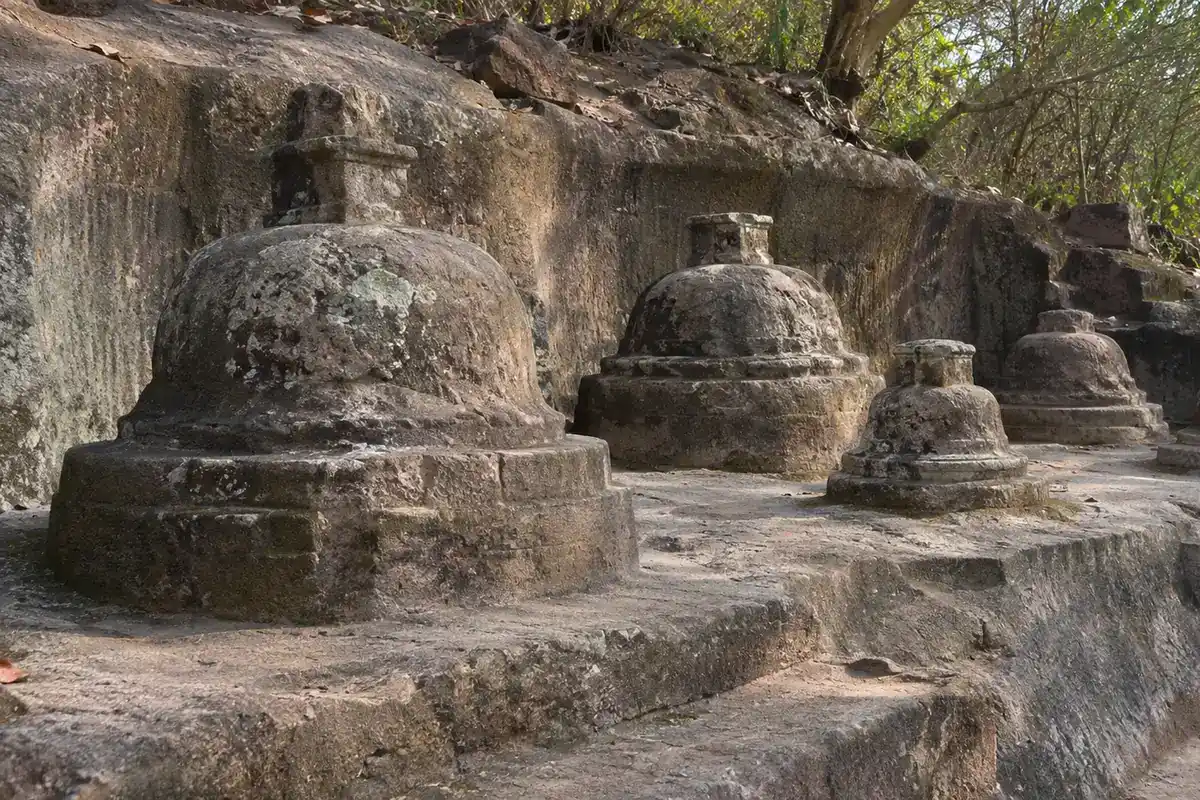
Langudi Hill displays a rare combination of structural brick architecture and living-rock sculpture. The archaeological ruins are concentrated along the northern and southern terraces of the laterite ridge.
Walking along the ancient hillside pathways reveals three primary clusters of monumentation:
The Central Mahastupa and Monastic Brick Foundations
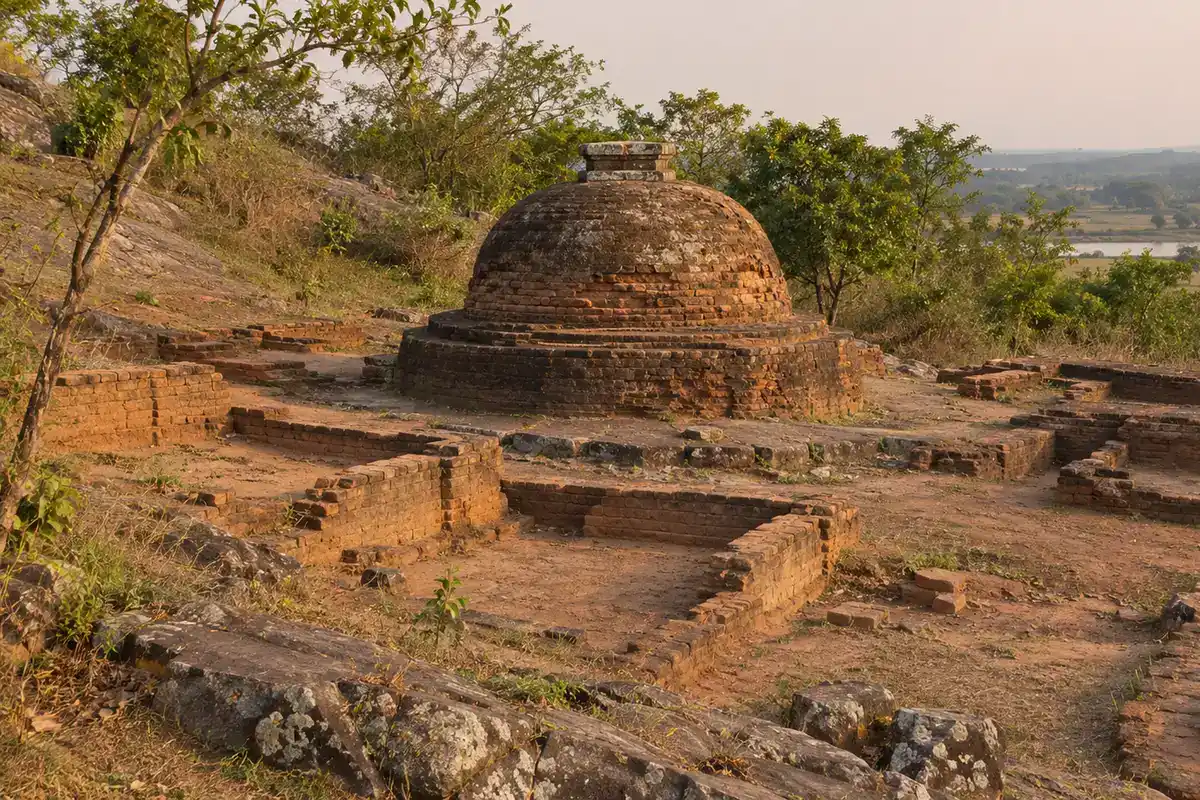
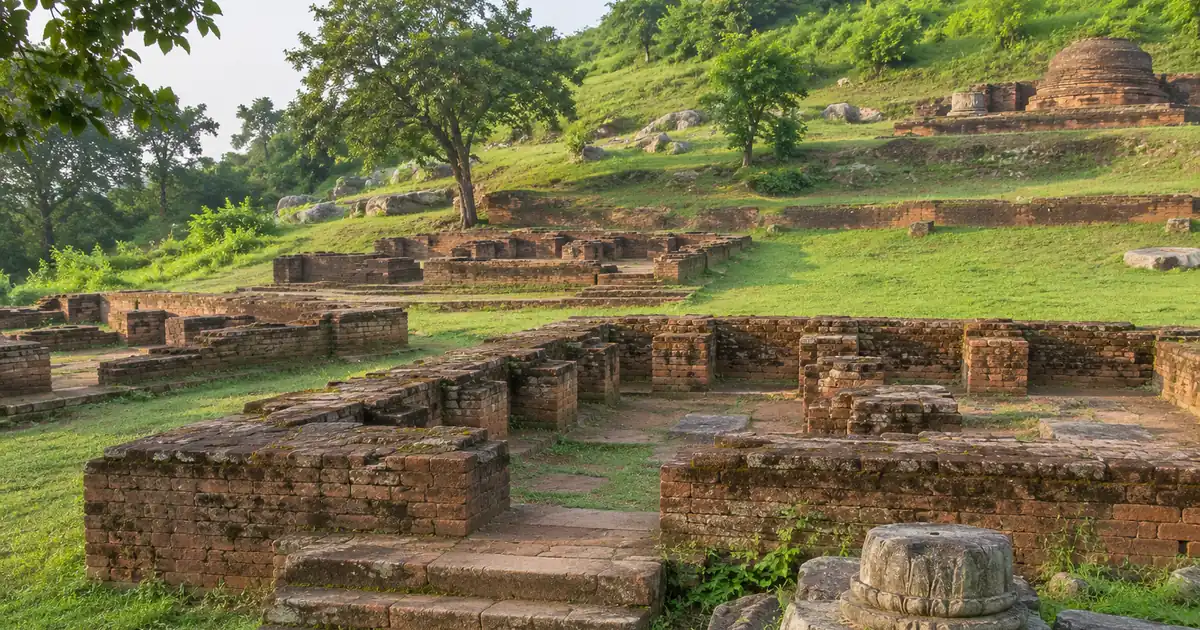
At the summit of the hill sits the ruined foundation of a monumental brick Mahastupa. Excavated brick alignments show that the stupa originally featured a circular base, a solid interior core, and a wide circumambulatory path (pradakshina patha) surfaced with compacted laterite gravel.
Surrounding the central stupa are the brick foundations of monastic cells, communal prayer halls, and ancient rainwater harvesting tanks cut into the rock. Monks stored monsoon rainwater in these cisterns to sustain the monastery through hot summer months.
The 34 Rock-Cut Monolithic Stupas
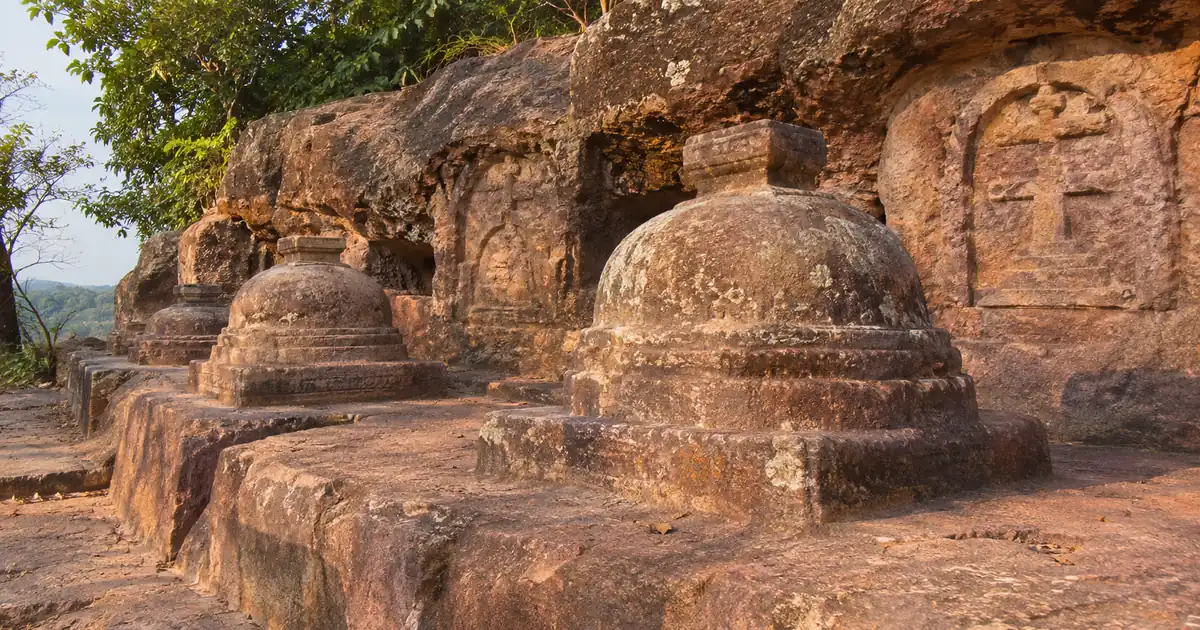
The most visually captivating feature of Langudi is the northern rock wall. Here, ancient stonecutters carved 34 rock cut monolithic stupas directly into the exposed vertical face of the laterite rock.
Carved in low and high relief, these stupas feature well-proportioned cylindrical drums (medhi), hemispherical domes (anda), square railings (harmika), and ceremonial umbrella spires (chhatravali). Because the stupas are carved directly from the living bedrock rather than built with loose stones, they have withstood natural weathering for over two millennia.
Sculpted Relief Panels of Buddha, Tara and Prajnaparamita
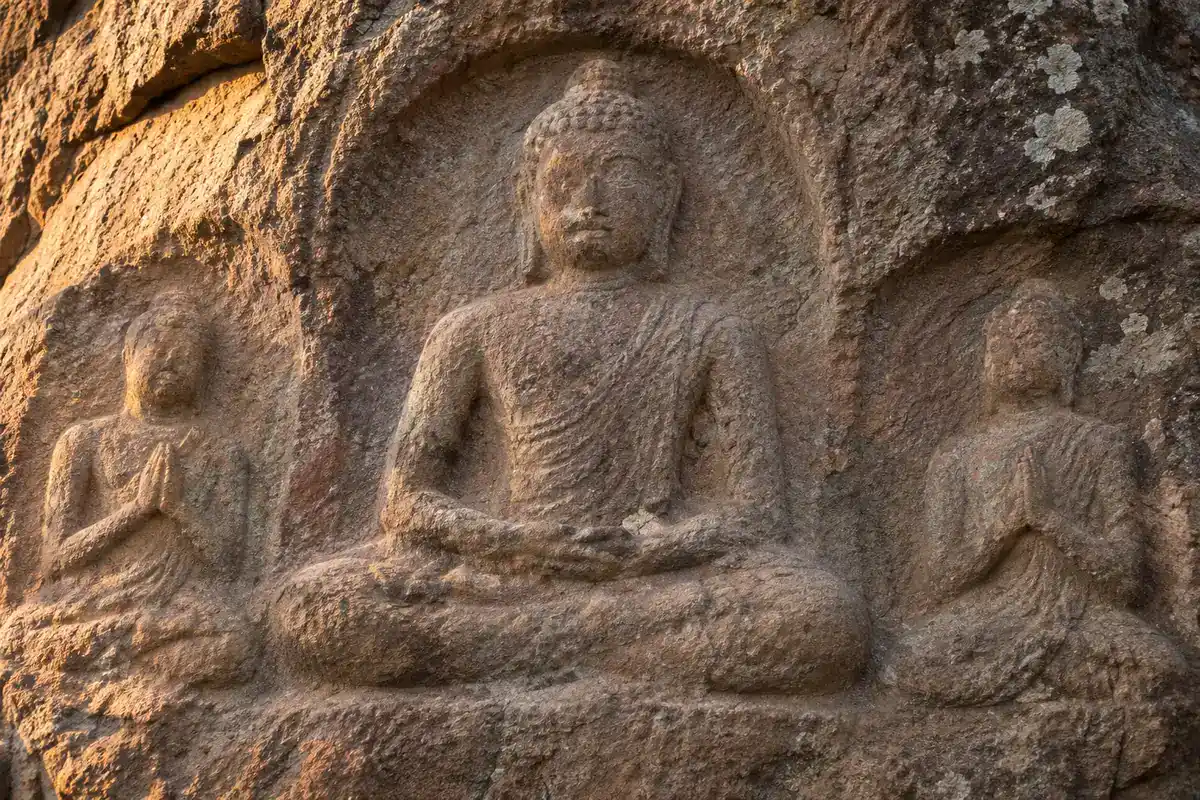
Carved alongside the rock-cut stupas are masterfully executed Buddhist sculptures dating from the early Kushana era through the mature Bhauma-Kara period:
- Dhyani Buddha Figures: Several panels depict Gautama Buddha seated in deep meditative posture (Dhyana Mudra) atop carved lotus pedestals, flanked by flying celestial attendants (Gandharvas).
- Bodhisattva Reliefs: Graceful representations of Avalokiteshvara holding lotuses and displaying the reassurance gesture (Abhaya Mudra).
- Goddess Tara & Prajnaparamita: Elegant female deities carved with detailed waist ornaments, floral crowns, and delicate hand gestures, representing the flourishing of Mahayana and Vajrayana devotional art.
- Ashokan Pillar Depictions: Unique bas-relief panels showing animal-crowned pillars, reflecting early Mauryan imperial influence across Kalinga.
Nearby Buddhist Sites: Kaima Rock-Cut Elephant, Tarapur & Deuli Hills
Langudi does not stand in isolation. It forms the core of an expansive Buddhist monastic landscape that flourished throughout the Assia and Langudi hill ranges along the Kelua River valley.
Travelers exploring Langudi can easily visit several fascinating satellite sites located within a ten-kilometer radius:
| Satellite Site | Approximate Distance from Langudi | Key Archaeological Feature | Historical Significance |
|---|---|---|---|
| Kaima Hill | 6 km west | Monolithic rock-cut elephant in four-pillared hall | 3rd Century BCE Mauryan sculpture reflecting Dhauli elephant style |
| Tarapur Stupa | 4 km south | Massive brick stupa ruins and early Brahmi inscriptions | Mentions merchants Tapassu and Bhallika offering hair relics |
| Deuli Hills | 8 km southwest | Ancient rock-cut monastic caves and meditation chambers | Monastic residential cells dating to early Buddhist ascetic eras |
| Neulpur | 5 km northwest | Copper plate inscription findspot of Subhakaradeva I | Historical charter establishing royal land grants to Buddhist viharas |
Kaima Hill: The Monolithic Mauryan Elephant
Just a short drive from Langudi, Kaima Hill features an extraordinary monolithic rock-cut elephant carved from a single exposed laterite boulder. The elephant is enclosed within a carved four-pillared structural pavilion.
Art historians compare the Kaima elephant to the famous Ashokan rock-cut elephant at Dhauli near Bhubaneswar, identifying it as an authentic Mauryan imperial artwork created to mark Buddhist monastic territory along ancient trading roads.
Tarapur: The Hair Relic Stupa
Tarapur houses a ruined brick stupa of immense antiquity. Epigraphic seals discovered here refer to Tapassu and Bhallika, the two merchant brothers from Utkala who according to Buddhist tradition became the Buddha’s first lay disciples and received sacred hair relics (Kesha Dhatu) directly from the Blessed One.
Langudi vs the Diamond Triangle: Architectural Comparison
Travelers exploring Buddhist heritage in eastern India frequently compare Langudi Hills with the famous Diamond Triangle complexes of Ratnagiri Buddhist Monastery, Udayagiri, and Lalitgiri.
While all four sites belong to the rich Buddhist legacy of coastal Odisha, they represent distinct historical epochs and architectural styles.
| Comparative Parameter | Langudi Hills (Pushpagiri) | Diamond Triangle (Ratnagiri, Udayagiri, Lalitgiri) |
|---|---|---|
| Primary Architectural Mode | Monolithic rock-cut stupas and bedrock reliefs | Elaborate structural brick monasteries with stone portals |
| Historical Age | 3rd Century BCE to 11th Century CE (earlier origin) | 5th Century CE to 13th Century CE (mature classical zenith) |
| Epigraphic Record | Confirmed as Puṣpa Sabhar Giri (Pushpagiri) | Ratnagiri Mahavihara, Madhavapura Mahavihara seals |
| Artistic Character | Austere early rock-cut relief carvings and stupas | Highly sophisticated green chlorite doorways and bronze sculptures |
| Atmospheric Setting | Open, rugged laterite hill ridge overlooking rural plains | Excavated museum campuses with restored monastery quadrangles |
| Visitor Density | Quiet, off-the-beaten-path, uncrowded exploration | Established national monument circuit with ticketed entry |
Langudi provides the missing link in Odisha’s Buddhist timeline. It shows how the faith took root during the Mauryan and post-Mauryan eras through rugged rock-cut monuments, paving the way for the sophisticated monastic universities that later blossomed at Ratnagiri and Udayagiri.
Devotees can also contrast Langudi’s ancient laterite rock art with the modern peace pagoda at Dhauli Giri Hills Shanti Stupa overlooking the historic Kalinga battlefield.
How to Reach Langudi Hills: Routes from Chandikhole, Cuttack & Bhubaneswar
Langudi Hills is accessible via paved highways branching off National Highway 16, the main transportation corridor connecting Bhubaneswar, Cuttack, and Kolkata.
| Origin City | Driving Distance | Approximate Duration | Recommended Route |
|---|---|---|---|
| Chandikhol Junction | 18 km | 25 minutes | NH-16 North to Dharmasala – Mirzapur Road – Langudi |
| Cuttack | 55 km | 1 hour 15 minutes | NH-16 via Tangi, Manguli, and Chandikhol to Dharmasala |
| Bhubaneswar | 75 km | 1 hour 45 minutes | NH-16 past Cuttack bypass to Chandikhol and Dharmasala |
| Jajpur Town | 35 km | 45 minutes | State Highway south via Kuakhia and Dharmasala to Mirzapur |
| Kolkata (Howrah) | 365 km | 6 hours 30 minutes | NH-16 southbound past Balasore and Bhadrak to Dharmasala |
Driving Directions from Chandikhol and Dharmasala
From Chandikhol Junction on National Highway 16, drive north toward Dharmasala for approximately 12 kilometers. Turn right near Jaraka or Dharmasala onto the paved district road leading toward Mirzapur and the Kelua river bridge.
Directional signage installed by the tourism department guides visitors toward Langudi Hill. A paved village access road leads directly to the base of the hill where open vehicle parking is available.
Nearest Railhead and Local Transport
The most convenient railway hubs are:
- Haridaspur Railway Station: Situated 22 kilometers away, handling select local passenger trains.
- Jajpur Keonjhar Road Station (JJKR): Located 30 kilometers north, served by express trains connecting Kolkata, Puri, and New Delhi. Taxis and auto-rickshaws can be hired outside the station.
Visitors traveling by bus can board any state (OSRTC) or private express bus running between Bhubaneswar and Bhadrak, alight at Dharmasala or Jaraka, and hire a local auto-rickshaw for the short final ride to the hill.
Best Time to Visit, Hillside Trekking Advice & Preservation Code
Planning your exploration around local weather patterns guarantees a comfortable and rewarding visit to this exposed archaeological hill.
Seasonal Recommendations
- Winter (October to February): This is the favored season to visit Langudi Hills. Daytime temperatures range comfortably between 20°C and 28°C with gentle breezes across the open ridge. Morning hours offer clear golden sunlight that brings out the deep red hues of the rock-cut stupas.
- Monsoon (July to September): Rain washes the laterite stone clean and turns the surrounding valley deep green. However, wet laterite rock becomes slick, requiring cautious footing along hillside paths.
- Summer (March to June): Summer temperatures frequently exceed 38°C across interior Jajpur. The open rocky hilltop offers little natural tree shade, making midday visits uncomfortable. If visiting in summer, plan your walk between 6:00 AM and 8:30 AM.
Field Advice for Exploring the Hill
Because Langudi is an open archaeological terrain rather than a paved museum campus, visitors should prepare accordingly:
- Footwear: Wear sturdy walking shoes with non-slip rubber soles. The trail involves climbing gentle rock slopes with loose gravel.
- Hydration & Sun Protection: Carry a reusable water bottle, sunglasses, and a wide-brimmed sun hat, as no commercial shops operate on the upper hill ridge.
- Timing: Allocate two to three hours to walk the full circuit of the central Mahastupa, the northern rock-cut stupas, and the southern sculpted panels.
Preservation and Site Etiquette
Langudi’s rock-cut sculptures are delicate cultural treasures that have survived for more than twenty centuries:
- Do Not Touch or Lean on Sculptures: The laterite stone is porous and prone to flaking. Avoid rubbing hands against carved relief faces.
- No Inscribing on Rocks: Carving names or graffiti onto ancient stone surfaces is a punishable offense under state archaeological protection laws.
- Pack Out All Trash: Carry all wrappers, bottles, and snack packaging back to your vehicle to keep the sacred hilltop clean and unspoiled.
Regional Jajpur Heritage Circuit: Biraja Temple & Riverside Ghats
A morning visit to Langudi Hills pairs seamlessly with celebrated cultural landmarks across Jajpur district, creating an enriching full-day itinerary.
Maa Biraja Temple in Jajpur Town
After exploring the Buddhist ruins of Langudi, drive 35 kilometers north to Jajpur town to visit the renowned Maa Biraja Temple in Jajpur. Recognized as an ancient Adi Shakti Peetha and the sacred realm of Nabhi Gaya, the temple draws pilgrims from across India.
Devotees take ritual baths at the historic Dashaswamedha Ghata on the sacred Baitarani River before offering prayers at the sanctum. The shrine provides an enriching cultural balance between ancient Buddhism and living Hindu Shakta traditions.
Gopalpur Handloom Weaving Clusters
Along the return drive toward National Highway 16, travelers can stop at the artisan villages of Gopalpur and Rasulpur. These rural cooperatives are famous across eastern India for handloom Tussar silk weaving.
Visitors can watch traditional weavers operate wooden pit looms and purchase authentic hand-woven Tussar silk sarees and shawls directly from master craftsmen. For comprehensive excursion ideas throughout the district, browse our curated directory of places to visit in Jajpur district and explore famous temples in Odisha across central coastal districts.
Frequently Asked Questions About Langudi Hills
Where is Langudi Hills located?
Langudi Hills is located near Mirzapur in the Dharmasala administrative block of Jajpur district, Odisha. It sits approximately 18 kilometers northeast of Chandikhol Junction and 75 kilometers north of Bhubaneswar along National Highway 16.
Is Langudi Hills confirmed as ancient Pushpagiri?
Yes, excavations by the Odisha Institute of Maritime and South East Asian Studies uncovered early Brahmi inscriptions mentioning Puṣpa Sabhar Giri. These epigraphs confirm the site as the ancient Pushpagiri Mahavihara documented in seventh-century records by Chinese traveler Xuanzang.
What are the visiting hours and entry fees for Langudi Hills?
Langudi Hills is open daily from 6:00 AM to 6:00 PM throughout the year. Admission to the archaeological site is completely free for all domestic and international visitors, with no entry tickets required.
What are the main archaeological attractions at Langudi Hills?
The site features a ruined brick Mahastupa on the hilltop summit and 34 rock-cut monolithic stupas carved into the laterite rock face. Visitors can also examine sculpted relief panels of Dhyani Buddhas, Bodhisattvas, and Goddess Tara dating between the 3rd century BCE and 11th century CE.
How far is Langudi Hills from Bhubaneswar and Cuttack?
Langudi Hills is located approximately 75 kilometers from Bhubaneswar (about 1 hour 45 minutes driving) and roughly 55 kilometers from Cuttack (about 1 hour 15 minutes driving). Both routes follow the four-lane National Highway 16 to Dharmasala.
Can visitors take photographs at Langudi Hills?
Yes, respectful non-commercial photography is permitted throughout the open-air archaeological ruins at Langudi Hills. Early morning and late afternoon light provide the best conditions for capturing the rock-cut stupas and surrounding river valley scenery.