Chhatia Bata Temple Jajpur: Timings, History & Visitor Guide
Plan your trip to Chhatia Bata Temple in Jajpur. Discover Second Srikshetra rituals, Kalki Avatar prophecies, Saint Hadi Das samadhi, timings, and travel guide.
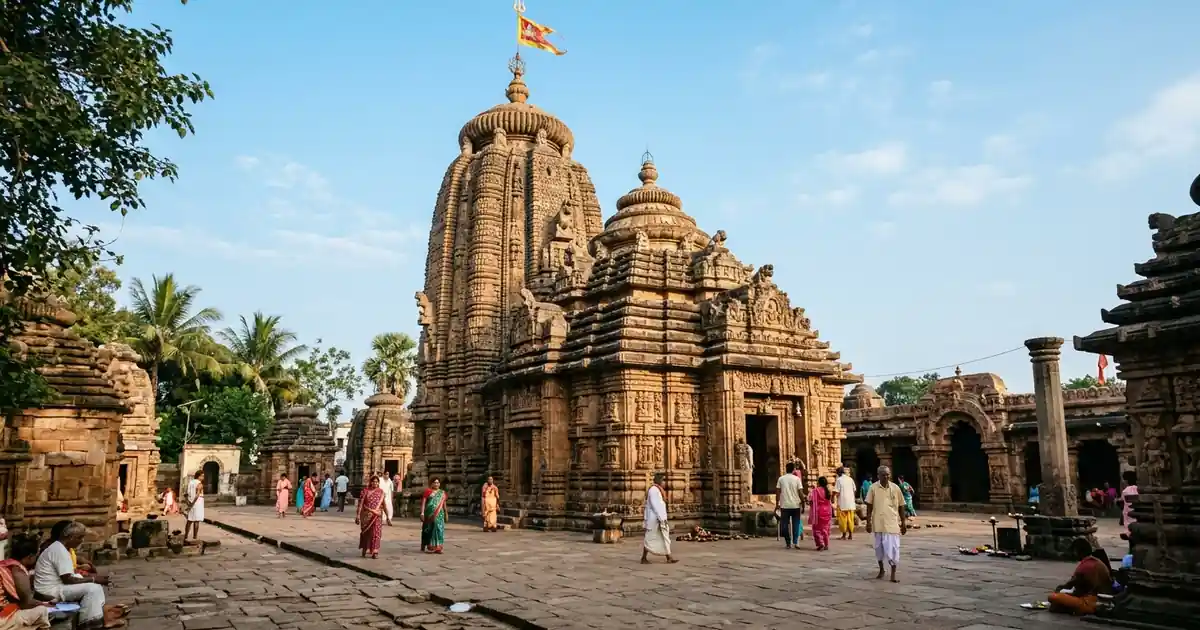
Standing prominently alongside National Highway 16 between Cuttack and Chandikhol, the historic chhatia bata temple jajpur serves as one of the most culturally significant spiritual destinations in eastern India. Known affectionately across Odisha as the Second Srikshetra, this sprawling stone complex bridges daily Jagannath worship with mystical prophecies regarding the future of humanity.
What distinguishes this venerated pilgrimage site is its intimate connection to the Bhavishya Malika scriptures. According to centuries-old Odia texts, this elevated sanctuary will serve as the divine refuge of Lord Jagannath when the current age draws to a close, making it a living monument of anticipation.
Together with regional heritage sites detailed in our Jajpur district travel guide and nearby best places to visit in Jajpur, Chhatia preserves an atmosphere of quiet devotion and ancient folklore. Whether you stop during a road trip to sample fresh local delicacies or arrive to pay homage at the resting place of Saint Hadi Das, this comprehensive guide provides all the details you need.
Key Takeaways
- Chhatia Bata is widely revered as the Second Srikshetra, housing consecrated idols of Lord Jagannath, Balabhadra, and Devi Subhadra.
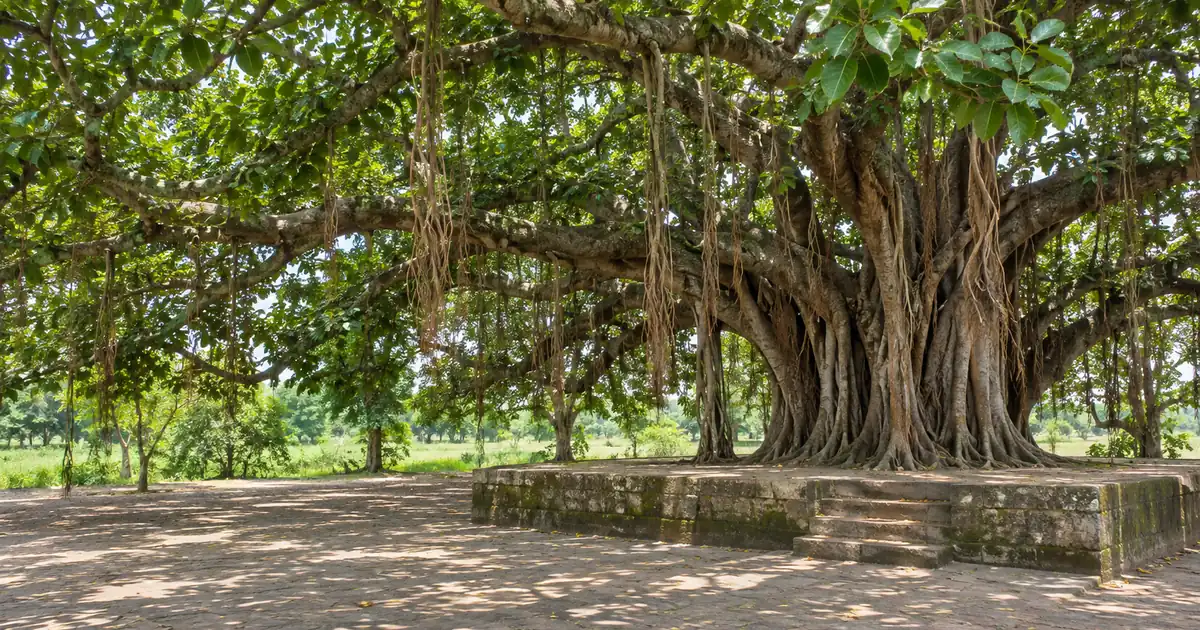
- The temple is named after an ancient, sprawling banyan tree (Bata) beneath which the 18th-century mystic poet Mahapurusha Hadi Das meditated.
- Regional Malika prophecies foretell that Lord Jagannath will appear here as the Kalki avatar at the end of the Kali Yuga.
- To reflect the scriptural prophecy of awaiting the Lord’s arrival, construction and stone expansion work at the complex continue on a perpetual basis.
- The temple is open daily from 5:30 AM to 9:00 PM with free public admission, situated conveniently right along the National Highway 16 corridor.
At-a-Glance: Temple Timings, Location & Sacred Summary
Planning a stop at Chhatia Bata is remarkably convenient due to its direct roadside location along the golden quadrilateral highway. Thousands of daily bus commuters, truck drivers, and families pause their journey here to seek safe travel blessings.
The temple complex maintains a relaxed and welcoming schedule. Devotees can comfortably walk through the outer stone arches, circumambulate the ancient banyan tree, and enter the main Natamandapa hall for personal prayer without rigid queues.
Daily Darshan Timings and Temple Schedule
The sanctuary opens early each morning at 5:30 AM with the ceremonial Mangala Alati. Priests perform morning ablutions and offer fresh flower garlands to the divine triad before general public darshan begins.
Unlike rural shrines that close for hours during the day, Chhatia Bata maintains continuous accessibility throughout the afternoon. Evening alati takes place at 7:00 PM with traditional drums and brass bells before nightly closure at 9:00 PM.
| Daily Darshan Window | Scheduled Timings | Religious Observance & Devotional Context |
|---|---|---|
| Mangala Alati & Dwaraphita | 5:30 AM to 6:15 AM | Early morning sanctum opening, cleansing, and lamp offering |
| Morning Darshan & Archana | 6:15 AM to 12:00 PM | Open public worship, individual coconut offerings, and prayers |
| Madhyanna Dhupa (Midday Bhog) | 12:30 PM to 1:30 PM | Traditional lunch offering cooked in the sacred temple kitchen |
| Afternoon Visiting Hours | 1:30 PM to 6:30 PM | Daytime darshan window popular with highway travelers |
| Sandhya Alati & Evening Puja | 7:00 PM to 8:00 PM | Resonant evening lamp ceremony with devotional chants |
| Pahada (Night Closure) | 8:45 PM to 9:00 PM | Final bedtime ritual and formal closing of the deula |
During annual festive observances such as Ratha Yatra, Snana Purnima, and Dola Purnima, visiting hours extend late into the night. Devotees from surrounding villages gather in large numbers to participate in colorful palanquin processions.
Essential Visitor Facts and Travel Parameters
The temple complex features paved flagstone courtyards, convenient drinking water stations, and shoe-storage facilities. Visitors arriving by road will find well-managed parking bays directly across the service lane.
Updated administrative bulletins and festival arrangements can be reviewed on the Official Odisha Tourism Portal and the Shree Jagannatha Temple Administration.
| Visitor Parameter | Practical Detail |
|---|---|
| Primary Presiding Deities | Lord Jagannath, Lord Balabhadra, and Devi Subhadra |
| Location | National Highway 16, Chhatia, Barchana Block, Jajpur 754023 |
| Admission Charges | Completely free public entry for all pilgrims |
| Temple Photography | Allowed in outer compound; strictly prohibited inside sanctum |
| Prescribed Attire | Modest traditional attire (dhoti, kurta, saree, salwar kameez) |
| Best Time for Visit | October to March for cool weather; July for Ratha Yatra |
| Nearest Railhead | Dhanmandal Railway Station (4 km); Cuttack Junction (30 km) |
| Nearest Airport | Biju Patnaik International Airport, Bhubaneswar (55 km) |
The Kalki Avatar & The Bhavishya Malika Prophecies
The extraordinary spiritual reputation of Chhatia Bata across Odisha is inextricably tied to the Bhavishya Malika, a collection of medieval prophetic palm-leaf texts. Authored by regional mystics, these verses detail cosmic transitions and the moral degeneration of Kali Yuga.
Among all sacred sites mentioned in these texts, Chhatia occupies the most dramatic geographic and theological role. The prophecies name this elevated sandstone mound as the destined seat where Lord Jagannath will culminate his earthly pastimes.
The Apocalyptic Pralaya and the 22 Steps of Puri
According to the cryptic verses preserved in the Malika, the conclusion of the present age will be marked by unprecedented natural cataclysms. Rising sea levels and massive coastal cyclones will gradually submerge low-lying coastal plains.
One widely quoted Odia prophetic verse warns that the ocean will breach the shore at Puri, sending waves so deep that fish will swim upon the historic twenty-two steps (Baisa Pahacha) of the Jagannath Temple.
[!NOTE] During this catastrophic deluge (Pralaya), the scriptures foretell that the elevated plateau of Chhatia will remain dry and untouched by floodwaters. Lord Jagannath, Balabhadra, and Subhadra will abandon Puri and travel north to establish their eternal court at Chhatia Bata.
Here, Lord Jagannath is prophesied to manifest his final incarnation as Kalki, riding a celestial white horse and wielding the divine sword Nandaka to restore righteousness and inaugurate the Satya Yuga.
The Living Prophecy: Continuous Temple Expansion
This apocalyptic legend has shaped a remarkable architectural custom that continues to this day. Traditional belief holds that construction at Chhatia Bata must never be declared complete until Lord Jagannath personally arrives to inaugurate his new realm.
As a result, stone masons, sculptors, and builders have been continuously working on the temple complex for decades. Whenever one hall, boundary wall, or gateway is finished, foundations for another pavilion or pilgrim shelter are begun.
Visitors touring the compound will observe piles of hand-chiseled laterite stones, newly erected carved columns, and busy artisans working alongside ancient shrines. For believers, every falling chisel blow is a tangible act of preparing for the divine future.
Saint Hadi Das, Samadhi Pitha & The Sacred Banyan Tree
Before rising to prominence as a monumental temple, Chhatia was a secluded woodland retreat favored by wandering ascetics. The modern spiritual foundation of the complex was established by the revered 18th-century mystic poet Mahapurusha Hadi Das.
Born in nearby Champapur, Hadi Das renounced worldly comforts in his youth to seek spiritual truth. He settled beneath the cooling shade of the great banyan tree at Chhatia, spending years in deep meditation and devotional verse composition.
Life and Teachings of Mahapurusha Hadi Das
Saint Hadi Das composed profound devotional songs and philosophical texts that criticized religious hypocrisy, caste rigidity, and empty ritualism. Writing in simple, direct Odia, his verses taught that pure inner devotion to the formless Divine was superior to elaborate outward ceremonies.
His most celebrated philosophical works, including Chhatia Bata Malika and Sankha Nabhi, remain widely read across Odisha. He emphasized universal human brotherhood and foretold the moral revival of society through divine intervention.
Upon his physical passing, disciples interred his mortal remains directly within the temple compound. Today, his sacred Samadhi Pitha stands as a peaceful sanctuary where devotees sit quietly to chant verses, burn incense, and seek meditative clarity.
The Sacred Banyan Tree and Meditation Courtyard
The centerpiece of the outer complex is the ancient banyan tree (Bata) from which the temple draws its name. Its massive, sprawling branches extend across the courtyard, sending down thick aerial roots that form a natural leafy canopy over the flagstones.
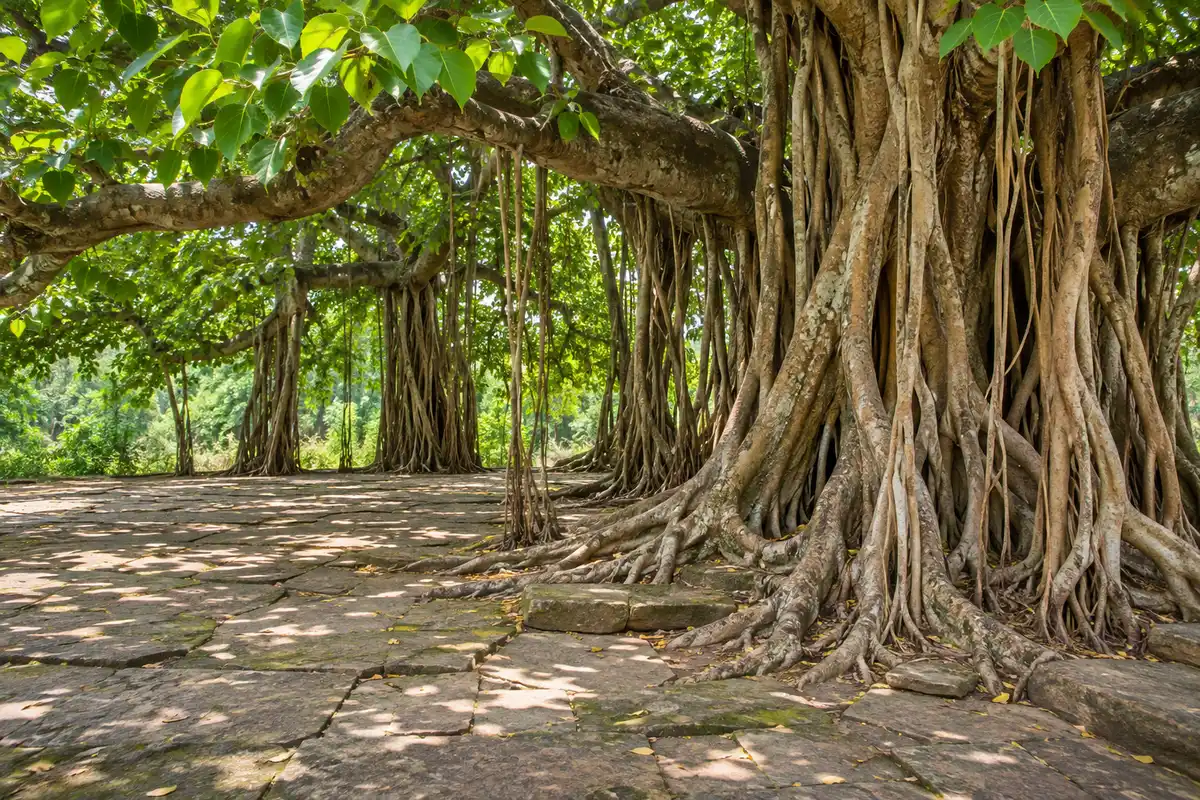
Devotees traditionally tie red and yellow sacred threads around the secondary trunks of the banyan tree while offering heartfelt prayers for family welfare, good health, and prosperous harvests.
Underneath the tree, a paved stone platform marks the exact spot where Saint Hadi Das sat during his hours of meditation. The cool breeze beneath the leaves provides a deeply soothing pause for travelers fatigued by long highway journeys.
Architecture: The Second Srikshetra & Unique Deity Alignment
Architecturally, Chhatia Bata is designed as a grand fortified sanctuary surrounded by imposing outer walls constructed from dressed laterite blocks. The massive boundary walls evoke the military architecture of ancient Kalinga fortresses, designed to withstand the test of centuries.
The main deula rises in the classic Rekha style, featuring fine curvilinear vertical ribs that soar toward an ornate Amalaka stone. Adjacent to the sanctum sits a spacious Jagamohana hall built in the stepped Pidha order, followed by an open assembly Natamandapa.
Reversed Deity Order: Precursor to a New Era
The most extraordinary feature inside the sanctum sanctorum is the placement of the divine idols. In the primary Jagannath Temple at Puri, the traditional seating arrangement places Devi Subhadra in the middle, flanked by Lord Balabhadra on her right and Lord Jagannath on her left.
At Chhatia Bata, however, the deities are seated in the exact order in which they are verbally named:
- Lord Jagannath: Positioned first on the left of the pedestal.
- Lord Balabhadra: Seated in the middle position.
- Devi Subhadra: Seated on the right end of the platform.
Theologians and scholars interpret this reversed alignment as a conscious departure that signifies the coming transition to a new cosmic order. It visually reinforces Chhatia’s identity as a distinct, futuristic manifestation of the Jagannath tradition.
Inner Sanctum Atmosphere and Courtyard Shrines
Entering the garbhagriha, pilgrims are greeted by the warm glow of brass oil lamps reflecting off the expressive wooden faces of the deities. The air is thick with the scent of fresh marigolds, crushed basil leaves, and burning frankincense.
Around the main deula, the vast compound shelters numerous secondary shrines dedicated to Lord Shiva, Goddess Durga, Lord Ganesha, and the Sun God. A separate pavilion houses the sacred iron sword representing the future weapon of the Kalki avatar.
Culinary Heritage: The Famous Chhatia Gaja & Travel Logistics
No journey to Chhatia is truly complete without experiencing its legendary sweet culinary specialty, Chhatia Gaja. Just outside the temple gates, a busy row of confectioners produces these famous sweets fresh throughout the day.
Unlike softer syrup-soaked sweets, authentic Chhatia Gaja features crisp, flaky layers of unleavened flour dough fried slowly in pure ghee until golden brown, then coated with crystallized sugar.
[!TIP] Fresh Chhatia Gaja can stay crisp for several weeks without refrigeration, making it the perfect culinary souvenir to purchase for friends and family back home.
How to Reach by Road, Bus, and Train from Cuttack and Bhubaneswar
Thanks to its position directly on the six-lane National Highway 16, reaching Chhatia Bata is straightforward from any major city in coastal Odisha.
| Starting Point | Recommended Transit Mode | Distance | Typical Duration | Approximate Fare (INR ₹) |
|---|---|---|---|---|
| Cuttack Badambadi | Direct Northward Highway Drive | 30 km | 35 to 40 minutes | ₹800 to ₹1,200 (cab) |
| Bhubaneswar Airport | Direct NH-16 Drive via Cuttack | 55 km | 1 hour 15 minutes | ₹1,500 to ₹1,900 (cab) |
| Jajpur Town | Highway Drive Southward on NH-16 | 48 km | 50 minutes | ₹1,200 to ₹1,500 (cab) |
| Regular State Bus | Any OSRTC bus toward Balasore | Direct stop | 45 minutes from Cuttack | ₹35 to ₹50 per passenger |
| Dhanmandal Station | Auto-rickshaw to temple gate | 4 km | 10 minutes | ₹80 to ₹120 per ride |
Frequent local buses running between Cuttack and Bhadrak stop directly at Chhatia Chhak. From the bus drop-off point, the temple entrance gate is just a two-minute walk across the paved roadside apron.
Day Trip Circuit Pairing: Chhatia Bata, Mahavinayak & Biraja Temple
Because Chhatia lies within the southern gateway of Jajpur district, combining it with nearby historic destinations creates an enriching full-day cultural circuit:
- Morning Stop at Chhatia Bata: Begin early with morning darshan at Chhatia, explore Saint Hadi Das’s samadhi, and sample warm Chhatia Gaja.
- Mid-Morning at Mahavinayak: Drive just 15 kilometers north along the highway to visit Mahavinayak Temple Chandikhol, situated beneath the Barunabanta hills and famous for its five-in-one Pancha Devata rock.
- Afternoon Pilgrimage to Maa Biraja: Travel 40 kilometers northeast into Jajpur town to visit the supreme Shakti Peetha of Maa Biraja Temple, exploring the sacred Nabhi Gaya well and ancient Baitarani river ghats.
- Return via Cuttack: On your return journey, explore nearby places to visit in Cuttack including the historic Barabati Fort and the maritime museum.
Frequently Asked Questions (FAQs)
Why is Chhatia Bata called the Second Srikshetra?
Chhatia Bata is known as the Second Srikshetra because it enshrines the sacred triad of Lord Jagannath, Balabhadra, and Subhadra, following daily rituals and offerings that mirror those of Puri. Prophetic scriptures state that Lord Jagannath will make Chhatia his permanent seat when Puri is submerged during the end of the current age.
What is the prophecy of the Kalki Avatar at Chhatia Bata?
According to the medieval Bhavishya Malika texts, Lord Jagannath will manifest his tenth and final incarnation as Kalki at Chhatia Bata at the close of Kali Yuga. He is foretold to appear riding a white horse and wielding a divine sword to vanquish wickedness and establish a new era of truth.
Who was Saint Hadi Das and what is his connection to the temple?
Saint Hadi Das was an 18th-century mystic poet and philosopher who meditated under the sacred banyan tree at Chhatia and authored celebrated devotional Malika scriptures. His mortal remains are preserved in a revered Samadhi Pitha located directly inside the temple courtyard.
What are the daily darshan timings at Chhatia Bata Temple?
The temple opens daily at 5:30 AM with the morning Mangala Alati and remains accessible to devotees throughout the day until 9:00 PM. Visitors can comfortably complete darshan, offer prayers, and tour the outer courtyards across all afternoon hours.
What is the famous sweet of Chhatia and where can visitors purchase it?
The signature sweet of the town is Chhatia Gaja, a crisp, multi-layered confection made from flour dough fried in ghee and coated with light sugar syrup. Fresh boxes of Chhatia Gaja can be purchased from traditional sweet stalls located along the highway directly outside the temple gate.