Adivasi Mela Bhubaneswar 2026: Dates and Visitor Guide
Plan your visit to Adivasi Mela Bhubaneswar 2026 with dates, venue details, tribal art highlights, food, and cultural events.
The air in Bhubaneswar during late January carries a certain crispness, but as you walk toward the Adivasi Exhibition Ground, that cool breeze is replaced by something much warmer and more evocative. It’s the distinct, earthy aroma of woodsmoke mixing with the sweet scent of roasting forest produce. If you close your eyes for a moment, the rhythmic beat of a madal (tribal drum) in the distance transports you far away from the city’s concrete lanes and straight into the heart of the Eastern Ghats You can also explore National Tribal Craft Mela. This isn’t just a fair; it’s a living, breathing celebration of Odisha’s soul.
When I visited the Adivasi Mela Bhubaneswar 2026 earlier this February, I was reminded once again why this event is the most awaited date on the city’s cultural calendar You can also explore International Trade Fair. There’s something deeply humbling about seeing the ancient traditions of our 62 tribal communities presented with such pride in the middle of a modern capital. From the vibrant beads of the Bonda women to the intricate Dokra art of the Kuldiha region, every corner of the mela tells a story of resilience, art, and an unbreakable bond with nature.
In this guide, I’ll take you through everything you need to know about the Adivasi Mela, based on my recent visit. Whether you missed it this year and are planning for the next, or you just want to relive the experience, here’s a deep dive into Odisha’s iconic Tribal Fair.
The History and Evolution of Adivasi Mela
To truly appreciate the Adivasi Mela, one must look back at its roots. Believe it or not, this festival has been a part of Odisha’s heritage since 1951 You can also explore Toshali National Crafts Mela. It started as a small initiative in Cuttack, the former capital of Odisha, with the primary aim of showcasing the developmental work done for the ST and SC communities. Over the decades, it evolved from a government report-card of sorts into a massive cultural phenomenon.
In 1954, the venue was shifted to Bhubaneswar, reflecting the city’s new status as the state capital. What began in the Old Town area eventually found its permanent home at the Adivasi Exhibition Ground in Unit-1. I remember my grandfather telling me stories of the mela in the 1970s. Back then, it was much smaller, focused mostly on agricultural produce and basic handicrafts. Today, it’s a high-tech event with digital displays, live streaming of cultural programs, and thousands of international tourists.
The shift in 2010 to extend the duration to 15 days was a response to its skyrocketing popularity. It’s no longer just an “exhibition”; it’s an economic lifeline for many tribal artisans who wait all year to bring their creations to the capital. For them, it’s a chance to earn a significant portion of their annual income in just a fortnight.
The Essence of Adivasi Mela: Why It Matters
Odisha is home to 62 different tribal communities, including 13 Particularly Vulnerable Tribal Groups (PVTGs). For most of the year, these communities live in the remote, hilly terrains of districts like Koraput, Rayagada, and Mayurbhanj. The Adivasi Mela, organized by the ST and SC Development Department of the Government of Odisha, acts as a bridge. It’s a rare window for us city dwellers to witness a lifestyle that has remained largely unchanged for centuries.
What I love about the Adivasi Mela is that it isn’t just about commerce. Yes, you can buy the best turmeric and honey here, but the real treasure is the exchange of culture. I remember standing near a replica of a Dongria Kondh hut, watching a young boy from the tribe explain the significance of the “Kapdagunda” (their traditional embroidered shawl) to a group of curious college students. That moment of connection is what makes this festival so special.
It’s a place where the “ancient” meets the “modern.” You’ll see tribal artisans using digital payment apps to sell their handmade terracotta while wearing the same traditional ornaments their ancestors wore a hundred years ago. It’s a beautiful, sometimes chaotic, but always authentic representation of Incredible Odisha.
Adivasi Mela Bhubaneswar 2026: Dates and Timings
For 2026, the Adivasi Mela followed its traditional schedule, coinciding with India’s Republic Day celebrations. It’s a time when the city is already in a festive mood, and the mela adds a layer of cultural richness to it.
The dates for Adivasi Mela 2026 were:
- Start Date: January 26, 2026
- End Date: February 5, 2026
- Visiting Hours: 2:30 PM to 9:00 PM daily
If you’re planning to visit in the future, here’s a pro tip: try to reach by 3:00 PM. The afternoon sun in Bhubaneswar can be a bit warm, but the crowds are much thinner then. As the sun begins to set around 5:30 PM, the lights come on, and the atmosphere becomes electric, but that’s also when the “masses” arrive. By 7:00 PM, the ground is usually packed, making it harder to have long conversations with the artisans.
The Venue: Adivasi Exhibition Ground, Unit-1
The venue has traditionally been the Adivasi Exhibition Ground in Unit-1, right in the heart of Bhubaneswar. While there have been years when the mela was shifted to larger grounds like Baramunda or the GNDA ground to manage crowds, the Unit-1 location remains the most accessible and “atmospheric” for many locals.
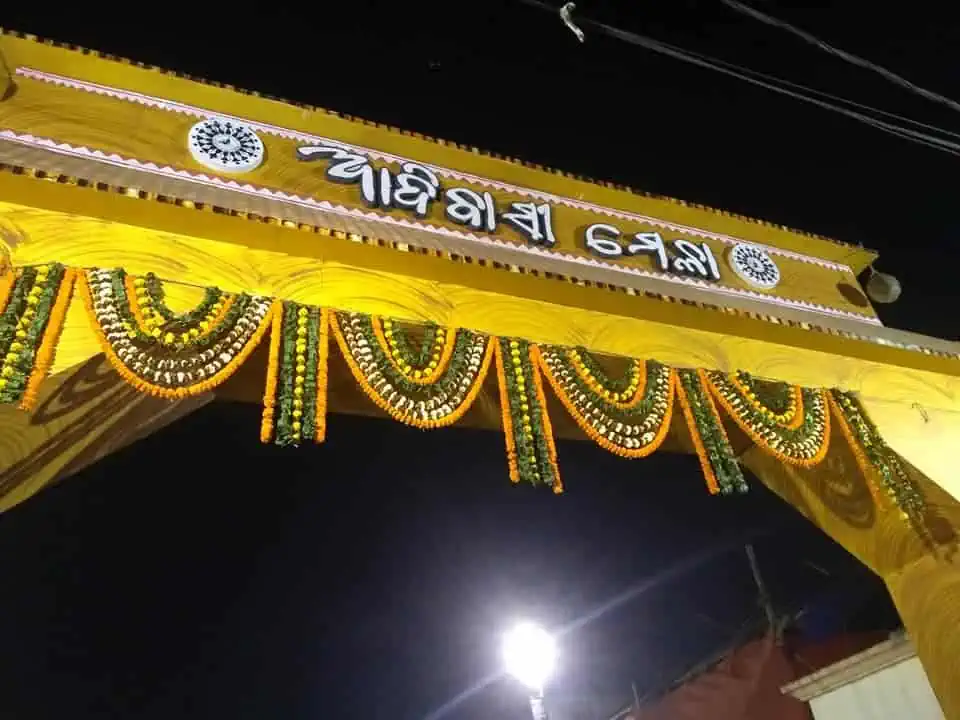
Located near the Secretariat and the Raj Bhavan, the ground is easy to reach from any part of the city. If you’re staying near the railway station, a quick 10-minute auto-ride will get you there. The entrance is usually marked by a grand, artistically designed gate reflecting tribal motifs—this year, it featured a massive installation of tribal masks that was a huge hit for selfies!
The Tribal Village: A Living Museum

The most popular section of the Adivasi Mela is always the “Tribal Village.” This is where the organizers build life-size replicas of traditional tribal houses. These aren’t just props; they are constructed using authentic materials like mud, bamboo, and thatch, often by members of the tribes themselves. Let’s take a closer look at some of the most fascinating huts I explored this year.
1. The Bonda Hut (Malkangiri)

The Bonda people, known as the “Remo,” are one of the most isolated and ancient tribes in India. Their huts are simple, circular or rectangular structures with low-hanging thatch roofs to protect them from the heavy rains of the Malkangiri hills. Inside the replica, you could see the traditional backstrap looms where the women weave their “Ringa”—a small piece of cloth worn around the waist. The walls are often left plain, reflecting their minimalist lifestyle.
2. The Dongria Kondh Hut (Rayagada)
The Dongria Kondh are the “dwellers of the hills” (Niyamgiri). Their huts are recognizable by the intricate embroidery patterns often painted on the walls, mimicking the designs on their famous Kapdagunda shawls. I was fascinated by the display of indigenous seeds inside the hut—millets, pulses, and oilseeds that they have preserved for generations without any chemical intervention.
3. The Saora Hut (Rayagada/Gajapati)

While I didn’t see a Saora house in this specific corner, the neighboring Gadaba house (pictured above) was equally stunning. The Saoras are famous for their “Idital” or “Ikons”—tribal wall paintings. The replica hut at the mela was a masterpiece of this art. Using a paste of rice and water on a red-oxide background, the artists depict scenes of daily life, ancestors, and nature. Every line and circle has a spiritual meaning. It’s not just decoration; it’s a way of inviting the divine into their homes.
4. The Santal Hut (Mayurbhanj)
The Santals are known for their cleanliness and aesthetic sense. Their huts at the mela are always a crowd favorite because of the vibrant murals. They use natural colors to paint birds, flowers, and geometric patterns. The raised plinths and neatly thatched roofs show a level of architectural sophistication that is truly impressive.
5. The Gond Hut (Western Odisha)
The Gonds are one of the largest tribal groups in India, and their presence in Odisha is significant. Their huts are often larger and more structured. What I found particularly interesting was the focus on the hearth (the kitchen area), which is considered sacred. The walls often feature symbolic carvings of animals, reflecting their deep connection to the wildlife of the Western Odisha forests.
6. The Ho Hut (Keonjhar/Mayurbhanj)
The Ho tribe has a very distinct architectural style. Their houses are often rectangular with very high plinths to keep out the dampness of the forest floor. Inside the replica, they displayed traditional musical instruments and hunting gear. The Ho people are known for their vibrant festivals, and the hut decor reflected that celebratory spirit.
7. The Bhumij Hut (North Odisha)

The Bhumij people build sturdy, mud-walled houses that are remarkably cool in the summer. At the mela, their hut showcased beautiful terracotta pottery and traditional fishing nets. It’s a reminder of how these communities have mastered the art of living sustainably with the resources available in their immediate environment.

If you’re planning a longer trip, you might want to see where these cultures live in their natural habitat—check out my guide on the 20 Best Tourist Places to Visit in Odisha to find the most authentic tribal circuits.
Handicrafts and Shopping: What to Buy

If you walk into the Adivasi Mela with a thin wallet, you’re going to regret it. The shopping here is unparalleled because you’re buying directly from the source. There are no middlemen, and the quality is as authentic as it gets.
1. Dokra Metal Craft
Dokra is the ancient “lost-wax” casting technique. I bought a small Dokra peacock this year, and the artisan from Dhenkanal explained how it takes days to create even a small piece. The rustic, golden finish of the brass is timeless. Look for Dokra jewelry too—it’s a great way to add a “boho” touch to your wardrobe.
2. Tribal Jewelry
Speaking of jewelry, the beadwork is incredible. The Bonda and Gadaba tribes are masters of this. You’ll find necklaces made of hundreds of tiny, colorful beads, along with brass armlets and silver hairpins. They are surprisingly affordable and make for unique gifts. I remember seeing a set of brass anklets that were so heavy and intricately carved they looked like museum pieces.
3. Terracotta and Pottery
The tribal potters bring everything from large garden urns to tiny “diyas.” What I love is the “organic” feel of the clay. It hasn’t been polished to death; it still has the texture of the earth. The “Hathi” (elephant) terracotta figures from the tribal regions are considered auspicious and are very popular.
4. Forest Produce (The Most Popular Section)
This is where the locals go crazy. The “Tribal Haat” section is filled with sacks of:
- Kandhamal Haldi: This turmeric has a GI tag for a reason. Its high curcumin content and intense aroma make it a must-buy.
- Wild Honey: Collected from the beehives of the Similipal forests. It has a complex, multi-floral taste.
- Phula Jhadu (Broomsticks): Made from hill grass, these are a staple in almost every Odia household.
- Palua (Arrowroot): A natural coolant often used in traditional desserts.
The “Tribal Haat” section is where you’ll find me most of the time. There’s a local saying in Bhubaneswar, “Adivasi Mela gale, haldi ani baku bhuli bani” (If you go to the Adivasi Mela, don’t forget to bring back turmeric). It’s a sentiment shared by almost every household in the city.
How to Spot Authentic Tribal Products
With the popularity of tribal art growing, it’s easy to find mass-produced imitations in city markets. Here’s how you can tell the difference at the Adivasi Mela:
- Imperfections are Key: Hand-cast Dokra or hand-woven Ringa will never be perfectly symmetrical. These minor “flaws” are the mark of a human hand, not a machine.
- The Weight of Metal: Real brass or bell metal (used in Dokra) has a certain weight to it. If it feels too light or “tinny,” it might be an inferior alloy.
- The Smell of Textiles: Authentic tribal textiles like Kotpad use natural dyes (mostly from the Aal tree root). They have a distinct, slightly pungent, earthy smell that doesn’t go away even after several washes.
- Talk to the Maker: The best way to know if a product is authentic is to talk to the person selling it. At the Adivasi Mela, the people behind the stalls are usually the ones who made the products. They can tell you exactly how long it took and what materials were used.
A Sensory Feast: The Food of the Tribes

You can’t visit the Adivasi Mela and not eat. Forget the standard chowmein and rolls for a day and head to the tribal food stalls. This is where the sensory experience of the mela truly peaks. The sizzle of the iron griddles and the aroma of fermenting rice cakes will lead you there before you even see the signs.
The first thing I always look for is Mandia Jau (Ragi Porridge). In the 2026 mela, the stalls were serving it cold with curd and bits of green chili. It’s the ultimate refreshing drink, especially after walking for an hour. It has a slightly earthy, sour taste that grows on you. It’s also incredibly healthy, packed with calcium and fiber.
Then there’s the Chakuli Pitha served with a spicy “Mansa Tarkari” (mutton curry) or a simple “Dalma.” The tribal version of Dalma often uses forest tubers and wild greens that you won’t find in any city restaurant. The smoky flavor comes from being cooked over an open wood fire.
For those with a sweet tooth, the Arisa Pitha (a deep-fried rice flour and jaggery cake) is a must. When it’s fresh and warm, the outer layer is crunchy with sesame seeds, and the inside is soft and chewy. I remember taking a bite and just standing there, ignoring the crowd, savoring the deep caramel flavor of the jaggery.
If you’re a fellow foodie, you should definitely dive into my full list of 10 Famous Odisha Foods You Must Try for a broader look at our incredible state’s cuisine.
Lesser-Known Tribal Delicacies to Try:
- Kurei Patra Pitha: Rice cakes steamed inside Kurei leaves, giving them a unique herbal aroma.
- Badi Chura: Sundried lentil dumplings crushed with garlic, green chilies, and mustard oil.
- Mandia Pitha: Sweetened ragi pancakes that are both filling and nutritious.
Tribal Art and Symbolism: Reading the Patterns
One of the most rewarding parts of my visit in 2026 was taking the time to actually look at the patterns on the various crafts. In tribal culture, nothing is accidental. Every line, circle, and motif has a meaning rooted in their spiritual and natural world.
For instance, the Dongria Kondh’s triangular patterns represent the Niyamgiri hills—their sacred home. When you see those same triangles on their hand-woven shawls, they aren’t just geometric designs; they are a declaration of their identity and their bond with the mountains. Similarly, the Saora Iditals use stick figures and circles to represent ancestors and celestial bodies, creating a bridge between the living and the spirit world.
Understanding these small details changed the way I looked at the stalls. I wasn’t just looking at “products” anymore; I was looking at a visual language that has been spoken for millennia. If you have the chance, ask the artisans about the meaning of a specific motif. The pride in their eyes as they explain their heritage is something you’ll carry with you long after you leave the mela.
Evening Cultural Programs: The Soul of the Mela
As the clock strikes 6:30 PM, the focus shifts to the open-air stage. Every evening, different tribal troupes perform their traditional dances. This isn’t a choreographed “Bollywood” version of tribal dance; it’s the real deal. The dancers travel hundreds of kilometers from their villages to share their joy with us.
I watched the Dhemsa dance of the Koraput tribes this year. It’s a group dance where people hold hands and move in a chain, reflecting the unity of the community. The sound of the Dhol and Tamki is so infectious that you’ll see people in the audience tapping their feet. The energy is raw and powerful. The colorful costumes, the rhythmic footwork, and the genuine smiles on the performers’ faces are something you won’t forget.
Other performances often include:
- Ghumura Dance: A martial dance with a deep, echoing drum sound that literally vibrates in your chest.
- Karma Dance: Performed during the Karma festival to honor the God of Fate. It’s a rhythmic prayer for a good harvest.
- Chhau Dance: Though more semi-classical, the Mayurbhanj style often makes an appearance with its athletic movements and masks.
The Cultural Significance and Legacy
The Adivasi Mela is more than just a 15-day event. It’s a statement of identity. For decades, tribal communities were often sidelined in the narrative of “progress.” This mela puts them front and center. It validates their knowledge systems—whether it’s their deep understanding of forest medicine or their sustainable farming techniques.
I spent some time talking to an official from the SCSTRTI (Scheduled Castes and Scheduled Tribes Research and Training Institute). He explained that the mela is a crucial part of their “Cultural Mapping” project. By bringing these traditions to the city, they are documenting and preserving them for future generations. In an age of globalization, this is a revolutionary act of cultural preservation.
The Impact on Tribal Economy
It’s important to remember that for many of these artisans, the Adivasi Mela is their biggest business opportunity of the year. In 2026, the mela saw record-breaking sales. This money goes directly back to the villages, supporting schools, healthcare, and the continuation of these ancient crafts.
When you buy a ₹200 bead necklace, you’re not just getting a piece of jewelry; you’re supporting a woman in Malkangiri who spent days stringing those beads while looking after her family. The mela provides a platform for Tribal Self Help Groups (SHGs) to showcase their collective strength. It’s a model of sustainable, community-led economic development that Odisha can be proud of.
Comparison: Adivasi Mela vs. Toshali Mela
People often ask me which one they should visit if they only have time for one. While both are fantastic, they offer very different experiences.
- Toshali National Crafts Mela: This is more “pan-Indian.” You’ll find Pashmina from Kashmir, Phulkari from Punjab, and leather from Rajasthan alongside Odia crafts. It’s more of a commercial “lifestyle” exhibition.
- Adivasi Mela: This is much more “Odisha-centric” and “earthy.” It’s focused exclusively on the tribal heritage of our state. If you want a deep dive into the local culture and authentic forest produce, Adivasi Mela is the clear winner.
For more details on the other big craft fair, you can read my post on Toshali Mela.
Sustainability and the Mela: An Eco-Friendly Tradition
One of the most heartening trends I noticed in the 2026 edition was the push for sustainability. Tribal culture, by its very nature, is eco-friendly. They use what the earth provides and return it to the earth.
The stalls are built using biodegradable materials. You’ll see food served in Sal-leaf plates (Khali) and water in earthen cups. The handicrafts are made of wood, stone, and natural fibers. In an era where we are struggling with plastic waste, the Adivasi Mela stands as a shining example of how a large-scale event can be managed with a minimal carbon footprint.
Practical Tips for Your Visit
Having visited the Adivasi Mela for several years now, here are some “insider” tips to make your experience smoother:
- Carry Cash: While many stalls now accept UPI (GPay/PhonePe), the network can be spotty because of the sheer number of people. Small change is also very helpful for buying snacks or small items.
- Bring Your Own Bag: In an effort to be eco-friendly, many stalls avoid plastic. Bring a sturdy cloth bag to carry your turmeric, honey, and handicrafts.
- Wear Comfortable Shoes: You’ll be doing a lot of walking on dusty ground. This is not the place for heels! I usually wear my most comfortable sneakers.
- Photography Etiquette: Most tribal people are happy to be photographed, but please ask first, especially if you’re taking close-ups. Be respectful.
- Check the Schedule: If you’re interested in a specific dance form, check the daily schedule usually posted near the entrance or on the official ST & SC Development Department website.
How to Reach the Adivasi Exhibition Ground
Getting to the mela is quite easy since it’s located in a central area of Bhubaneswar.
- From Biju Patnaik International Airport: It’s about a 10-15 minute drive (4 km). You can take a pre-paid taxi or a Mo Bus.
- From Bhubaneswar Railway Station: It’s barely 3 km away. An auto-rickshaw is your best bet and shouldn’t cost more than ₹50-₹80.
- By Mo Bus: Bhubaneswar’s excellent bus service has several routes that pass through Unit-1. Look for buses heading toward the AG Square or Secretariat.
If you’re new to the city, check out my guide on the 11 Best Tourist Places to Visit in Bhubaneswar to plan your full itinerary.
Nearby Attractions to Explore
If you have a full day, you can combine your visit to the Adivasi Mela with other nearby spots:
1. Museum of Tribal Arts and Artifacts
Often called the “Tribal Museum,” it’s located a bit further away in CRP Square, but it’s the perfect companion to the mela. It houses a permanent collection of tribal costumes, weapons, and jewelry. It’s one of the best museums in India. The library there is an absolute goldmine for anyone interested in anthropology.
2. Ekamra Haat
Just a short distance from the mela ground, Ekamra Haat is a permanent marketplace for Odisha’s handicrafts. It has a more relaxed vibe and some great food stalls too. It’s a great place to sit and relax if the mela crowd gets too overwhelming.
3. Odisha State Museum
Located at Kalpana Square, it has an extensive collection of palm-leaf manuscripts and ancient sculptures. The evolution of the Odia script section is particularly fascinating.
A Day in the Life at Adivasi Mela: A Personal Narrative
Let me paint a picture of a typical day at the mela for you. I arrived at 3:30 PM. The sun was still bright, but the cool winter breeze made it pleasant. My first stop was the “Tribal Village” section. I spent an hour talking to a Juang elder who was sitting outside his replica hut. He spoke about how his village in Keonjhar had changed over the years, but their songs remained the same.
By 5:00 PM, I was hungry. I headed to the food court and grabbed a plate of hot Mandia Pitha. Sitting on a wooden bench, surrounded by the chatter of different dialects, was a surreal experience. It felt like I was in the middle of a forest, not a bustling city.
As the sun set, the crowd grew. The lights of the stalls twinkled like stars. I spent the next two hours “haunting” the forest produce stalls. I bought five kilos of Kandhamal turmeric (enough for the whole year!) and some wild honey.
By 7:00 PM, the rhythmic beating of the drums started. I found a spot near the stage and watched the Paraja dance. The dancers were in such a trance that the audience couldn’t help but be swept up in the rhythm. I left the ground around 8:30 PM, tired but with a heart full of stories and a bag full of treasures.
The Future of Adivasi Mela
As I walked out of the ground on the final day of the 2026 edition, I felt a sense of gratitude. In a world that’s becoming increasingly digital and “same-ish,” the Adivasi Mela is a reminder of the beauty of diversity. It’s a testament to the fact that while we move forward, we must carry our roots with us.
The Government of Odisha has been doing a commendable job in expanding the reach of the mela. There’s talk of making the “Tribal Haat” a more frequent event or creating a permanent “Tribal Village” experience. Whatever the future holds, the Adivasi Mela will always be the heartbeat of Bhubaneswar’s winter. It’s an event that celebrates the “Incredible” in Incredible Odisha.
For more updates on upcoming events and festivals in our beautiful state, stay tuned to Odisha Tourism or keep checking back here at Incredible Odisha!
FAQs on Adivasi Mela Bhubaneswar
1. Is there an entry fee for Adivasi Mela?
No, entry to the Adivasi Mela is absolutely free for everyone. You only need to pay for the items you purchase or the food you eat. This makes it one of the most inclusive festivals in the city.
2. Is parking available at the venue?
Yes, but it can be very challenging. There are designated parking spots for two-wheelers and four-wheelers nearby, but they fill up fast. I highly recommend using public transport, a cab, or an auto-rickshaw during peak hours.
3. Can I buy authentic tribal art online?
While some government portals like Boyanika or Utkalika sell tribal-inspired handicrafts, the specific items you find at the mela are often unique to those individual artisans. Buying at the mela ensures that the money goes directly to the creator.
4. Is the Adivasi Mela suitable for children?
Absolutely! It’s a great educational experience for kids. They’ll love the tribal huts, the colorful dances, and the open spaces. It’s a much better way to learn about history and geography than any textbook. Just keep a close eye on them as it gets very crowded.
5. What are the dates for Adivasi Mela 2027?
While not officially announced yet, the mela traditionally starts on January 26th every year. Keep an eye on the Odisha Festivals page for updates.
6. Is photography allowed?
Yes, photography is allowed and encouraged. However, if you are planning to use professional equipment like tripods or drones, you might need special permission from the organizers. Always ask for permission before taking close-up portraits of the participants.
7. What should I wear to the Adivasi Mela?
Comfort is key. Wear breathable cotton clothes and sturdy walking shoes. The ground can be a bit dusty, so avoid white if you’re worried about stains!
Final Thought: The Adivasi Mela isn’t just about shopping; it’s about shifting your perspective. It’s about realizing that the people we often call “primitive” have a relationship with the earth that we are desperately trying to relearn today. Their knowledge of herbs, their respect for the forest, and their community spirit are lessons for the modern world. If you have the chance, don’t just visit—engage, talk, and listen. You’ll leave with more than just a bag of turmeric; you’ll leave with a piece of Odisha’s heart.
Dhanyabad! (Thank you!)