Raja Festival in Odisha 2026: Dates, Rituals and Poda Pitha
Explore Raja Festival in Odisha 2026 with dates, rituals, Pahili Raja traditions, swing customs, and the meaning behind Poda Pitha.
The first time I stood under a massive banyan tree in my ancestral village during Raja, the air was thick with the scent of wet earth and the sweet, smoky aroma of Poda Pitha. I remember the rhythmic creaking of a decorated rope swing—the Raja Doli—and the melodic laughter of girls in new sarees. In Odisha, Raja isn’t just a festival; it’s a feeling that stays with you long after the monsoon clouds have moved on.
Raja Parba, as we locally call it, is perhaps one of the most unique and beautiful festivals you’ll ever encounter. While the rest of the world might shy away from discussing menstruation, Odisha celebrates it through the metaphor of Mother Earth. It’s a three-day (sometimes four) period where the land takes a rest, women are pampered, and the entire state vibrates with a joy that is both primitive and profoundly sophisticated.
I want to share the heart and soul of Raja Festival with you—from the specific 2026 dates and rituals to the hidden meanings behind our songs and the secrets of the perfect Poda Pitha.
What is Raja Festival? The Core Concept of Earth’s Rest
At its heart, Raja (pronounced Raw-jaw) is a celebration of menstruation and fertility. According to Odia belief, the Earth Goddess (Bhumi Devi) undergoes her menstrual cycle during these three days. Just as a woman rests during her period in traditional households, the Mother Earth is given a complete rest.
This means no agricultural activities—no ploughing, no digging, and no hurting the soil in any way. It’s a beautiful environmental concept where we acknowledge our dependence on the land and give it time to rejuvenate before the heavy monsoon rains begin. For three days, the Earth is “off-limits” for work, and by extension, the women of Odisha—who are seen as embodiments of the Earth’s creative power—are also given a break from all household chores.
The word ‘Raja’ comes from ‘Rajaswala’ (meaning a menstruating woman). It’s a rare instance where a traditional culture openly celebrates this biological process as a symbol of life-giving strength and abundance.
The Significance of Raja Parba: Womanhood and Agriculture
The significance of Raja Festival in Odisha is two-fold: it is a celebration of the feminine spirit and a vital agricultural milestone.
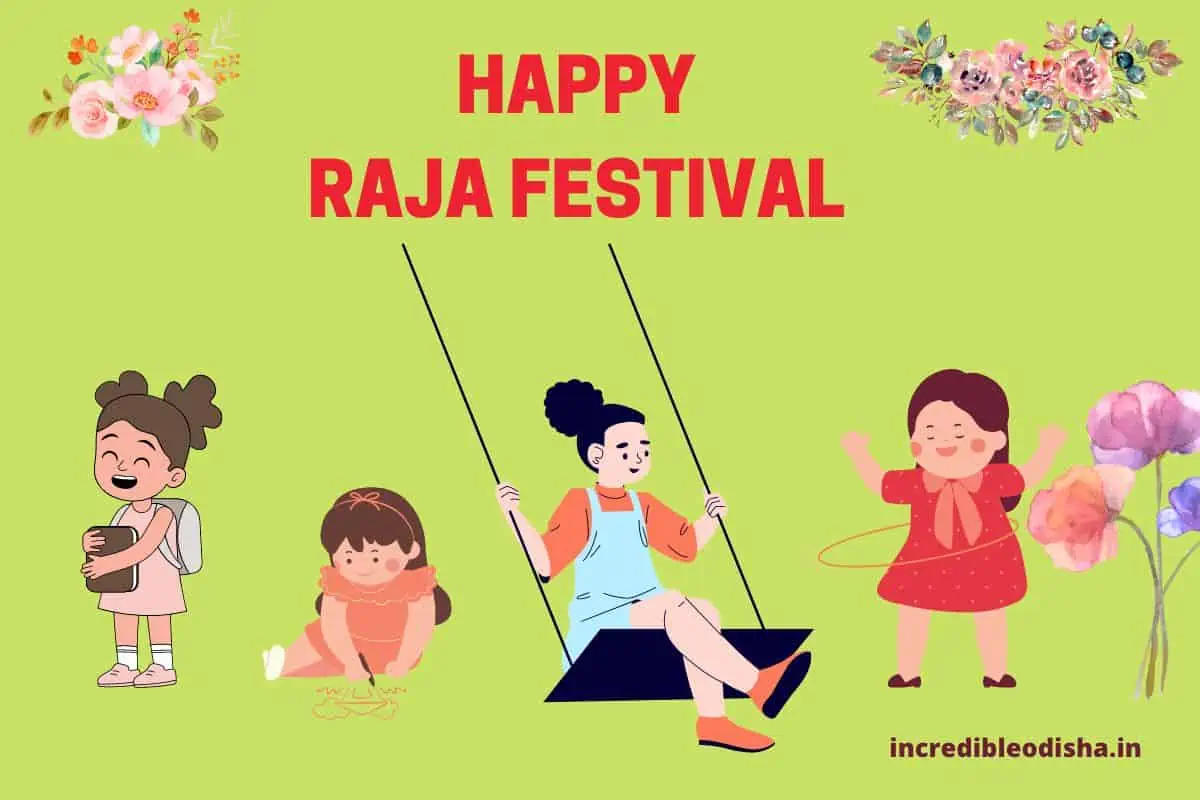
For women, especially young girls, Raja is the most anticipated time of the year. They are treated like queens. They don’t cook, they don’t sweep, and they don’t even walk barefoot on the ground (to avoid “hurting” the resting Earth). Instead, they wear new clothes, apply Alta (red pigment) to their feet, and spend their days on swings and playing traditional games.
From an agricultural perspective, Raja marks the transition. The summer heat has parched the land, and the first pre-monsoon showers have just arrived. This period of “rest” for the soil is the final preparation before the intense sowing season begins. Once the festival ends with Basumati Snana (the ritual bath of the Earth), the farmers return to the fields with renewed energy and the blessings of the Goddess.
Raja Festival 2026 Dates and Schedule
If you are planning to experience this festival, you need to mark your calendar for mid-June. The dates are determined by the solar calendar (Mithuna Sankranti).
For 2026, here is the detailed schedule for the Raja Festival:
| Day | Name of the Ritual | Date in 2026 | Significance |
|---|---|---|---|
| Day 1 | Pahili Raja | June 14, 2026 | The first day of the festival, preparation and joy. |
| Day 2 | Raja Sankranti | June 15, 2026 | The main day when the sun enters the Mithuna sign. |
| Day 3 | Basi Raja | June 16, 2026 | The “stale” or final day of the main festivities. |
| Day 4 | Basumati Snana | June 17, 2026 | The ritual bath of the Earth and the end of rest. |
Each of these days has a specific set of customs that make the festival a multi-layered experience.
The Four Days of Celebration: A Deep Dive
Pahili Raja – The First Day of Joy
Pahili Raja (June 14, 2026) is all about anticipation. The day starts early, often before dawn. Girls wake up, perform their “Saja-Baja” (grooming), and put on their finest new clothes. The kitchen is busy, but not with the usual chores. Instead, the family prepares the batter for Poda Pitha, which is traditionally slow-cooked overnight.
On this day, the first swings are tied to trees. The sound of “Raja Geeta” begins to echo through the villages. It’s a day of visiting neighbors, sharing the first batches of cakes, and setting the tone for the festivities.
Raja Sankranti – The Main Event
This is the second day (June 15, 2026), and scientifically, it is the day the Sun enters the zodiac sign of Gemini (Mithuna). In terms of celebration, this is the peak. The energy is at an all-time high. In many parts of Odisha, this is when large-scale fairs (Raja Mela) are organized.
If you are in Bhubaneswar during this time, you’ll see parks and malls setting up traditional swings to keep the spirit alive for urban dwellers. But the real magic is in the villages of coastal districts like Cuttack, Puri, and Jagatsinghpur, where every grove of trees becomes a playground.
Basi Raja – Keeping the Spirit Alive
Basi Raja (June 16, 2026), often called Sesha Raja in some regions, is the third day. The term “Basi” means stale, but the celebration is anything but. It’s the last day of the Earth’s “rest.” By now, everyone is thoroughly soaked in the festive spirit. The games become more competitive, and the singing more passionate.
Basumati Snana – Respecting Mother Earth
The fourth day (June 17, 2026) marks the conclusion. The “rest period” is over. Women wake up early and perform a ritual bath for a grinding stone (Sila-Pua), which represents Mother Earth. They smear it with turmeric paste, decorate it with flowers and vermilion, and offer seasonal fruits.
This ritual signifies the purification of the Earth after her menstrual cycle. After this, life returns to normal. Men return to the fields, and women resume their household duties, but with a heart full of memories.
The Historical Evolution of Raja: From Royal Courts to Every Home
While we celebrate Raja today as a community festival, its roots are deeply intertwined with the royal history of Odisha. Historically, Raja was not just a village affair but a significant event in the courts of the Gajapati Kings of Puri and various other princely states across the Kalinga region.
In the medieval period, Raja was a time for the kings to display their connection to the land and the people. Historical records and palm-leaf manuscripts suggest that the royal families would organize large-scale archery competitions, wrestling matches, and dance performances during these three days. The “Paikas” (traditional warrior class of Odisha) used this time to showcase their martial skills in “Paika Akhadas.”
As the festival evolved, it moved from the royal courtyards into the hearts of common households. However, even today, some royal families in districts like Dhenkanal, Nayagarh, and Baripada maintain specific traditions that remind us of this regal past. For instance, in some estates, the first swing is still tied by the royal priest, signifying the start of the festival for the entire region.
Understanding this transition from a royal decree to a grassroots celebration helps us appreciate why Raja is celebrated with such immense pride. It is one of the few festivals that managed to bridge the gap between the elite and the commoners, creating a unified Odia identity centered around the respect for the feminine and the soil.
District-Wise Variations: How Raja Changes Across Odisha
While the core spirit of Raja remains the same, if you travel across the 30 districts of Odisha, you will find delightful local variations that add color to the festival.
Coastal Odisha (Cuttack, Puri, Jagatsinghpur, Ganjam)
This is the heartland of Raja. In districts like Ganjam, the festival is celebrated with an extra emphasis on “Dalkhai” and other folk dances. The girls here are known for their incredibly intricate Alta designs that sometimes cover the entire foot up to the ankles. In Puri, the celebration is deeply linked to the Jagannath Temple, and the “Mahaprasad” during these days often includes special festive items.
Western Odisha (Sambalpur, Balangir, Bargarh)
In the western belt, Raja is celebrated but often shares the spotlight with other agricultural festivals like “Nuakhai.” However, the “Raja Geeta” here often takes on a more rhythmic, tribal-influenced tone. The food habits also change, with “Chakuli Pitha” being paired with spicy mutton curry, a favorite among many families in this region.
Northern Odisha (Mayurbhanj, Keonjhar)
In the tribal-dominated northern districts, Raja becomes a bridge between mainstream Hindu traditions and indigenous tribal customs. The “Santhal” and “Ho” communities have their own versions of Earth-worship that coincide with Raja. Here, the swings are often tied to Sal trees instead of Banyan or Mango trees, and the festivities include traditional tribal beverages and forest-sourced delicacies.
Southern Odisha (Koraput, Rayagada)
In the hilly terrains of the south, Raja is a quieter but more spiritual affair. The focus is heavily on the “Basumati Snana” ritual. The connection to the “Dongria Kondh” and other tribes adds a layer of ancient Earth-wisdom to the festival, where the hills themselves are seen as the body of the Goddess.
A Culinary Journey: Masterclass in Raja Recipes
To truly understand Raja, you must understand its kitchen. Here’s a deeper look at the recipes that define the festival.
1. The Traditional Biri Poda Pitha (The Authentic Way)
This is the version that takes the most patience and is the crown jewel of Odia festive baking.
- The Batter: Soaked rice and urad dal (black gram) in a 2:1 ratio are ground separately. The urad dal is whisked until it is light and fluffy—this is the secret to a soft pitha.
- The Mix: To this fermented batter, add grated jaggery, small chunks of fried coconut, crushed ginger, black pepper powder, and a pinch of salt.
- The Baking: Line an earthen pot with wilted banana leaves. Pour the batter. Cover with more leaves and a lid. Traditionally, this is placed on a dying chulha (wood fire) at night, with hot embers placed on the lid. By morning, the slow heat has transformed the batter into a cake with a crust that smells of caramelized jaggery and burnt banana leaves.
2. Lau Poda Pitha (Bottle Gourd Cake)
This is a unique variation popular in rural pockets of Odisha. The bottle gourd is grated and squeezed to remove excess water, then mixed with rice flour and jaggery. It creates a moist, almost pudding-like consistency that is incredibly refreshing during the humid June weather.
3. Janta Manda Pitha
Unlike the usual Manda, the “Janta” version involves cooking the rice flour in boiling water first to create a soft dough. This dough is then stuffed with a mixture of coconut, jaggery, and cardamom. These are then steamed. They are white as pearls and melt in your mouth, often served as a lighter alternative to the heavy Poda Pitha.
4. Arisa Pitha (Hard Rice Cake)
This is a test of a cook’s skill. It requires making a perfect “paga” (syrup) of jaggery and then mixing in rice flour at the right temperature. The result is a deep-fried, sesame-seeded pancake that is crunchy on the outside and chewy inside. It is one of the longest-lasting pithas, often kept in jars for weeks.
Consider reading: 10 Famous Odisha Foods You Must Try
Traditions and Rituals of Raja: What Makes it Unique?
The beauty of Raja lies in its specific, often quirky, traditional restrictions and rituals.
Saja-Baja: The Grooming Rituals
“Saja-Baja” refers to the preparation and decoration. Girls spend hours applying Alta to the edges of their feet in intricate patterns. They wear Chandua (small mirrors) on their foreheads and decorate their hair with jasmine or marigold flowers. It is a time when the “shringar” (beauty) of a woman is celebrated without any inhibitions.
No Salt, No Walking? The Traditional Restrictions
One of the most fascinating aspects of Raja is the set of taboos that are strictly followed in rural Odisha:
- No Walking Barefoot: To avoid hurting the Earth, girls wear slippers made of dried banana stems (traditionally) or modern footwear. Some even avoid walking altogether, moving from one place to another only when necessary.
- No Cutting or Grinding: Since the Earth is resting, no one should cut vegetables or grind spices using a stone. Most of the food is prepared a day in advance or made in ways that don’t involve these actions.
- No Salt on the First Day: In some communities, girls avoid eating salt on Pahili Raja, opting for a diet of fruits and pithas.
Raja Doli: The Iconic Swings of Odisha
You cannot talk about Raja without mentioning the Doli (swing). The swing is the symbol of the festival. It represents the “unbound” spirit of women during these days.
Types of Swings
- Ram Doli: Large wooden swings often found in fairs that move in a circular vertical motion.
- Chaki Doli: A merry-go-round style swing that moves horizontally.
- Pata Doli: A simple but sturdy swing made of a wide wooden plank suspended by thick ropes from a strong branch of a Mango or Banyan tree.
- Dandi Doli: A swing where the ropes are decorated with flowers and mango leaves.
The experience of swinging high into the air, with the wind in your hair and the collective singing of friends, is something that defines an Odia childhood.
Raja Paan: A Sweet Tradition
If Poda Pitha is the king of food, Raja Paan is the undisputed queen of the festival. Eating Paan (betel quid) is a ritual in itself during Raja. During these days, the consumption of Paan goes up exponentially.
What makes Raja Paan special? It’s usually a Meetha Paan (sweet betel) stuffed with extra cherries, grated coconut, fennel seeds, cloves, cardamom, and sometimes even silver foil (Vark). The act of sharing a Paan is a symbol of friendship and festive greeting. In cities like Cuttack and Bhubaneswar, Paan shops compete to create the most elaborate Raja Paans, sometimes costing hundreds of rupees for a single, giant, decorated piece!
Deconstructing Raja Geeta: The Poetry of the Soil
The songs of Raja are not just random lyrics; they are a repository of Odia social history. These songs, known as “Raja Geeta,” are sung by girls while swinging.
“Banaste dakila gaja, Barasake thare asichi Raja, Asichi Raja go, asichi Raja…”
Translation & Meaning: “The elephant trumpets in the forest, Once a year, Raja has arrived, Oh, the Raja has come, the Raja has come…”
The imagery of the “hasuchi gaja” (the elephant is laughing/trumpeting) is a metaphor for nature’s bounty and the arrival of the life-giving rains. The “rupa gora jhia” (the fair-skinned girl) often mentioned in these songs represents the idealized beauty of the season.
These songs were traditionally a way for girls to express their hidden desires and their joy in a society that was otherwise quite restrictive. During Raja, the “Laxman Rekha” of the household was temporarily lifted, and these songs were the medium of that freedom.
There are also “teasing songs” where girls from one village would sing mock-insults to girls of the neighboring village as they passed the swings. It was all in good fun, a form of “musical battle” that kept the community spirit alive.
Traditional Games: Puchi and Kabaddi
While the girls are busy with Puchi (a game involving rhythmic squatting and moving, which is an incredible workout for the core), the men and boys engage in Kabaddi and other country games.
Puchi is especially significant. It requires great balance and stamina. There are two types: Basa Puchi (done while sitting/squatting) and Thia Puchi (done while standing). Seeing a group of girls perform Puchi in perfect sync to a rhythmic beat is a sight to behold.
The Global Odia Diaspora: Raja Beyond Borders
In 2026, Raja is celebrated as much in New Jersey, London, and Dubai as it is in Bhubaneswar. The Odia diaspora has taken this festival global, turning it into a “World Odisha Day” of sorts.
Odia associations like OSA (Odisha Society of the Americas) and various groups in the UK and Australia organize “Raja Utsavs.” Since they can’t always find a Banyan tree in a suburban park, they innovate. Portable metal swings are decorated with plastic mango leaves, and Poda Pitha is baked in modern convection ovens.
However, the essence remains. For an Odia living abroad, the taste of a piece of Poda Pitha is a portal back home. In 2026, we see a rise in “Virtual Raja” celebrations where families join via holographic or high-definition video calls to sing Raja Geeta together, bridging the thousands of miles with the common thread of tradition.
The Astronomical Significance: Why Mithuna Sankranti?
While we focus on the cultural aspects, there is a strong scientific and astronomical basis for the timing of Raja. Mithuna Sankranti marks the transition of the Sun from the Taurus (Vrusha) to the Gemini (Mithuna) constellation.
In the Indian calendar system, this is a crucial period. It marks the end of the summer solstice preparations and the beginning of the “Varsha Ritu” (Monsoon season). The three days of Raja are seen as the “menstrual period” of the Earth because this is when the first rains saturate the dry, hot soil, leading to a “discharge” of heat and the start of a new life cycle. It is a perfect synchronization of human observation with the natural celestial cycles.
Learn more about the Odia Months Name List and Seasons.
Raja and the Environment: A Lesson in Sustainability
Long before “Sustainability” became a corporate buzzword, Raja was teaching Odias how to live in harmony with nature.
- Soil Conservation: By banning all agricultural work, we give the soil a much-needed break from the pressure of tools.
- Tree Worship: The swing tradition ensures that groves and large trees are protected and respected. A village with no trees has no Raja—this was a powerful incentive for forest conservation.
- Local Sourcing: Every element of the festival, from the Sal leaves to the rice and jaggery, is locally sourced and biodegradable.
In 2026, as the world struggles with climate change, the philosophy of Raja—giving the Earth a period of “rest” and “recovery”—is more relevant than ever. It is a festival that tells us it is okay to stop. It is okay to let the land be.
Modern Celebrations in Cities
In 2026, the way we celebrate Raja in cities like Bhubaneswar, Cuttack, and Rourkela has evolved. While the core rituals remain, there’s a modern twist.
Malls like Esplanade One or Utkal Kanika Galleria in Bhubaneswar often set up massive decorated swings and offer “Raja Special” thalis in their food courts. Many hotels host Raja festivals where they serve authentic Poda Pitha and organized Puchi competitions.
However, if you want the authentic experience, I always recommend heading a few kilometers outside the city into the rural heartlands. There is nothing that compares to the sight of hundreds of swings tied to trees in a village grove (Raja Badi).
How to Celebrate Raja 2026: A Step-by-Step Guide for Newcomers
If you are not from Odisha but want to participate in this beautiful celebration in 2026, here is how you can do it:
- Day 0 (Sajabaja): On the evening of June 13th, prepare your home. Clean the space and get your ingredients ready.
- The Outfit: Wear something comfortable and colorful. For women, a cotton Odisha Handloom Saree is ideal.
- The Food: Try your hand at baking a Poda Pitha. If you don’t have a wood fire, an oven at 180°C for 45-60 minutes works surprisingly well.
- The Swing: If you don’t have a tree, even a simple balcony swing can be decorated with flowers and mango leaves.
- The Paan: Visit a local betel shop and ask for a “Meetha Paan” with all the trimmings.
- The Music: Play some traditional Raja Geeta. Even if you don’t understand the words, the rhythm will get you in the mood.
The Social Impact of Raja: Empowering the Feminine
Raja is one of the few festivals that places the focus entirely on the girl child and the woman. In a world where we often talk about women’s empowerment, Raja has been practicing it for centuries. By giving women a total break from work, it acknowledges the “invisible labor” they perform daily. It validates their biological cycles and turns something often treated as a stigma into a grand public celebration. Similar to Sabitri Brata, another important festival celebrating women’s devotion and strength, Raja reinforces the sacred role of women in Odia culture.
For those three days, a girl in an Odia village is not a helper in the kitchen or a laborer in the field—she is a Goddess in training. The confidence and joy that this instills in young women are immeasurable.
Raja Paan: The Art of the Fold
We mentioned Raja Paan earlier, but let’s look at the “art” behind it. A true Raja Paan is not just about the ingredients; it’s about the “Khila” (the fold).
- The Leaf: Only the freshest, tender “Banarasi” or local “Jagannath” leaves are used.
- The Stuffing: It’s a delicate balance. Too much Gulkand and it’s too sweet; too much Areca nut and it’s too bitter.
- The Garnishing: In recent years, we see “Fire Paan” where a lit clove is placed inside, or “Chocolate Paan” for the younger generation. But the classic “Mitha Khila” remains the gold standard.
Future of Raja: 2026 and Beyond
As we look at Raja in 2026, we see a festival that is successfully navigating the digital age. Social media platforms like Instagram and TikTok are flooded with “Raja Challenges”—from the best Puchi dance to the most creative Poda Pitha decoration.
While the technology changes, the core emotion remains: a deep-seated love for the soil of Odisha and a profound respect for the women who nurture it. Raja will continue to be the heartbeat of Odisha as long as there is a single Banyan tree left and a single drop of rain falls on the thirsty earth.
For more festival experiences, consider reading about the Jagannath Rath Yatra, another iconic celebration of Odisha.
The Lingering Echo of the Swing: Why Raja Matters Today
The Raja Festival in Odisha is a symphony of traditions. It’s the sound of the swing, the taste of the pitha, the redness of the Alta, and the scent of the rain. It is a reminder that we are children of the Earth, and like any mother, the Earth needs her time to rest and heal.
As you celebrate Raja 2026, whether in the bustling streets of Bhubaneswar or a quiet village in Koraput, remember the spirit of this festival. Be kind to the land, celebrate the women in your life, and don’t forget to have that extra piece of Poda Pitha.
Namaskar and Jai Jagannath!
FAQs on Raja Festival in Odisha 2026 (Expanded)
When is Raja Festival 2026?
The Raja Festival in 2026 will be celebrated from June 14th to June 17th. Pahili Raja is on June 14, Raja Sankranti on June 15, Basi Raja on June 16, and Basumati Snana on June 17.
Why is Raja Festival celebrated?
Raja is celebrated to honor the menstrual cycle of Mother Earth (Bhumi Devi) and to celebrate womanhood and fertility. It marks the transition into the agricultural sowing season.
What is the most famous food of Raja Festival?
The most famous food is Poda Pitha, a slow-baked rice and lentil cake. Other popular items include Manda Pitha, Arisa Pitha, and Raja Paan.
Can non-Hindus participate in Raja celebrations?
Absolutely! Raja is a cultural festival of the land. While it has Hindu mythological roots, the celebration of swings, food, and games is shared by everyone across Odisha regardless of religion.
Where is the best place to see Raja celebrations?
The coastal districts of Odisha, particularly rural areas of Puri, Cuttack, and Jagatsinghpur, offer the most traditional and vibrant celebrations.
What are the main restrictions during Raja?
Traditionally, people avoid hurting the Earth—no ploughing, digging, or cutting. Women are given a rest from household chores, and girls often avoid walking barefoot.
Is it true that people don’t wear shoes during Raja?
Yes, traditionally, girls and women avoid walking barefoot on the soil during the three days of Raja to show respect to Mother Earth who is believed to be menstruating and resting. They wear traditional slippers made of banana stems or modern footwear.
What happens if it doesn’t rain during Raja?
While Raja marks the onset of the monsoon, sometimes the rains are delayed. However, the festival goes on! The “rest” for the soil is even more important if it’s exceptionally hot, as it prepares the land for the coming moisture.
Stay updated with the latest on Odisha’s culture and festivals at Incredible Odisha.
Authoritative Sources: